








Introduction:Do you make it a habit to drink coffee or tea every day? The latest research shows that moderate consumption of coffee and tea—individually or in combination—can help reduce the risk of stroke and dementia. A long-term study conducted by Tianjin Medical University on over 360,000 participants aged 50 to 74 found that those who consumed a combined total of 4 to 6 cups of coffee and tea per day had the lowest risk of both stroke and dementia. This article will explore how to drink them most effectively and the health mechanisms behind these benefits.
Many people start their day with a cup of coffee or tea, not only to wake up but also, perhaps unknowingly, to protect their brain health. According to a study published by Tianjin Medical University in the international journal Plos Medicine, researchers analyzed more than a decade’s worth of health data from over 360,000 participants aged 50 to 74 from the UK Biobank. This is the first study to clearly reveal the relationship between the intake of coffee and tea and the risks of stroke and dementia.

This large-scale study recruited participants from 2006 to 2010 and tracked them through 2020, during which time 10,053 stroke cases and 5,079 dementia cases were recorded. Researchers used detailed questionnaires, health examinations, lab tests, and dietary records to deeply analyze the number of daily cups of coffee and tea consumed by participants, assessing their potential impact on stroke and cognitive decline.
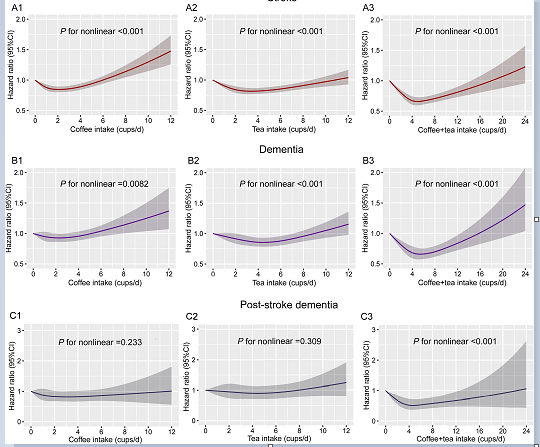
The results showed that consuming2 to 3 cups of coffeeper day, or3 to 5 cups of teaper day, or even a combination totaling4 to 6 cupsper day, significantly reduced the risk of both stroke and dementia. Notably, compared to those who did not consume coffee or tea at all, individuals who drank 2 to 3 cups of coffee or 3 to 5 cups of tea daily had a lower risk of stroke by32%and a lower risk of dementia by28%.
The study also noted that the intake of coffee and tea shows anon-linear relationshipwith the risks of stroke and dementia, meaning that excessive consumption may not provide additional benefits and could even have adverse effects. For example, while moderate daily consumption of coffee and tea can help guard against stroke and cognitive decline, drinking too much coffee (e.g., more than 6 cups per day) may increase the risk of dementia. Earlier this year, an Australian research team also pointed out that consuming more than 6 cups of coffee per day could potentially raise dementia risk by as much as 53%.
More notably, when coffee and tea areconsumed together, their combined effect on health becomes even more significant. The study found that simultaneous intake of coffee and tea was not only associated with a reduced risk of stroke, but particularly with lowered risks ofischemic strokeandvascular dementia. Additionally, a daily intake of3 to 6 cups of the coffee-and-tea combinationwas also positively associated with a reduced risk of post-stroke dementia.
Although this is the first study to deeply analyze the combined intake of coffee and tea, researchers cautiously stated that causality has not yet been confirmed and that this interaction might be influenced by other dietary or lifestyle factors. Nevertheless, this finding still provides valuable health insights for the daily consumption of coffee and tea.
In addition to the potential protective effects against stroke and dementia, the study also noted that both coffee and tea are rich in caffeine—the most commonly consumed psychoactive substance—and both can help reduce the risk of cardiometabolic diseases, including type 2 diabetes, high blood pressure, and various cardiovascular conditions. Previous studies have also shown that moderate coffee consumption is linked to lower risks of chronic liver disease, fatty liver, coronary heart disease, and may even be associated with decreased overall mortality.
However, experts also remind that one should follow theprinciple of moderationwhen drinking coffee. Overconsumption may lead to counterproductive effects, such as reduced brain volume and increased dementia risk. Therefore, it’s key to monitor intake amounts and choose a drinking combination that suits you.

The above content is compiled by CoffeeHunters, a coffee news website.


