







Introduction:ByteDance recently applied to register the trademarks "ByteTea" and "Byte茶", sparking widespread speculation about whether it is entering the milk tea industry. This article delves into ByteDance’s trademark strategy, the backdrop of slowing advertising revenue, and the massive user base and marketing potential of Douyin, to explore its possible foray into the tea beverage market — while also reminding industry players that the tea drink sector is highly competitive, and product quality remains the key to success.
The parent company of the short video platform Douyin, ByteDance, has reportedly applied to register the trademarks "Byte茶" and its English counterpart "ByteTea", drawing significant market attention. As the parent company of Douyin, does this move signal ByteDance's imminent crossover into the milk tea industry? This article will analyze the possibility of ByteDance entering the tea beverage market from the perspectives of its trademark strategy, the current slowdown in advertising business growth, and the vast user base and marketing advantages of Douyin — while emphasizing that in the fiercely competitive tea beverage industry, the quality of the product itself is the ultimate key to success.
Douyin, the globally popular short video app, is undoubtedly a familiar name. It encourages users to record life and share creativity through videos, supports diverse content creation, and has become part of many people’s daily lives. Officially launched in September 2016, Douyin quickly established a short video community covering all age groups in China with its highly active user base and explosive growth rate, becoming a hub for new-generation traffic.
The rise of Douyin is inseparable from the incubation by ByteDance. According to publicly available corporate information, the operator of Douyin is Beijing Weibo Vision Technology Co., Ltd., which is wholly owned by Xigua Video, and the holding company behind Xigua Video is Beijing ByteDance Network Technology Co., Ltd. As early as 2017, ByteDance made an angel round investment in Douyin amounting to several million RMB, laying the foundation for its subsequent rapid expansion.
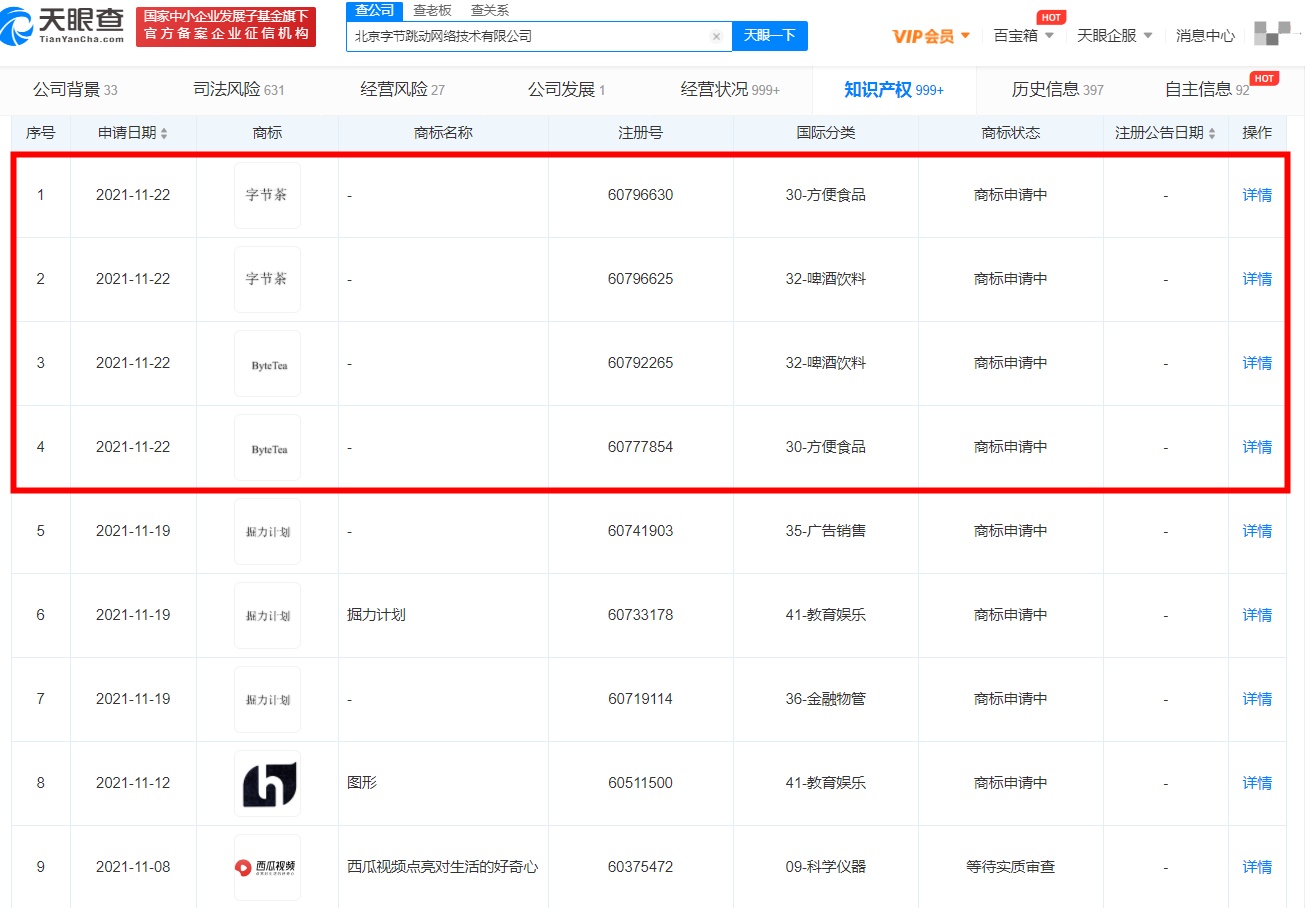
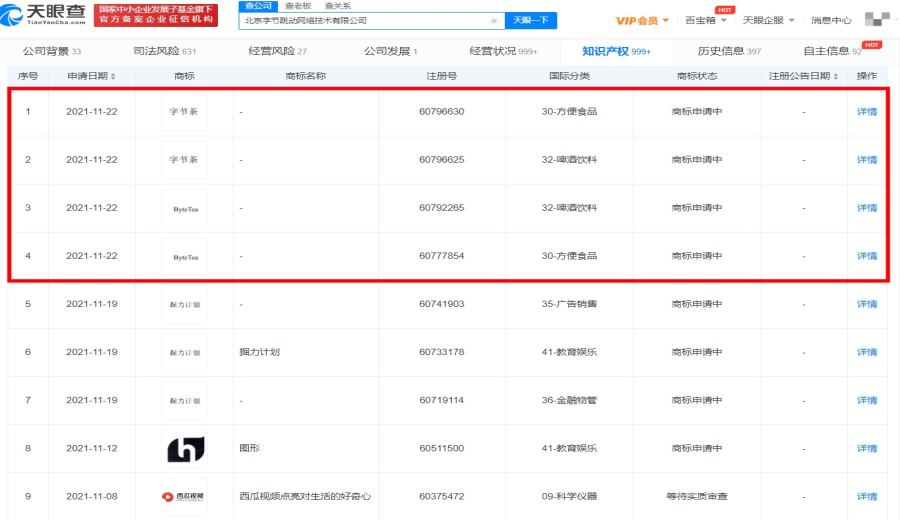
So, what’s the connection between this background and the recent registration of the "Byte茶" trademark? Clarifying these relationships helps us understand the strategic thinking of major internet companies in their business layouts. According to information from Tianyancha on November 26, Beijing ByteDance Network Technology Co., Ltd. has submitted multiple trademark registration applications for "Byte茶" and "ByteTea", covering international categories such as beer beverages and convenience foods, and these trademark applications are currently under review.
Looking back at recent industry developments, in mid-November, the topic "#ByteDance’s domestic revenue growth significantly slows#" briefly trended on Weibo. According to financial media reports, insiders from ByteDance revealed that at the company’s Commercial Product Department all-hands meeting held on November 18, it was disclosed that the company’s domestic advertising revenue had largely stagnated over the past six months. Meanwhile, according to ByteDance’s 2020 financial report data, advertising revenue accounted for as much as 77% of total revenue.
The stagnation in advertising revenue growth may indicate challenges for ByteDance’s overall revenue growth. The insider also pointed out that Douyin’s revenue growth has plateaued, while another core product, Jinri Toutiao, is even close to a loss-making state. A report by 36Kr on November 23 also mentioned that ByteDance’s advertising revenue in the first half of 2023 was approximately 115 billion RMB, achieving double-digit growth and nearing its set target, but in the third quarter, the growth rate of advertising revenue noticeably declined, with some months showing extremely low month-on-month growth rates, almost approaching zero growth.
Based on the above information, many market observers have begun to speculate: will ByteDance seek new growth drivers by expanding into new business areas, such as venturing into the milk tea sector? Although these reports have not been officially confirmed, this wave of trademark registrations has already sparked widespread industry associations.
If we take a closer look at Douyin’s user profile, it’s not hard to see that its massive user base is primarily composed of younger demographics (of course, now many middle-aged and elderly users are also active on the platform, creating rich content…), which highly overlaps with the main consumer group of today’s tea beverage market. High traffic naturally brings big business opportunities. In July this year, Douyin officially disclosed for the first time that its global monthly active users exceed 500 million, with the majority being domestic users. In addition, since entering the overseas market under the brand "TIKTOK" in 2017, Douyin has also gained considerable international recognition. If ByteDance does decide to enter the tea beverage market, with its strong traffic foundation, it could capture a sizable consumer base right from the start. Coupled with precise user analysis in the era of big data, it would be even more conducive to adjusting product strategies based on consumer preferences.
It cannot be overlooked that Douyin’s ability to drive sales has long been proven by the market. On the platform, a short video featuring a trending topic can quickly go viral, and some brands have even used Douyin challenge campaigns to encourage users to generate brand-related content. Compared to traditional advertising formats, Douyin marketing is not only lower in cost and simpler to operate, but also allows for straightforward evaluation of effectiveness through data.
However, for enterprises aiming to enter the tea beverage market, the intensity of competition in the current industry cannot be underestimated. Numerous well-known brands, including China Post, Xiaomi, and Nongfu Spring, have already set their sights on the lucrative tea beverage sector, and the influx of capital will only make market competition even fiercer. Ultimately,product quality is the fundamental factor for any brand to succeed in the tea beverage market. While considering cross-sector expansion, ensuring the flavor, ingredients, and production craftsmanship of beverages will be the challenge that all new entrants must face.
The above content is compiled by CoffeeHunters, a coffee news website.


