







Introduction:Many tea enthusiasts mistakenly believe that the more golden buds in Dian Hong (Yunnan Black Tea) and the more golden-yellow the liquor, the higher the quality. However, the truth is not so straightforward. This article delves into why Dian Hong golden buds appear golden, explores the real relationship between the proportion of golden buds and tea quality, and reveals the unique processing characteristics of Dian Hong and why it is well-suited for milk tea. It also reviews the historical development of Yunnan black tea to help you gain a more comprehensive understanding of this classic Chinese black tea.
Yunnan black tea, commonly known as Dian Hong, is one of China’s three most renowned black tea categories, alongside Zhengshan Xiaozhong and Qimen black tea. In the minds of many tea drinkers, Dian Hong with more golden buds and a more golden-yellow liquor seems to symbolize high quality. But is the reality really that simple? This article will guide you through the science behind the golden color of Dian Hong golden buds, analyze the relationship between the proportion of golden buds and tea quality, and further introduce the production characteristics of Dian Hong, its suitability for blending, as well as the historical background of this tea.
Yunnan black tea, widely known as Dian Hong — “Dian” being the abbreviation for Yunnan — gets its name from its place of origin. It’s worth noting that although the term “Dian Hong” is commonly heard, it is not an independent variety of black tea, but rather a general term for black teas produced in Yunnan. In classification, Yunnan black tea is simply Dian Hong, and there is no such thing as an independent tea category called “Dian Hong variety.”
The world’s earliest black tea originated from Zhengshan Xiaozhong in Wuyi Mountain, Fujian, with a history traceable to around 1600 years ago. As Zhengshan Xiaozhong gained fame and its price rose, Qimen County in Anhui later developed Qimen black tea around 1800, based on the production method of Zhengshan Xiaozhong. In comparison, the emergence of Yunnan black tea was relatively late, generally believed to have gradually taken shape between the 1930s and 1940s.
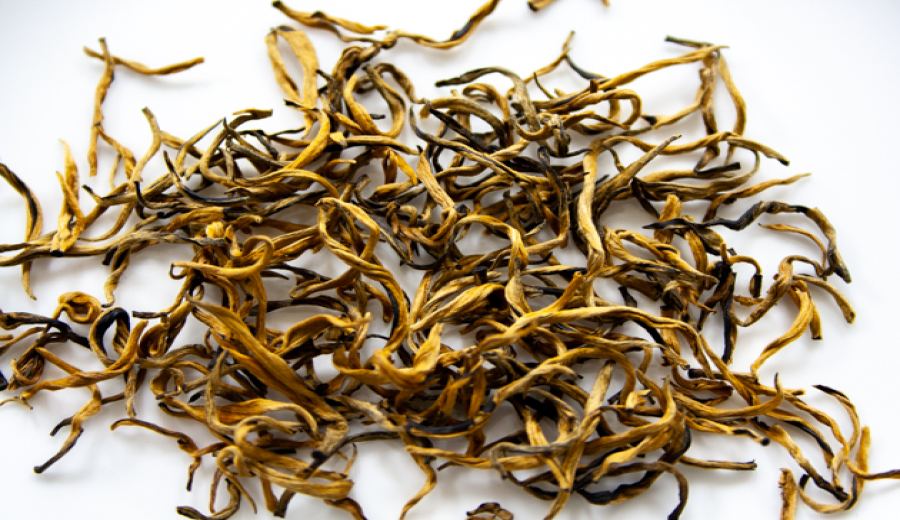
When it comes to Dian Hong, many people first think of its eye-catching golden hue, especially those teas rich in golden buds, which look quite appealing. But do you know why the golden buds in Dian Hong appear golden? The key lies in the rolling process, where the fine fuzz on the surface of the buds adheres to the essential substances inside the tea leaves. Through fermentation, these substances transform into yellow or even golden hues, making the buds shimmer brightly.
Therefore, the higher the proportion of buds in the tea leaves, the more the overall tea liquor or dry tea tends toward a golden-yellow color. For instance, teas made solely from single buds or those with one bud and one newly opened leaf, due to their high bud content, naturally tend to present a luxurious golden-yellow hue after processing. However, such teas with a high proportion of buds are more costly to produce and are accordingly more expensive, but a high price does not necessarily equate to high quality.
First, although buds are rich in amino acids and offer a smooth, buttery mouthfeel, they contain relatively fewer volatile compounds and polyphenols — the substances crucial for tea aroma. As a result, the aroma of the tea liquor is often less rich, and the taste may seem thin. Generally speaking, a plucking standard of around one bud and two leaves is more likely to achieve a balance between aroma and taste, offering a more layered flavor profile.
Secondly, if the tea comes from lower-altitude tea gardens with heavy fertilization, although the buds may be plump and visually appealing, the tea liquor often lacks depth, and the aftertaste and throat sensation may be rather plain. Therefore, one should not judge the true quality of a Dian Hong solely based on how golden the tea looks or how many golden buds it contains. The reason golden bud teas are more expensive is mainly because they require selective picking of only buds or one bud and one leaf, which is labor-intensive and thus increases costs.
In addition, Dian Hong also has unique characteristics in its production techniques. Compared to other well-known black teas, the withering stage of Dian Hong is usually lighter. This is not a deliberate pursuit of a certain flavor, but rather related to traditional local tea-making techniques and withering conditions. Even with insufficient withering, the inherent richness of the substances within the large-leaf Yunnan tea variety ensures the tea’s distinct personality, contributing to Dian Hong’s bold and layered flavor characteristics.
It’s worth mentioning that Dian Hong generally has a higher degree of fermentation, combined with moderate rolling, allowing the tea leaves to release a full-bodied liquor and rich mouthfeel upon brewing. This is also one of the reasons for its widespread popularity. Due to its strong and robust tea character, Dian Hong is particularly well-suited for blending into milk tea. It can both complement the milk flavor and retain the essence of the tea, making it a top choice for many tea beverage enthusiasts.
In summary, the golden-yellow color of Dian Hong golden buds primarily results from chemical changes in the bud fuzz and internal substances during fermentation. While a high proportion of golden buds may make the tea look more valuable, it does not directly equate to high tea quality. To evaluate the merits of Dian Hong, one must comprehensively consider factors such as the tea’s origin, altitude, plucking standard, degree of fermentation, and overall flavor profile in order to truly select a good tea that suits one’s personal taste.
The above content is compiled by CoffeeHunters, a coffee news website.


