







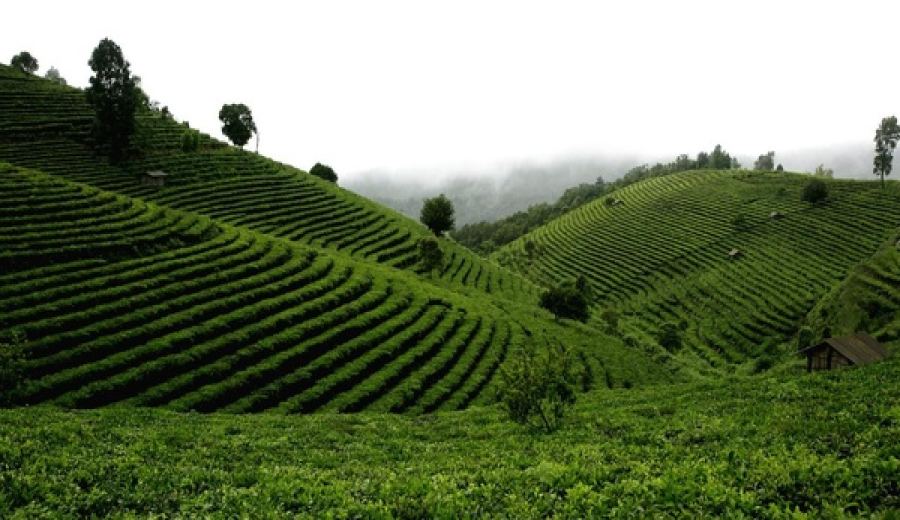
Introduction:First Flush Darjeeling black tea often displays a vibrant greenish hue, prompting many tea enthusiasts to wonder: why does this “black tea” look like green tea? This article delves into the unique fermentation process of First Flush Darjeeling production, while also comparing altitude and harvest schedules across three renowned regions—Yunnan, Taiwan, and Fujian—to uncover the key variables behind tea coloration, and why the northerly latitude First Flush Darjeeling is available even earlier than teas from southern China.
Although also classified as black tea, First Flush Darjeeling batches (commonly referred to as 1st Flush) often exhibit a greenish tint. This is not because it is green tea, but rather due to the deliberate choice in processing to shorten the fermentation time. What specific details make it look so different from traditional black tea? This article will start with the release timing of Darjeeling 1st Flush, analyze how its production differs from other well-known regions such as Yunnan, Taiwan, and Fujian, and further explore how altitude influences harvest periods and flavor profiles.
The term “First Flush tea” generally refers to the earliest harvested batch of tender buds each year, also labeled as 1st Flush in the industry. These leaves, sprouting after the end of winter, are not only particularly delicate but also, due to differences in fermentation methods, showcase colors and flavors distinct from teas of other seasons.
It’s a common misconception that green-colored tea leaves automatically mean spring tea. In truth, the green appearance mainly results from significantly shortening the fermentation duration during processing. Even within the 1st Flush grade, extending the fermentation can bring the tea liquor closer to the typical black tea color, or even further process it into a deep, rich red suitable for blending with milk. The key lies in the tea maker’s precise control over the degree of fermentation.
New Darjeeling 1st Flush tea usually begins to hit the market around February each year, with sales peaking in March. It’s worth noting that the Darjeeling tea region shares a similar latitude with China’s Fujian Province and Taiwan, and is even slightly farther north than Yunnan. So why does tea from higher latitudes manage to come to market first?
The answer lies in the altitude distribution of the tea gardens. Most Darjeeling tea estates are managed by large agricultural enterprises, with individual gardens spanning hundreds of hectares and altitudes ranging dramatically from a few hundred meters up to nearly 2000 meters. For example, the Singbulli Tea Estate covers elevations from 360 to 1230 meters, while the Lingia Tea Estate ranges between 760 and 1460 meters. Due to the conical shape of the mountain terrain, low-altitude areas cover much more land than high-altitude ones, and spring arrives earlier at lower elevations. As a result, Darjeeling’s First Flush tea mainly comes from these early harvests in low-altitude zones.
In contrast, in Yunnan and Taiwan, even tea gardens at around 1500 meters typically don’t begin harvesting until March. If the altitude drops to around 1000 meters, the harvest timing may be slightly earlier, but still can’t compete with the February new teas from Darjeeling’s low-altitude areas. As for gardens above 2000 meters, whether in Yunnan or Taiwan, the first harvests generally don’t begin until mid-April or later, with some high-altitude regions waiting until late April to early May.
Therefore, although Darjeeling is at a higher latitude, the early availability of its First Flush tea is mainly thanks to the uniquely favorable climate conditions of its low-altitude gardens. Understanding these regional differences and the impact of altitude on harvest timing not only helps you better grasp the characteristics of black teas from each region, but also allows you to more deeply appreciate the unique flavors shaped by terroir and craftsmanship during tasting.
The above content is compiled by CoffeeHunters, a coffee news website.


