







Introduction:The quality and flavor of black tea often lie in the details of the leaf grade. Based on international grading standards from major producing regions such as India and Sri Lanka, the tenderness and integrity of the tea leaves directly affect aroma and taste. This article will delve into common black tea grade abbreviations, such as FOP, BOP, and BOPF, to help you understand the leaf parts each grade represents, their quality characteristics, and provide practical brewing suggestions to assist you in selecting the most suitable black tea based on your needs.
In the world of black tea, leaf grade is not only a symbol of quality but also a key indicator of flavor profile. From tender buds to whole leaves to fine broken pieces, each grade represents different plucking standards and production processes. For coffee and tea enthusiasts, understanding these grade abbreviations can help you more accurately choose your favorite black tea.
The international black tea grading system primarily originates from producing regions such as India and Sri Lanka and is widely used in global trade. This system classifies black tea into multiple grades according to the integrity, size, and tenderness of the leaves, ranging from the highest-grade full bud teas to the most basic broken leaf teas, each with unique flavor expressions and suitable scenarios.
Common black tea grade abbreviations, such as FOP (Flowery Orange Pekoe), BOP (Broken Orange Pekoe), and BOPF (Broken Orange Pekoe Fannings), all have clear definitions. FOP typically consists of new buds at the top of the tea shoot and one to two tender leaves. The more buds there are, the more delicate the aroma and the softer the taste. This grade of black tea is suitable for drinkers who prefer floral and fruity notes and a light mouthfeel.
BOP belongs to the broken leaf grade and is made by mechanically crushing larger leaves. Although it is not as refined in appearance as whole leaves, broken leaf tea has an increased surface area, which allows it to release flavors more quickly, making it suitable for making strong milk tea or flavored tea beverages. BOPF is a finer version among broken leaves, with tea liquor that infuses quickly, commonly found in tea bag products.
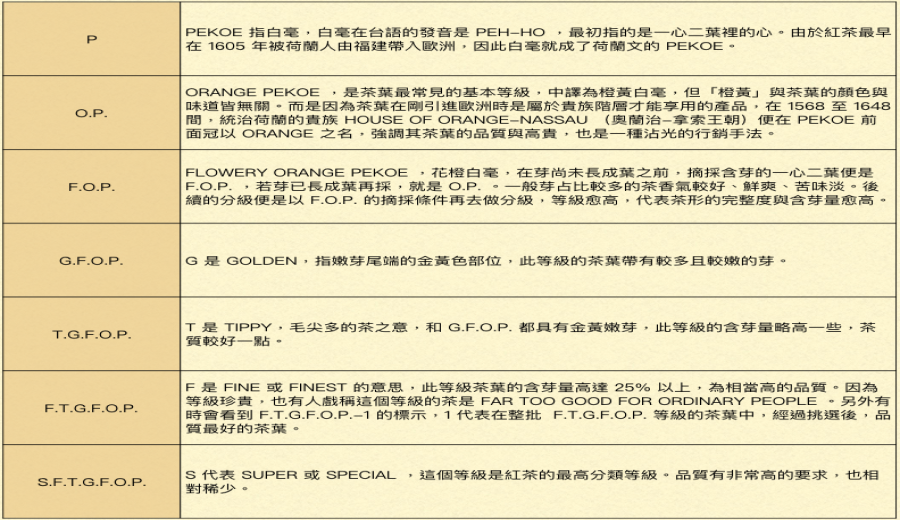
In grade names, certain keywords carry specific meanings. For example, "Orange" does not refer to citrus flavor but originates from the historical title "Orange-Nassau" of the Dutch royal family, symbolizing high quality; "Pekoe" refers to young leaves with white downy fuzz, usually associated with buds. Meanwhile, "Tippy" indicates that the tea contains a large number of golden bud tips, which are typically harvested from early-season tender buds, have a higher caffeine content, and offer a more pronounced aroma.
Higher-grade black teas such as TGFOP (Tippy Golden Flowery Orange Pekoe) emphasize the presence of rich golden buds, which not only enhance the brightness of the tea liquor but also bring a more layered and intense aroma. FTGFOP (Finest Tippy Golden Flowery Orange Pekoe) is the top tier of TGFOP, with both leaf quality and production craftsmanship undergoing strict selection. As for SFTGFOP (Special Finest Tippy Golden Flowery Orange Pekoe), it is even synonymous with premium black tea, and the addition of the number “1” indicates that this batch of tea is even more outstanding in terms of quality and rarity.
In addition to the commonly mentioned grades, there are other abbreviations such as S (Souchong, referring to more mature leaves) and P (Pekoe, standard black tea leaves), each corresponding to different leaf parts and flavor characteristics. Understanding these abbreviations not only helps you decipher the grade markings on packaging but also enables you to select the most suitable type of black tea based on your personal taste preferences.
In terms of practical advice, if you prefer pour over black tea, it is recommended to choose FOP or OP grades, as these whole leaves can showcase a richer aroma layering and a more delicate taste. If you often brew with tea bags, BOP or BOPF grades are more cost-effective and infuse more quickly. Additionally, pay attention to water temperature and steeping time when brewing—whole leaves are recommended to be brewed with water close to boiling point for 3–5 minutes, while broken leaf tea can have the time appropriately shortened to avoid over-extraction, which leads to bitterness.
In summary, the black tea grading system is not just a classification of quality but also a guide to flavor and usage. By understanding the meanings of abbreviations such as FOP, BOP, and BOPF, you can more confidently select black tea and adjust your brewing methods based on the characteristics of different grades to enjoy the tea liquor flavor that best suits you.
The above content is compiled by CoffeeHunters, a coffee news website.


