







Introduction:The Piccolo Latte is a small yet intensely flavorful Italian-style milk coffee, often found on the hidden menus of specialty coffee shops. Compared to a regular latte, it has a volume of only 85 to 100 milliliters, yet achieves a perfect balance between espresso and milk. This article will delve into the definition of the Piccolo Latte, how it differs from a standard latte, its standard preparation ratio and techniques, along with practical brewing parameters and flavor characteristics to help you better appreciate the charm of this refined milk coffee.
Although the Piccolo Latte is less commonly seen on the menus of many coffee shops, it is actually a classic small-sized milk coffee in Italian coffee culture. This coffee typically has a volume between 85 and 100 milliliters, which is noticeably smaller than the common 250 to 300 milliliter latte, and is therefore often misunderstood as an "incomplete latte" or a "downsized coffee."
The term "Piccolo" means "small" in Italian, so the Piccolo Latte can be literally translated as "small latte." It usually consists of one shot of espresso (about 20 to 30 milliliters) paired with two parts hot milk (about 40 to 60 milliliters), plus a small amount of fine microfoam. The overall proportions are compact, and it can be finished in just a few sips, yet it fully showcases the harmony between coffee and milk.
Compared to a regular latte, the biggest difference of the Piccolo Latte lies in its volume and ratio. A standard latte typically ranges from 250 to 300 milliliters, using one shot of espresso with about three parts milk, resulting in a milder coffee flavor that suits consumers who prefer a more prominent milk taste. In contrast, the Piccolo Latte emphasizes the essence of the espresso, with milk primarily serving to soften the intense coffee flavor, resulting in a more balanced and layered overall taste.
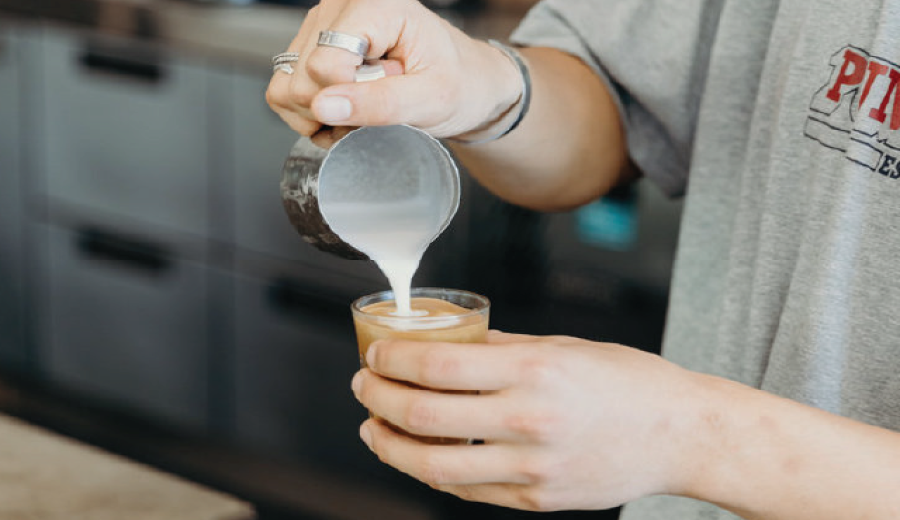
The standard recipe for making a Piccolo Latte is usually one part espresso to two parts hot milk. For example, when using 20 grams of coffee grounds to extract about 40 grams of espresso, you would add about 40 to 60 grams of hot milk, keeping the total volume around 85 to 100 milliliters. The process is similar to that of a regular latte: first pour the espresso into a small cup with a capacity of about 100 milliliters, then heat the milk to about 60 to 65°C and froth it into fine microfoam. Slowly pour the milk into the espresso in a circular motion to evenly blend the milk and coffee, and sometimes a simple latte art design is also added.
In actual preparation, it is recommended to use a medium-dark roasted blend, as these coffee beans can retain sufficient body and flavor even after being mixed with milk. The extraction parameters for the espresso can be set to 20 grams of coffee grounds yielding 40 grams of espresso liquid, with an extraction time of about 28 to 32 seconds, which will produce a rich espresso base with appropriate crema.
For the milk, it is recommended to use fresh whole milk, and the heating temperature should not exceed 65°C to avoid the milk becoming too hot, which could cause the flavor to turn sour or the foam to become too coarse. The milk-to-coffee ratio is suggested to be maintained between 1:1 and 2:1, adjustable according to personal taste. If you prefer a stronger coffee flavor, you can reduce the amount of milk; if you prefer a smoother taste, you can slightly increase the milk quantity.
When all elements are perfectly combined, the Piccolo Latte typically presents a rich coffee aroma accompanied by the silky texture of milk. The flavors may include classic espresso notes such as caramel, nuts, and chocolate, along with the sweetness of milk, resulting in a full-bodied and distinctly layered mouthfeel—perfect for enthusiasts who enjoy exploring the finer details of coffee.
In summary, the Piccolo Latte is a coffee beverage that, despite its small size, is highly expressive. It not only tests a barista’s mastery of the espresso-to-milk ratio but also allows the drinker to focus more intently on the inherent flavor characteristics of the coffee itself. If you are new to coffee or want to gain a deeper understanding of the basics of milk coffee, the Piccolo Latte is an excellent choice to start with.
The above content is compiled by CoffeeHunters, a coffee news website.


