








Introduction:The coffee flavor wheel is an essential tasting tool in the specialty coffee field. From its initial release in 1995, through its scientific upgrade in 2016, to the emergence of region-specific versions tailored to local dietary cultures, and even consumer-friendly simplified editions, its development reflects the evolution of tasting language. This article delves into the characteristics and cultural differences of each version, helping you master how to use the flavor wheel to describe coffee experiences more precisely, and understand why the same cup of coffee can be interpreted so differently across contexts.
In the world of specialty coffee, there’s a colorful circular chart that beginners often love and hate at the same time — the well-known SCAA 2016 version of the coffee flavor wheel. This chart is not just a teaching aid but also a bridge for industry communication in tasting. In fact, it’s the result of multiple revisions and cultural adaptations, with its origins tracing back to 1995, when the flavor wheel was divided into positive and negative sections to help coffee professionals establish a common language.
Going back to 1995, the Specialty Coffee Association of America (SCAA) released the first edition of the coffee flavor wheel, marking a milestone in the industry’s first attempt to unify flavor descriptions. That version listed up to 90 common analogous flavor substances, such as berries, caramel, and spices. For an industry lacking common evaluation standards at the time, this was a major breakthrough. The flavor wheel not only clarified many vague sensory descriptions but also provided a reference basis for global coffee professionals discussing coffee characteristics, gradually becoming an authoritative reference.
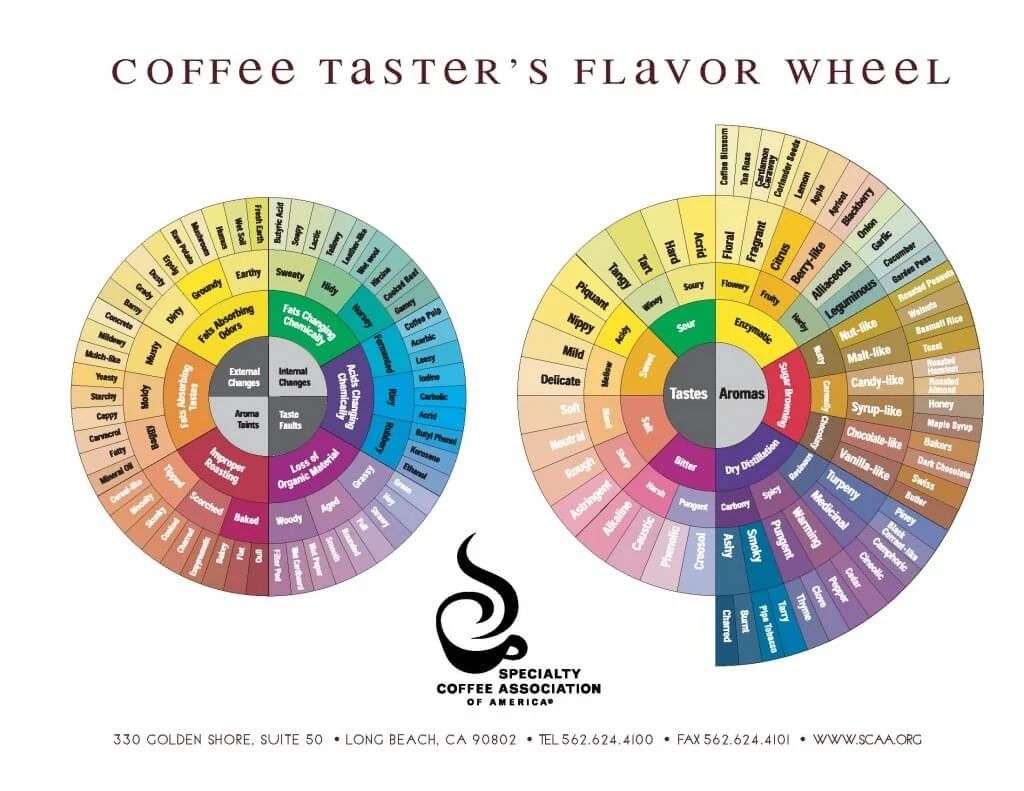
By 2016, the SCAA collaborated again with several internationally renowned institutions, including the World Coffee Research (WCR), Kansas State University, and the University of Hohenheim in Germany. They mobilized over 100 samples from 13 major coffee-growing regions for systematic flavor analysis, compiling them into the World Coffee Research Sensory Lexicon. On this foundation, they also worked with researchers from the University of California, Davis, using sensory science and statistical analysis. A panel of 72 professional assessors collectively ranked and categorized the data, ultimately resulting in the updated version of the coffee flavor wheel.
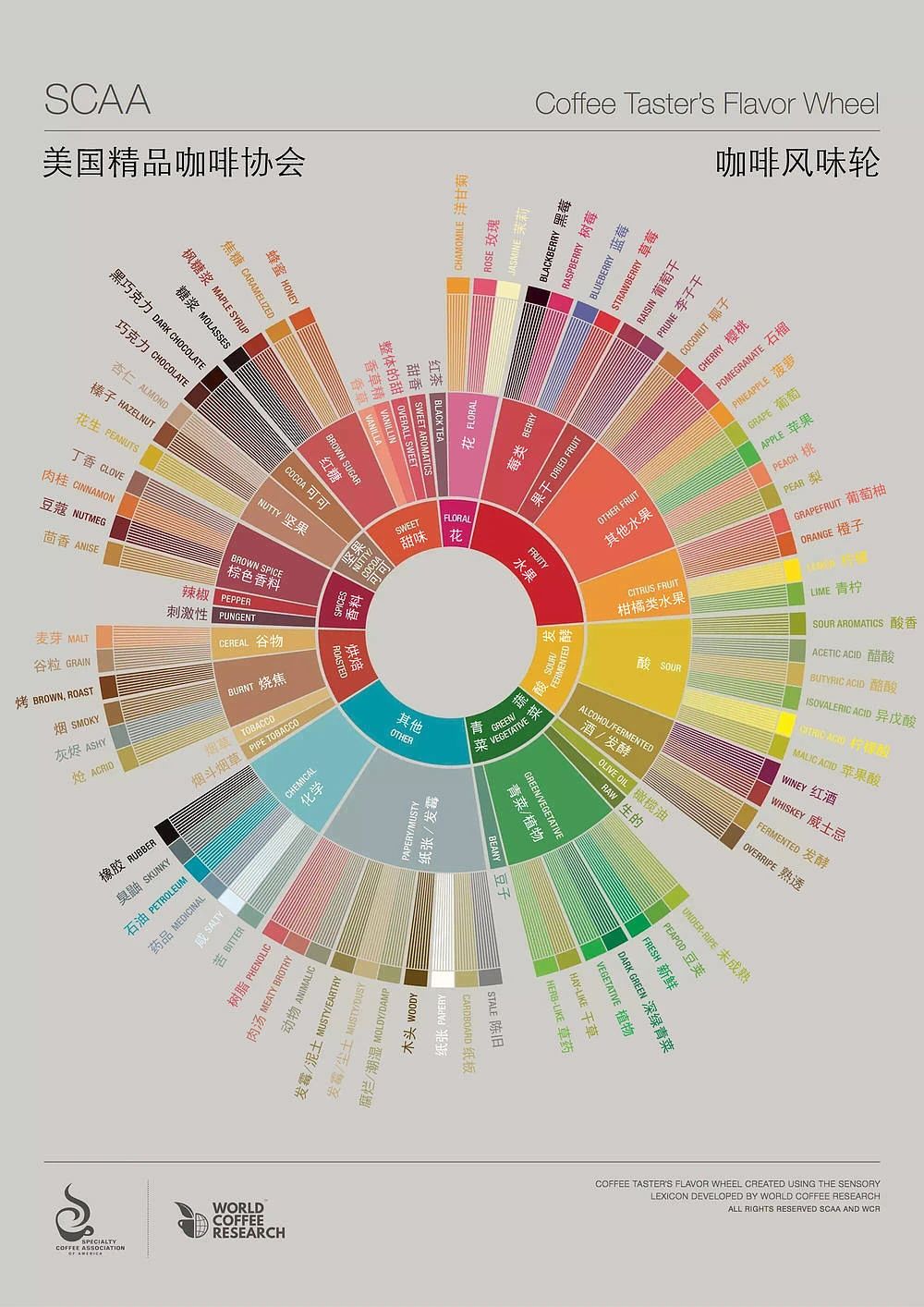
The 2016 revision merged the original positive and negative flavor wheels into one, appropriately condensing the negative flavor items, while more finely dividing the diverse types of positive flavors. It included a total of 85 representative analogous flavor substances. Although the number was slightly reduced compared to the previous version, the categorization became stricter and more recognizable. Notably, the visual design of this edition was meticulously crafted by the renowned London-based design agency One Darnley Road. Each color was carefully selected based on the psychological associations linked to the corresponding flavors, making the overall image both scientific and intuitive.
However, while the SCAA flavor wheel is highly scientific, it does have certain limitations in cultural applicability. Since its flavor analogies often draw from everyday American ingredients — such as grapefruit, cherries, maple syrup, or prunes — these references may be unfamiliar to consumers in Chinese or Southeast Asian regions, creating a sense of distance or even difficulty in visualizing the described flavors. As a result, some regions with deep coffee cultures, such as Taiwan and Indonesia, began developing localized versions that better reflect their own dietary experiences.
Taking Taiwan as an example, the locally developed flavor wheel introduced by the Taiwan Coffee Research Laboratory in 2018 includes 95 flavor substances. These not only feature common fruits like longan, wax apple, and durian, but also incorporate elements with East Asian characteristics such as soy sauce, meaty notes, ginseng, and cedarwood. Even Southeast Asian commonly used seasoning flavors like smoked plum were included. The project leader pointed out that terms like red dates, roselle, dried longan, sweet fermented rice, and osmanthus are high-frequency terminologies in Taiwanese cupping sessions, but may seem unfamiliar to international cuppers. Similarly, the Indonesian version, reflecting its background as the “Spice Kingdom,”细分出多种香料风味类别,总计包含36种香气及82种感官描述,远较SCAA原版对香料的6项分类更为细致。
Kristian, an expert involved in flavor development in Indonesia, also mentioned that certain flavors considered defects in the SCAA system — such as the aroma of coffee pulp — are actually positive traits in sun-dried or honey-processed coffees. This is especially true when washed processing is seen as the standard, highlighting how cultural differences influence flavor interpretation. He emphasized that understanding processing methods and terroir conditions is key to using the flavor wheel objectively, rather than blindly applying international standards.
Beyond the professional and localized versions, there are also simplified flavor wheels designed for general consumers. For instance, the consumer-friendly version launched by the Belgian roasting brand Cuperus is divided into just six main categories: bright fruits, nuts, sweet fruits, flowers, chocolate, and spice-vanilla. These six broad types actually correspond to the major positive flavor categories in the 2016 flavor wheel, helping the general public understand the diverse flavors of coffee in a more straightforward way. This also transforms the flavor wheel from being solely a professional tool in the industry into a daily tasting reference guide.
In summary, from the initial 1995 version to the 2016 scientific upgrade, and further to the region-specific and consumer-friendly simplified editions, the evolution of the coffee flavor wheel not only reflects the diversification of tasting language but also reveals how cultural backgrounds influence our perception and description of flavors. Whether you’re a beginner coffee enthusiast or a professional cupper, understanding these version differences and their underlying logic will help you taste, describe, and enjoy the unique flavors of each cup of coffee more accurately.
The above content is compiled by CoffeeHunters, a coffee news website.


