







Introduction:You can enjoy high-quality iced coffee even without pour over equipment. A French press uses immersion brewing to consistently extract a rich and balanced coffee liquor. This article provides a detailed guide on how to make iced coffee with a French press, covering everything from suitable coffee bean types, precise coffee-to-water ratios and water temperature control, to medium-coarse grind size and step-by-step brewing instructions—offering a complete walkthrough so you can easily brew flavorful, layered iced coffee at home.
With just a French press, you can produce satisfying iced coffee even if you don’t own any pour over tools. The French press employs immersion brewing, which, compared to pour over, often delivers a more balanced flavor and fuller body under the same coffee bean conditions. Drawing inspiration from the concept of Japanese iced pour over, you can first steep the coffee grounds with a small amount of hot water to extract a concentrated coffee liquor, then pour it over ice to cool and dilute, resulting in an excellent-tasting iced coffee.
However, since adding ice will dilute the overall concentration of the coffee, it is not recommended to use light roast beans with overly pronounced acidity. These beans tend to release undesirable off-flavors such as almond or peanut skin during the immersion process, and once diluted by ice, the overall mouthfeel may turn out thin. In contrast, medium to dark roasts with balanced flavors are better suited for this method.
The coffee beans used in this demonstration feature rich floral and fruity notes, along with moderate caramel and candied tones. The aroma is fresh yet not overly sharp, making them very suitable for immersion brewing. For actual brewing, it is recommended to use 15 grams of coffee grounds with 120 grams of hot water, setting the coffee-to-water ratio at 1:8 and controlling the water temperature around 94°C to fully bring out the layers of flavor in the coffee.
Regarding grind size, since the French press uses a metal filter, too fine a grind can lead to over-extraction, resulting in bitterness or a gritty mouthfeel. Therefore, a medium-coarse grind is recommended—approximately equivalent to 70% extraction through a standard #20 sieve—which ensures appropriate extraction efficiency while preventing coffee particles from passing through the filter and affecting taste.
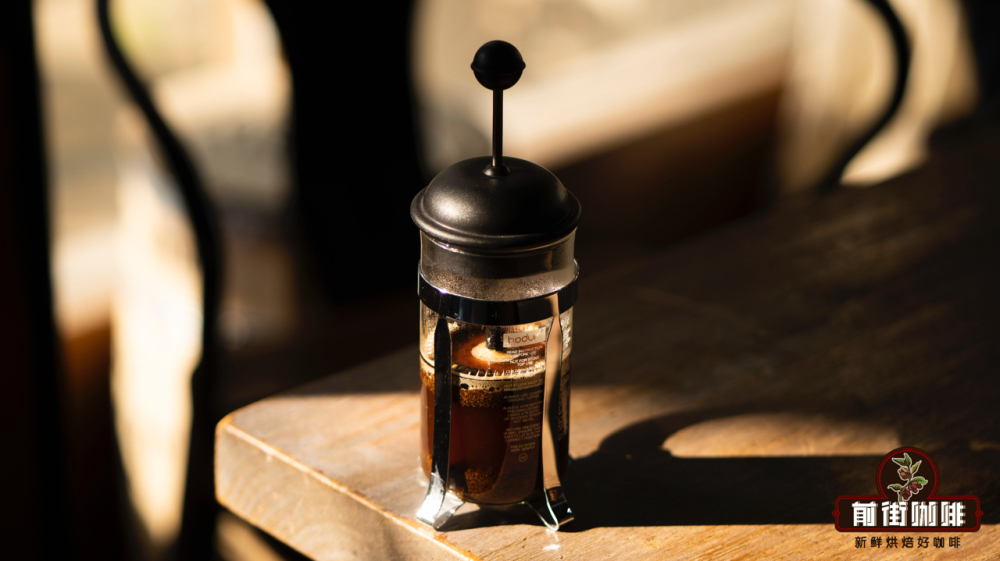
Here’s the step-by-step brewing process: First, grind the coffee beans to a medium-coarse size and pour them into the French press. Then add 120 grams of 94°C hot water, ideally pouring slowly from the center of the press to allow the water to evenly penetrate the coffee bed. Once the water is added, start the timer immediately. At around 30 seconds, gently stir the coffee bed with a stirring stick to help improve overall extraction. At this point, you may observe the coffee liquor, grounds, and foam gradually forming three distinct layers.
After stirring, lightly place the French press lid on top without pressing down the plunger. Let the coffee grounds steep for about 3 minutes. During this time, you can pre-fill a glass with approximately 105 grams of ice cubes in preparation for cooling. After the 3-minute steeping period, slowly press down the plunger to separate the coffee liquor from the grounds, then let it sit for about 1 minute to allow the coffee grounds to fully settle at the bottom of the press, preventing cloudiness and maintaining smoothness when poured over ice.
Finally, at the 4-minute mark, slowly pour the coffee liquor from the French press into the glass with the prepared ice cubes. Because the French press uses a metal filter, the coffee surface usually retains a natural layer of coffee oils, enhancing the drink’s smoothness and aroma. The resulting iced coffee not only has a rich and clear flavor profile, but also clearly showcases berry and floral notes, offering a refreshing yet full-bodied mouthfeel.
In summary, making iced coffee with a French press is not only simple and beginner-friendly, but also allows you to achieve near pour over-level quality by controlling the coffee-to-water ratio, water temperature, grind size, and steeping time. As long as you master the key parameters and correct steps, you can easily enjoy a professional-grade iced coffee experience at home.
The above content is compiled by CoffeeHunters, a coffee news website.


