







Introduction:The Long Dragon Fruit coffee from Aceh in Sumatra, Indonesia, is a rare variety that naturally mutated from Typica. It grows in high-altitude volcanic soil regions and is processed using the wet-hulled method, giving it unique herbal and spicy characteristics. This article delves into the history, cultivation challenges, and processing features of this variety, and provides professional roasting suggestions and pour over parameters to help you explore the secrets behind its spicy acidity and clean taste.
Indonesian coffee is world-renowned for its full-bodied, low-acid Mandheling, but the Long Dragon Fruit coffee from the Gayo Highlands of Aceh, Sumatra, showcases distinct regional flavor traits. This natural mutation of Typica originating from the high-altitude Lake Tawar area not only has an elongated bean shape but also, due to the dual influence of its growing environment and traditional processing method, develops rich layers of herbal and spicy notes.
Aceh Province is located in the northwest of Indonesia, situated on the equator, and features a typical tropical maritime climate with high temperatures and abundant rainfall throughout the year. Especially in the Lake Tawar region — a volcanic crater lake formed by ancient volcanic activity at around 1,100 meters above sea level — the surrounding coffee farms are mostly located between 1,200 and 1,600 meters. The area is often shrouded in morning fog, bathed in ample midday sunlight, with occasional afternoon showers, coupled with fertile volcanic soil, providing ideal growing conditions for coffee trees.
The cultivation history of Long Dragon Fruit coffee can be traced back three centuries. It originally came from the Harrar region of Ethiopia in Africa and was later introduced to Sumatra via trade routes. Its name comes from the fact that the beans are more elongated than those of common varieties, and it is also commonly known as "Long Bean Mandheling," being a natural mutation of the Typica family. It’s worth noting that this variety grows slowly, taking about seven years from planting to first fruiting, and has relatively low yields per plant, making it quite rare in the market.
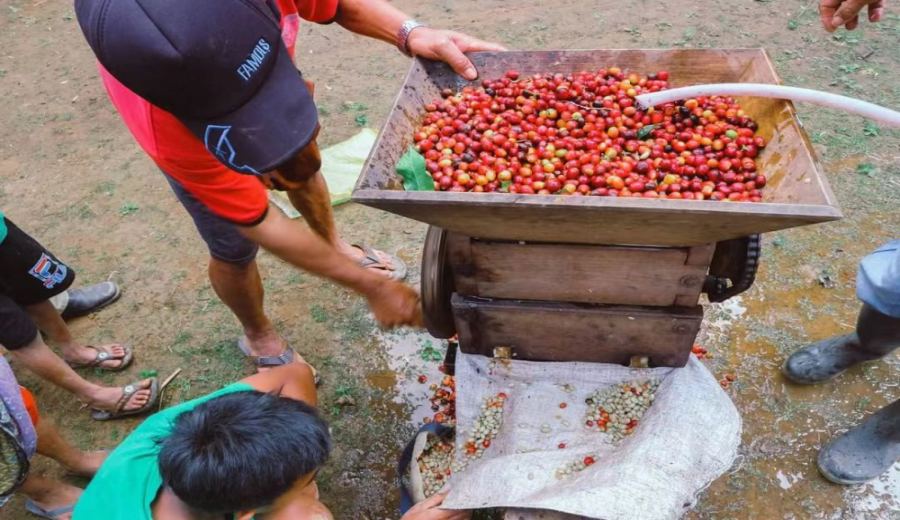
In terms of processing, Long Dragon Fruit employs Indonesia’s unique wet-hulled method. This technique involves first removing the coffee cherry’s skin and pulp, followed by brief fermentation and initial drying. Then the mucilage and part of the parchment layer are removed, and the beans are further dried to approximately 12% moisture content. Since the entire drying process takes only two to four days, the fermentation time is significantly shortened. This results in lower acidity but enhanced body and sweetness, often accompanied by caramel, herbal, and subtle woody aromas — classic characteristics of Sumatran coffee flavors.
A coffee team paid special attention to the interaction between its regional characteristics and processing method during cupping of this batch. This variety not only exhibits distinct spice and herbal notes but also delivers a spicy acidity reminiscent of green apples upon tasting, with a clean and layered aftertaste. For coffee lovers seeking low acidity without sacrificing depth of flavor, this is a choice worth exploring in depth.
Regarding roasting recommendations, since Long Dragon Fruit is a low-acid, high-body variety, medium to dark roasting is suitable to fully bring out its spicy and woody undertones, while still preserving a moderate highlight of fruit acidity to maintain flavor balance. Roasters are advised to carefully control the temperature curve during the development stage to avoid over-extraction, which could lead to bitterness.
If choosing to brew via pour over, it is recommended to use a Kono filter. Its design effectively extends the contact time between water and coffee grounds, improving extraction uniformity. Specific suggested parameters are as follows: water temperature controlled at87-88°C, grind size approximatelythe size of coarse sugar (70% sieved through a Chinese No. 20 sieve), with a coffee-to-water ratio set to1:15, and a recommended coffee dose of15 grams.
Suggested pour over steps are as follows: begin with a 30-second bloom using 30 grams of water to activate the aroma of the coffee grounds; then pour water in small circles, performing the first pour when the total water volume reaches 125 grams; once the water level naturally drops to just about to expose the coffee bed, continue pouring until reaching 225 grams, then stop and wait for the water level to drop again before removing the filter. The total extraction time should be controlled at around2 minutes, yielding a full-bodied and layered taste experience.
In summary, the Long Dragon Fruit coffee from Aceh, Sumatra, not only carries three hundred years of cultivation history and regional character, but also, through the enhancement of the wet-hulled method and high-altitude environment, presents unique flavors of spices, herbs, and spicy acidity. Whether for variety exploration or pour over practice, this coffee offers enthusiasts a profound and unforgettable taste experience.
The above content is compiled by CoffeeHunters, a coffee news website.


