







Introduction:In recent years, Catimor coffee has been widely planted in Yunnan, but due to its Robusta genetic lineage, it is often questioned as to whether it truly belongs to the Arabica family. This article delves into the breeding background and genetic makeup of Catimor, explores its performance differences at high and low altitudes, and analyzes how Yunnan has enhanced its flavor potential through cultivation and post-harvest techniques. It also provides practical pour over parameters and flavor characteristics to help you gain a more comprehensive understanding of this unique variety.
In the world of specialty coffee, Arabica has long been favored by coffee enthusiasts for its delicate aromas and diverse acidity profiles. However, the Catimor variety, which has been extensively planted in Yunnan in recent years, has sparked discussions due to its unique lineage and flavor profile: does it truly belong to the Arabica family? Behind this lies a breeding story involving trade-offs between disease resistance, yield, and flavor.
Arabica is one of the most prominent coffee varieties globally, classified as a type of Coffea arabica, accounting for over 70% of the world’s total coffee production. It has relatively low caffeine content, ranging from 0.9% to 1.2%, far lower than Robusta’s 2% to 4%. Thanks to its rich content of sugars and fats, it can deliver soft, layered aromas and a balanced acidity-sweetness taste. However, Arabica is also relatively demanding in terms of growing conditions, thriving best at high-altitude plateaus between 600 to 1800 meters, with an average annual temperature around 20°C, and it has weaker resistance to pests and diseases, which is one reason for its higher cultivation costs.
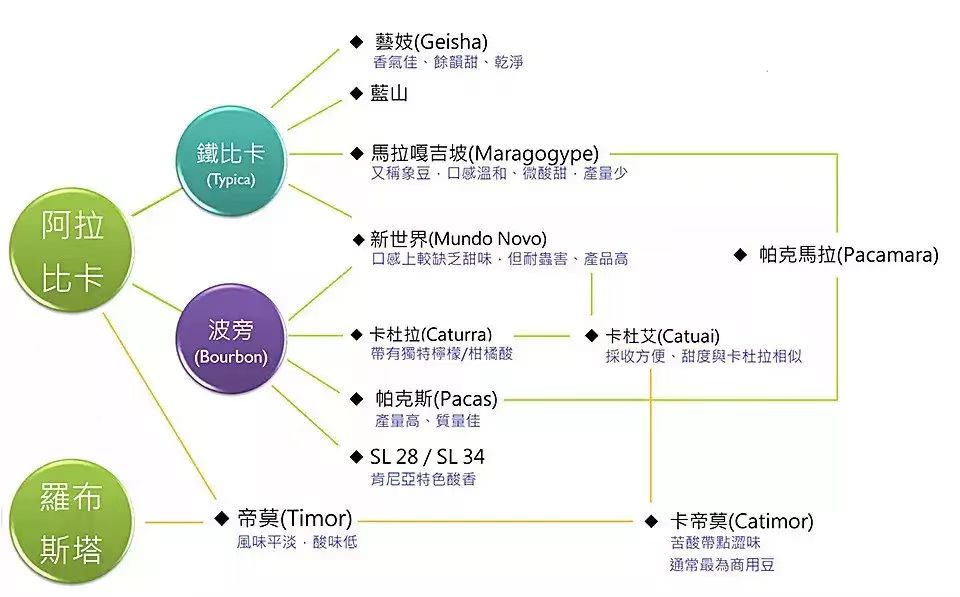
Common Arabica varieties include Typica, Bourbon, Caturra, Catuai, Pacas, Mundo Novo, and Maragogype, all of which are known for their delicate flavors and bright acidity.
Catimor, on the other hand, is a relatively “young” variety. It was created in 1959 when Portuguese breeders crossed Brazil’s Caturra with Timor. Caturra is a dwarf natural mutation of Bourbon, known for its higher yield and bright acidity, but it has limited disease resistance. Timor, meanwhile, is a natural hybrid of Arabica and Robusta, first discovered in the 1940s on the Indonesian island of Timor. Its most notable trait is a high tolerance to leaf rust and stable yields.
This genetic combination gives Catimor the advantages of strong disease resistance and high yield, especially enabling stable production in regions plagued by leaf rust. As a result, during the global leaf rust epidemic of the 1970s to 1990s, Catimor became an important alternative variety in many producing regions and quickly gained widespread adoption under the promotion of international organizations.
However, Catimor also inherited some of Timor’s disadvantages—due to its 25% Robusta genetic makeup, its flavor profile is not as refined as that of typical Arabica varieties. Common critiques include lack of aroma, thin body, and even noticeable astringency or off-flavors reminiscent of mold. These drawbacks are especially pronounced when grown at low altitudes.
Yunnan began introducing coffee cultivation in the late 1980s. At that time, international markets and organizations actively promoted Catimor to combat leaf rust and increase per-unit yield. In 1988, Nestlé launched a coffee trial planting program in Pu’er, Yunnan, and established a coffee agricultural department in 1992, introducing the Catimor variety while providing technical guidance and guaranteed purchase prices, greatly boosting the development of the local coffee industry.
However, due to Catimor’s genetic background, early plantings in Yunnan generally exhibited poor flavor performance, especially at low altitudes, where cupping results often struggled to stand out. Even when grown at high altitudes (above 1200 meters), Catimor’s shorter growth cycle and comparatively lower nutrient accumulation than traditional Arabica varieties often led to thinner aromas and less complex flavor layers.
In recent years, however, Yunnan’s growers and processing facilities have gradually unlocked Catimor’s potential by improving cultivation management and refining washed and natural processing techniques. Some specialty-grade Catimor produced at high altitudes has begun to showcase flavors such as nuts, black tea, caramel, and even subtle fruit acidity, earning recognition from some international buyers. Particularly in regions like Baoshan, through strict selection and processing, some batches have even demonstrated bright plum-like acidity and well-balanced sweetness.
For coffee enthusiasts looking to experience the actual flavor of Yunnan Catimor, one can pay attention to its common dry fragrance notes, such as nuts, berries, and herbal scents. After brewing, it often presents brown sugar, fruity sweetness, and soft plum acidity, with a clean aftertaste and a lingering fruity acidity.
For brewing recommendations, using a V60 dripper can effectively highlight its layered profile. It is suggested to use a medium-fine grind (approximately 80% passing through a 20-mesh sieve), with a 1:15 coffee-to-water ratio, and water temperature controlled around 90°C. A specific three-stage extraction process can be followed: first, pour 30 grams of water for a 30-second bloom, then add 95 grams of water, wait until the dripping slows down, and finally pour the remaining 100 grams of water. The total brew time is about 2 minutes, with an allowable error margin within 10 seconds. These parameters help balance acidity and sweetness while avoiding over-extraction that could lead to bitterness.
In summary, although Catimor carries Robusta genetics and cannot be entirely classified as a traditional purebred Arabica, it can still deliver a distinct and flavorful coffee experience when grown at appropriate altitudes, processed with refined techniques, and brewed with care. For readers interested in understanding the development trajectory and varietal evolution of Yunnan coffee, Catimor is undoubtedly a case worth exploring in depth.
The above content is compiled by CoffeeHunters, a coffee news website.


