








Introduction:Hacienda La Esmeralda classifies its Geisha beans into Red Label, Green Label, and Blue Label based on altitude and cupping scores, each with unique flavor profiles and ideal usage scenarios. This article delves into the regional backgrounds, processing differences, and market positioning of these three labels, while also offering practical pour-over recommendations—including key parameters such as using a V60 dripper with 92–93°C water and a 1:15 coffee-to-water ratio—to help you precisely capture Geisha’s floral-fruity aromas and balanced acidity-sweetness.
Geisha coffee has become a focal point in the specialty coffee world in recent years, and Hacienda La Esmeralda is the key force that brought this variety from Panama’s remote highlands to the global stage. Based on altitude and cupping results, the estate divides Geisha into three tiers—Red Label, Green Label, and Blue Label—leaving many coffee enthusiasts curious about the actual differences between them. This article starts with the natural conditions of Panama’s Boquete region, explores the development history of Hacienda La Esmeralda, compares the characteristics of the Red, Green, and Blue Labels in detail, and provides useful pour-over tips so you can brew representative floral and fruity notes at home.
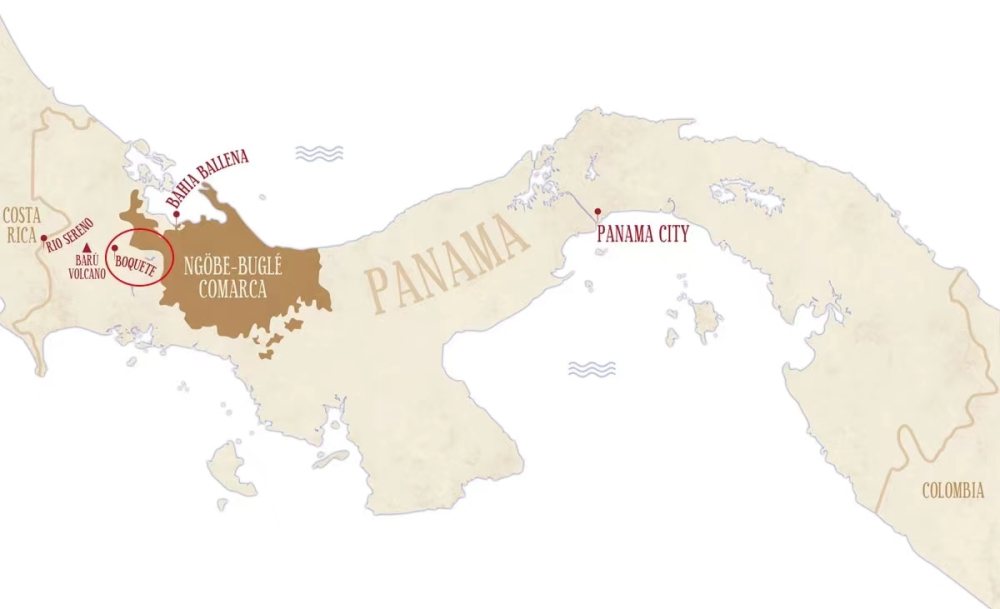
The Boquete region is located in western Panama, bordering Costa Rica, and boasts uniquely favorable geography. The orientation of the Central Mountain Range causes cold air to gather here, creating a microclimate ideal for high-altitude coffee cultivation. Particularly in areas above 6,500 feet (≈1,981 meters), stable temperatures, fertile soil, and even rainfall distribution provide perfect conditions for delicate varieties like Geisha. The area where Hacienda La Esmeralda is situated is also influenced by the Barú Volcano, whose mineral-rich volcanic soil further enhances the flavor potential of the coffee.
The Geisha variety was first discovered in 1931 in Ethiopia’s Gesha Forest and later introduced to Kenya, Uganda, and Tanzania. It wasn’t until the 1970s that the variety took root in Panama. However, due to its slow growth and low yield, Geisha was long used only as a windbreak until the third-generation owner of Hacienda La Esmeralda, Daniel Peterson, recognized its potential. In 2003, he won the Best of Panama competition for the first time with Geisha coffee, completely transforming the fate of this variety.
The predecessor of Hacienda La Esmeralda was the Pamela Farm, originally purchased in 1964 by American banker Rudolph Peterson, primarily for dairy farming. Later, his son quit his medical career to take over the farm, introduced Catuai and Caturra varieties, and gradually transitioned it into a coffee estate. In 1997, Daniel began managing the farm and, driven by the specialty coffee movement, dedicated himself to unlocking Geisha’s potential. Through strict cupping classification and altitude-based separation, he successfully brought Geisha onto the international stage.
The Red Label, Green Label, and Blue Label under Hacienda La Esmeralda actually reflect differences in altitude and processing methods. The Red Label (Esmeralda Special) typically comes from single plots such as Jaramillo or Cañas Verdes, at altitudes between 1,600–1,800 meters, with cupping scores exceeding 90. These batches may participate in auctions (like the renowned Best of Panama) or be sold non-auction, but they consistently exhibit a rich flavor profile: intense floral notes, complex fruit acidity, and layered sweetness. The Green Label (Private Collection) is a blend of micro-lots from the same altitude range, without specific plot designation, sharing similar flavors with the Red Label but at a more accessible price. The Blue Label (Geisha 1500) uses Geisha grown at 1,400–1,500 meters, processed exclusively via washed method, with relatively softer flavors, and was previously sold under the “Las Rocas” brand.
In terms of processing, the Red Label and Green Label usually offer both natural and washed options, while the Blue Label is only available as washed. Natural-processed Geisha often displays more intense fruitiness and a heavier body—for example, a Red Label from the Jaramillo plot offered by one supplier features flavors of lemon, honey, berries, and citrus, with a creamy, silky finish. The Green Label highlights bright acidity with notes of jasmine, ginger flower, and lemon, paired with a green-tea-like lingering finish. The Blue Label, due to its lower altitude, has relatively simpler flavors, making it suitable for drinkers who prefer a milder taste.
For home brewers looking to prepare Geisha, medium-light roasted beans are recommended to highlight its floral-fruit character. The tested pour-over parameters are as follows: use a V60 dripper, with water temperature controlled at92-93℃, coffee dose15 grams, coffee-to-water ratio1:15, and grind size at20-mesh standard sieve 80% passing rate(approximately medium-fine). The brewing process can be divided into three steps: start with a 30-second bloom using 30 grams of water, then pour 95 grams, and finally add the last 100 grams after the flow slows. The entire process takes about 2 minutes, with attention to maintaining steady water flow to avoid over-extraction or uneven filtration.
The Red Label Geisha typically offers more pronounced flavors, with a noticeable rose aroma upon grinding, followed by sweet-tart notes of tropical fruits like mango upon tasting, and a silky-smooth mouthfeel. The Green Label presents a crisper citrus and lemon profile, paired with a green-tea-like finish, ideal for those who prefer brighter acidity. The Blue Label, constrained by processing and altitude, has a more restrained flavor but still showcases Geisha’s essential characteristics. No matter which label you choose, proper roast level and brewing parameters are key to unlocking its full potential.
The above content is compiled by CoffeeHunters, a coffee news website.


