







Introduction:Dive deep into the historical roots, micro-lot management, and unique flavors of Ethiopia’s Sidama region, with a special focus on the renowned Huila coffee—from its 2017 TOH championship win to the meticulous natural processing at Buku Washing Station. Discover the backstory behind this star bean, and get expert pour over recommendations at the end to help you master the ideal extraction parameters and savor its rich berry and citrus notes.
Among Ethiopia’s many specialty coffee regions, Sidama has long been beloved by global coffee enthusiasts for its distinctive floral aromas and bright fruit tones. This article will take you from the historical evolution of the names “Sidamo” and “Sidama,” exploring the region’s cultivation practices, flavor profiles, and micro-lot management, with a focus on the widely acclaimed Huila coffee—rising to fame after winning the 2017 TOH competition and through the rigorous natural processing at Buku Washing Station in the Guji sub-region of Hambella.
As one of Africa’s most iconic coffee origins, Ethiopia is home to numerous specialty coffee regions, among which Sidama coffee stands out with its rich floral and fruity characteristics, securing a notable place in the international market. However, many coffee lovers may have wondered why some sources refer to it as Sidamo while others call it Sidama. Behind this lies a story of historical and cultural transformation.
Sidamo was the name of an old province in Ethiopia before the administrative restructuring in 1995. As early as the 9th century, the Sidama people had settled in southern Ethiopia, maintaining their own unique culture, religion, and language. However, in the late 19th century, following the conquest by Emperor Menelik II of the Ethiopian Empire, the Sidama region was incorporated into the imperial territory and renamed Sidamo—a name that carried certain political and cultural connotations and was even considered somewhat derogatory.
After 1995, Ethiopia adopted a federal system that respected the autonomy and cultural identity of its ethnic groups, reclassifying the region as part of the Southern Nations, Nationalities, and Peoples' Region (SNNPR) and restoring its historical name—Sidama. However, because the name “Sidamo coffee” had already established a reputation in the international market and the former Ethiopian government had registered the trademark as Sidamo®, many consumers still commonly refer to the coffee from this area as Sidamo, despite the administrative name change.
It is worth noting that, according to maps from renowned specialty coffee suppliers such as Trabocca, the traditional Sidamo coffee region actually encompasses parts of today’s Oromiya Region and SNNPR Region, not just the current Sidama Region. Therefore, so-called Sidamo coffee more often refers to beans with specific flavor characteristics, typically showcasing bright citrus acidity, smooth mouthfeel, and an overall flavor profile that is fuller than that of Yirgacheffe.
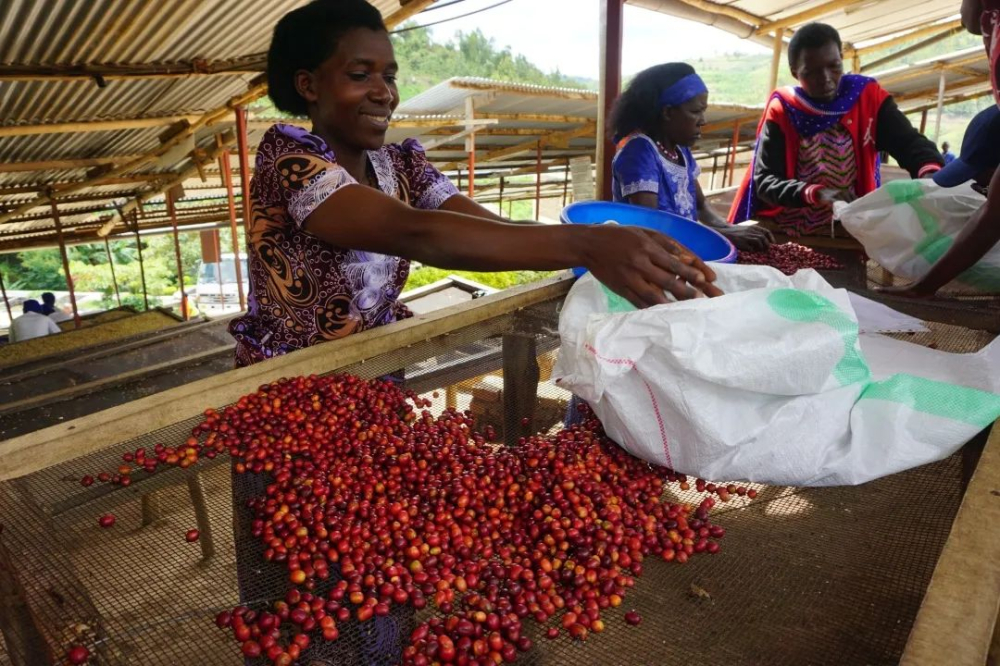
Similar to other regions in Ethiopia, Sidama coffee relies primarily on smallholder farmers with relatively limited production volumes. The area hosts numerous coffee cooperatives and washing stations that are responsible for centralized processing of coffee cherries harvested by surrounding smallholders. When the coffee cherries reach maturity, farmers transport them to nearby washing stations with access to water for unified processing, and the final product is sold under the name of the processing station. With the rise of the specialty coffee trend, more and more producers are choosing to work directly with farmers, strengthening micro-lot management and traceability to further enhance coffee quality and consistency.
When mentioning Sidama coffee, many people first think of the recently famous Huila coffee and its series of natural-processed batches. In 2017, a natural batch from Buku Abel Washing Station under Ethiopia’s DW Company won the TOH (Ethiopia National Taste of Harvest Competition) national championship with its intense strawberry and creamy aroma. In the same year, during the China leg of the World Brewers Cup, Beijing CREMA coffee trainer Li Jianfei defeated multiple Geisha entries with this coffee, claiming second place nationally—since then, the term “Huila” has been closely associated with this Sidama natural coffee.
In a post-competition interview, Li Jianfei stated that he believed this Ethiopian coffee bean performed on par with Panama’s famous Geisha, and thus drew inspiration from the traditional Chinese concept of “the foremost among a hundred flowers,” naming it “Huila” (meaning “Flower Queen”), symbolizing its top-tier flavor and status. This coffee actually comes from the Hambella sub-region of the Guji zone within Sidama.
Hambella is a relatively new coffee-producing area within the Guji region, currently hosting about 20 washing stations of varying sizes, with Huila coffee originating from Buku Washing Station. Originally part of Sidama, Guji was geographically remote and developed later, leading to a slower start in its coffee industry. It wasn’t until recent years, thanks to its exceptional flavor profile, that it gained recognition and became an independent, highly regarded emerging region.
Buku Washing Station is located in Buku Abel village at an altitude of 2200 meters, situated in a highland area with fertile black soil and an average elevation of over 1800 meters, offering a microclimate and soil conditions ideal for coffee tree growth. Local farmers pay special attention to the growing environment of coffee trees, often planting shade trees among them to regulate sunlight exposure, ensuring that coffee cherries can fully accumulate flavor compounds without losing nutrients due to excessive sun.
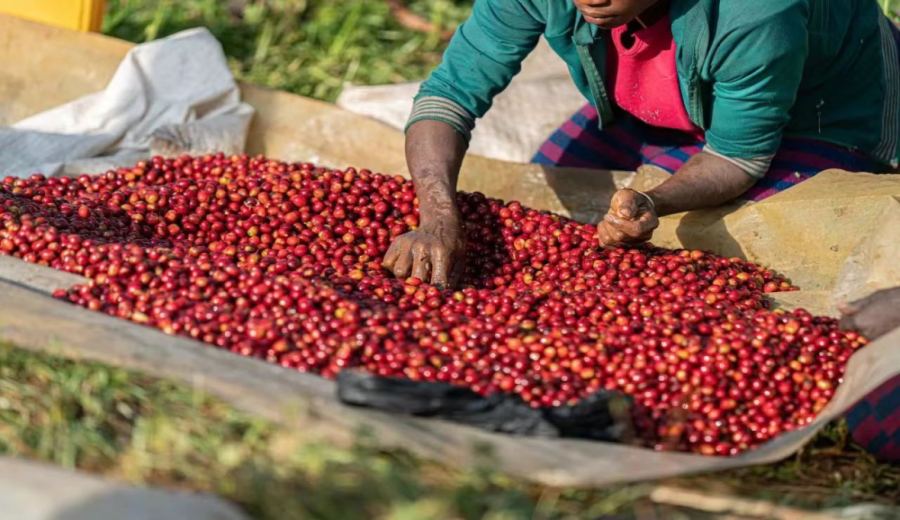
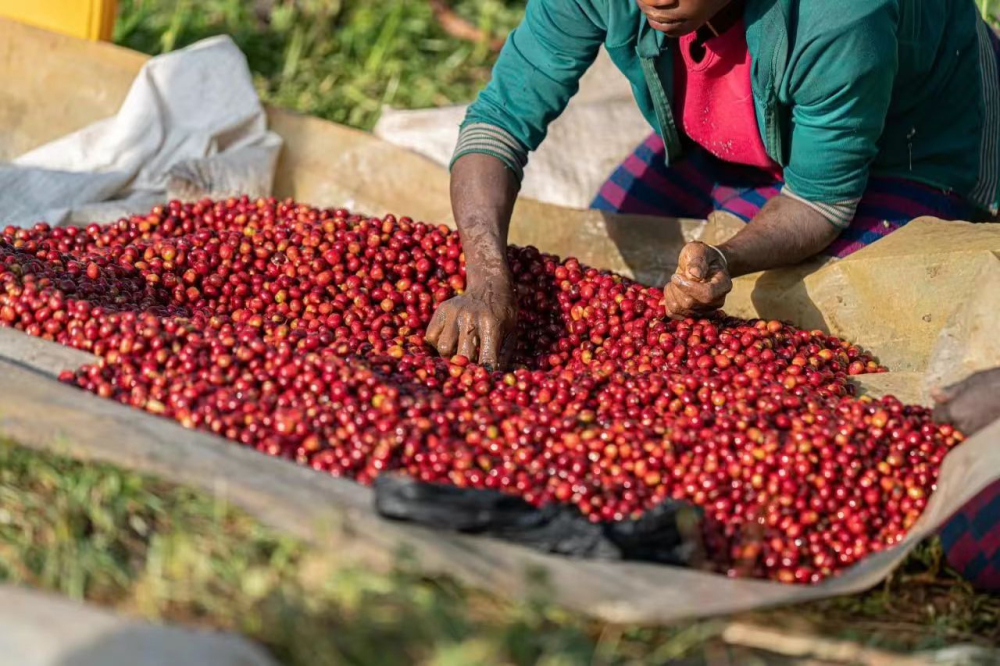
The main harvest season runs from December to January each year. Buku Washing Station selects only fully red coffee cherries with a sugar content of 30 or higher, placing them on African beds for natural drying. To precisely control the drying process, farmers shield the cherries from the midday sun to prevent over-fermentation, and use plastic sheeting at night to guard against sudden rainfall. The entire drying process involves constant turning of the cherries to ensure even drying, taking approximately 18 days until the green beans reach a moisture content of 13%, after which they are hulled and packaged.
If you’d like to try pour over brewing this uniquely flavored Huila coffee at home, here are some professional suggestions: It is recommended to use lightly roasted beans along with hot water at 92°C to 93°C to effectively highlight its rich floral and fruity notes. For grind size, a medium-fine grind (approximately 78% passing through a #20 sieve) is advised—too coarse may lead to under-extraction and weak flavors, while too fine may result in over-extraction and bitterness at high temperatures.
Regarding brew ratio, both 1:15 and 1:16 are suitable. Choose 1:15 for a stronger cup or 1:16 if you prefer clearer flavor layers and a more pronounced sweetness. Use a V60 filter cone with about 15 grams of coffee, employing a three-pour technique: begin with a 30-second bloom using twice the coffee’s weight in hot water, then pour in a slow spiral from the center outward until reaching 125 grams for the first pour; once the coffee bed drops to the middle of the filter, pour the second round up to 225 grams. Total brew time should be around 2 minutes to ensure full flavor release without over-extraction.
The above content is compiled by CoffeeHunters, a coffee news website.


