







Introduction:If you want to easily brew coffee with an espresso-like flavor at home, the moka pot is an incredibly cost-effective choice. But did you know that the grind size of your coffee grounds directly affects the crema layer and taste? This article will delve into the brewing principles of the moka pot, teach you how to choose the right grind size and coffee bean type, and provide correct usage and cleaning tips so you can brew more aromatic and captivating coffee with this classic device.
Thanks to its affordability in the hundred-yuan range and ease of use, the moka pot has become an essential tool in the homes of many coffee enthusiasts, especially those who enjoy bold coffee flavors. However, many people have the same question: does coffee made with a moka pot count as espresso? How does the grind size of the coffee powder affect the crema layer and overall taste? This article will start from the basic principles, introduce in detail the ideal grind size range, operation steps, suitable types of coffee beans for the moka pot, and remind you of cleaning precautions to help you master this classic device more comprehensively.
For those who frequently visit coffee shops, the espresso extracted by an espresso machine—with its golden, rich crema and delicate latte art—is always fascinating. However, an entry-level espresso machine is often quite expensive, whereas a moka pot, which costs just over a hundred yuan, appears much more affordable and practical.
The moka pot has a huge user base globally and is almost a household coffee appliance in Italy. Compared to the complex structure and maintenance challenges of an espresso machine, the moka pot is affordable, easy to operate, doesn’t require electricity, and can easily brew strong coffee with just a heat source—it’s even convenient for outdoor use. However, many consumers wonder before purchasing: is the coffee made with a moka pot the same as the espresso from a café?
The answer actually depends on the extraction pressure. Typically, espresso is made using about 20 grams of finely ground coffee powder, with water heated close to boiling point pushed through a tightly packed coffee puck under high pressure of up to 9 bar, extracting a concentrated coffee liquid. This high-pressure environment forces out carbon dioxide from the coffee beans, forming fine bubbles that result in the golden, enticing crema. However, the moka pot cannot produce such high pressure; its pressure is far below 9 bar, so it cannot generate true espresso crema. It can only be said that what it produces is a relatively strong cup of coffee.
Although the pressure is insufficient, if you want the coffee brewed with a moka pot to have a taste closer to espresso and enhance the appearance of the crema layer, adjusting the grind size of the coffee powder is one of the keys. Professional advice suggests that the moka pot is suitable for coffee grounds with a particle size of approximately0.3 millimeters to 0.55 millimeters, a range close to that used by espresso machines, but slightly coarser is recommended.
Since grind particle size is a matter of micrometer-level detail, it is difficult to judge accurately with the naked eye. You can confirm it in two ways: one is to directly purchase commercially available moka pot-specific coffee powder for reference; the other is to buy a dedicated grind size measuring ruler for comparison. Of course, the most practical method is to conduct multiple actual brewing tests, adjusting the grind coarseness until you achieve the desired flow rate and taste. If the grind is too coarse, water flows through with little resistance, and the coffee may pour out too quickly, resulting in under-extraction; conversely, if the grind is too fine, it may cause difficulty in water flow, slow pressure buildup inside the pot, or even a muffled “wuu wuu” sound without any coffee dripping, in which case you should immediately turn off the heat to avoid overheating.

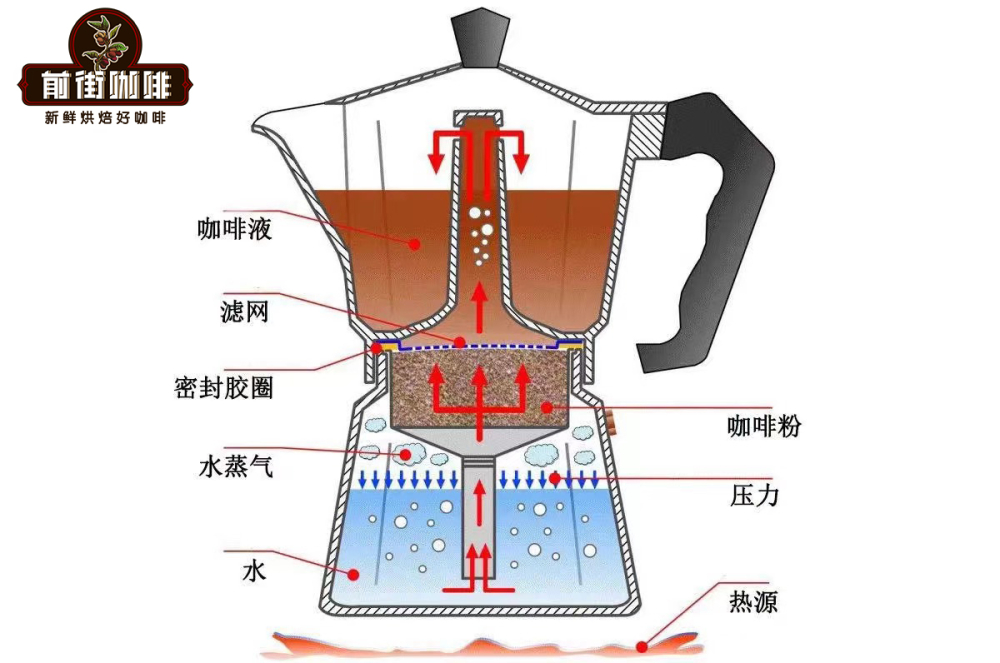
Additionally, when using a moka pot, be mindful of water level control. The lower chamber is designed with a pressure relief valve to release excess pressure, so remember not to fill the water above the position of the relief valve to ensure safe use. The water in the lower chamber is heated and turns into steam, generating pressure to push the hot water upward through the coffee layer, eventually dripping into the upper chamber to form the coffee liquid.
Regarding the choice of coffee beans, since the coffee brewed with a moka pot has a strong flavor, it is recommended to choose beans with a darker roast to better highlight the richness and aroma. For example, Indonesia’s Golden Mandheling or Brazil’s Queen Estate coffee beans are great choices.
Take Brazil’s Queen Estate as an example—this coffee is made from the Yellow Bourbon variety, processed with the natural (sun-dried) method, which preserves the complete pulp layer, giving the coffee beans richer fructose and sweet-tasting compounds. The roaster chose a medium-dark roast to enhance its nutty and creamy notes, delivering a rich and smooth taste that is very suitable for use with a moka pot.
Of course, if you prefer coffee with floral or fruity notes, as long as you choose the right roast level and processing method, the moka pot can also showcase diverse flavors while retaining a certain level of crema and bold texture.
Finally, a reminder: most moka pots are made of aluminum metal, so avoid using strong alkaline cleaners when cleaning. It is recommended to gently wash with a neutral dishwashing detergent to prevent damage to the pot’s material. Regular cleaning not only helps maintain the purity of the coffee’s flavor but also extends the lifespan of the device.
The above content is compiled by CoffeeHunters, a coffee news website.


