







Introduction:Explore the coffee potential of Bolivia, a landlocked South American country, from the challenging Yungas region to the unique Java variety. Delve into how its microclimates, processing techniques, and the "Project Tomorrow’s Sun" are helping to revive specialty coffee. This article will help you grasp the flavor characteristics of high-altitude coffee and provide practical roasting and brewing parameters.
As one of the few landlocked countries in South America, Bolivia may not have a high total coffee output, but its high altitude and unique microclimates nurture many specialty coffees with great potential. In particular, the Yungas and Caranavi regions, not only feature rugged terrain and difficult transportation, but also produce coffees with distinct flavor profiles due to their varying climates and altitudes. Additionally, the Java variety—originally from Indonesia but rediscovered in Bolivia—adds an intriguing chapter to the country’s coffee story. This article will take an in-depth look at the geography, variety backgrounds of these regions, and how the "Project Tomorrow’s Sun" led by the Rodríguez family is overcoming various challenges to restore Bolivia’s former glory in specialty coffee.
Bolivia’s coffee industry history dates back to the late 19th century, initially dominated by large farm owners north of La Paz. However, local coffee development did not prioritize quality until 1991, when the government implemented policies encouraging indigenous coffee cultivation, gradually increasing the participation of smallholder farmers. Nevertheless, limited infrastructure, difficult transportation, and competition from cash crops have made it difficult for Bolivian coffee to break into the mainstream market. Even so, some high-altitude regions still manage to grow coffee beans with remarkable complexity and unique flavors, showcasing the country’s distinctive potential in the specialty coffee arena.
Among them, the Yungas region is Bolivia’s most important specialty coffee producing area. Located on the eastern side of the Andes mountains near La Paz, the terrain is steep and coffee transportation is extremely challenging. One of the world’s highest-altitude coffee farms—Finca Takesi—is located here, sitting at an elevation of 2,500 meters. The significant day-night temperature variation and abundant sunlight at high altitudes result in slow fruit maturation, allowing the accumulation of rich sugars and complex flavors. Common tasting notes include deep sweetness, black berries, and soft citrus tones. However, due to treacherous roads, dubbed the “road of death” by locals, harvested coffee must be riskily transported to La Paz for processing, where delays can easily lead to over-fermentation or off-flavors.
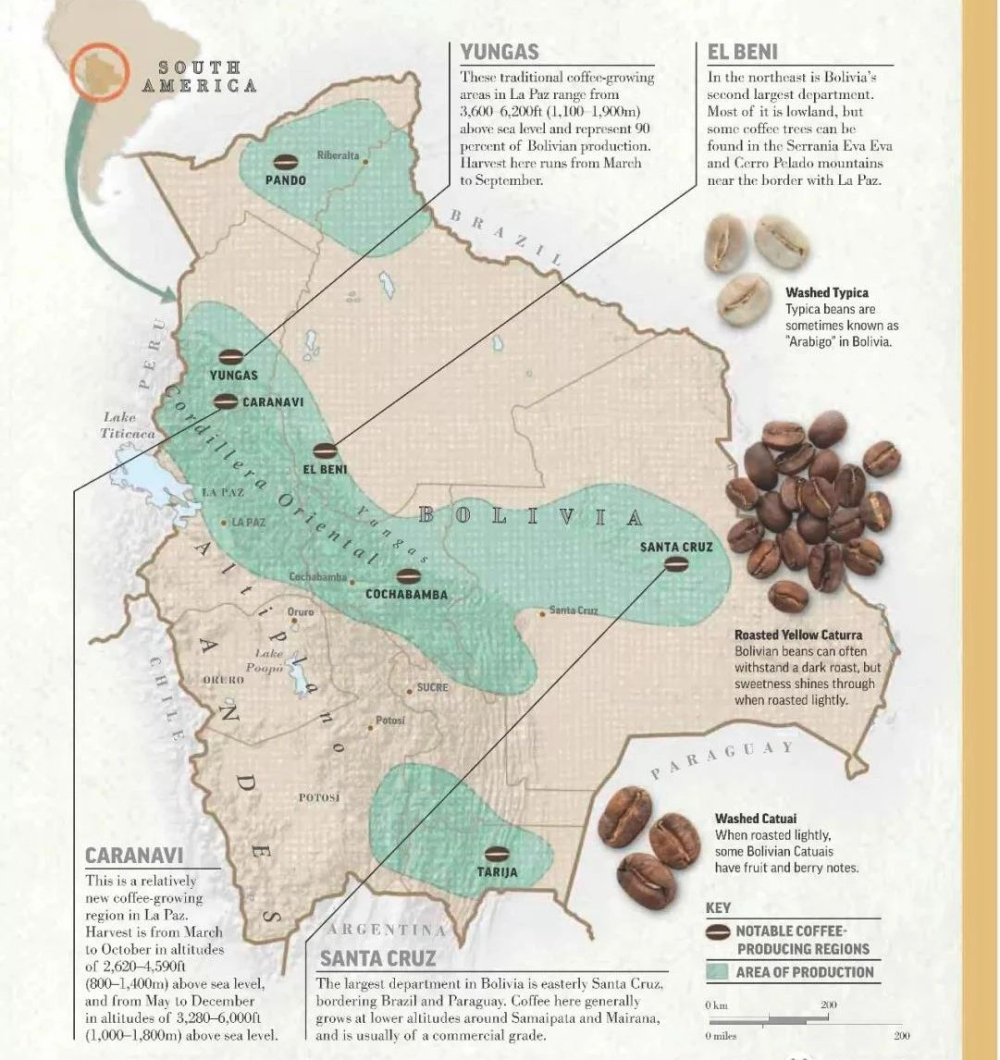
Compared to Yungas, Caranavi—also in the Andes but at a lower altitude (average around 1,500 meters)—produces coffee with more balanced flavors, notable sweetness, and prominent chocolate notes. Though slightly less complex overall, it still offers considerable drinking value. Additionally, the Copacabana region, located in western Bolivia near Lake Titicaca—the world’s highest-altitude lake—benefits from a consistently cool environment with an annual average temperature of just 10–14°C. This helps coffee mature slowly, developing unique bright acidity and aromatic qualities.
In terms of varieties, Bolivia mainly grows traditional Typica, but one variety worth highlighting is Java. Known locally as “long bean” due to its slender shape, the Java variety may evoke thoughts of Indonesia, but it actually originated from the primeval forests of Ethiopia and was introduced to Indonesia via Yemen, hence the name. Genetic studies show that Java is a descendant of the Ethiopian variety Abysinia, not a Typica mutation. In 1991, thanks to the efforts of breeder Benoit Bertrand, the Java variety was introduced to Costa Rica through the CIRAD organization, and later gained official certification in Central American countries such as Panama. This variety not only delivers layered flavors comparable to Geisha, but also shows high resistance to leaf rust and fruit diseases, making it an ideal choice for smallholder farmers.
In processing methods, Bolivian farmers predominantly use the washed process, which involves: first removing the outer skin and pulp of the coffee cherry, then fermenting the beans with mucilage in water for about 24 hours, followed by rinsing to remove residual mucilage, and finally drying the parchment-covered beans either naturally or using machines until the moisture content drops to 12%. Due to Bolivia’s relatively cold climate, some regions opt for machine-assisted drying, and even developed the so-called "Coco Natural" process—using cacao drying equipment to slowly dry coffee beans in a low-temperature environment, reducing weather-related flavor interference. This technique was pioneered by Pedro of the Rodríguez family and later refined through UV treatment and manual sorting to ensure consistent quality.
However, Bolivia’s coffee industry has faced severe challenges in recent years, with production continuously declining. Major reasons include competition from coca leaf cultivation—due to its faster harvest cycles and higher profits—leading farmers to switch crops, along with the lack of national-level support institutions. Additionally, a major leaf rust outbreak in 2013 caused nearly half of the annual production to be lost within a single year, leading to a 70% drop in overall production capacity over the decade. In response to this crisis, the "Project Tomorrow’s Sun" was launched. Led by the Rodríguez family, the initiative aims to enhance smallholders’ planting and post-harvest skills by providing one-stop services including seed selection, cultivation guidance, collective processing, and export sales. This not only stabilizes green bean quality but also significantly increases farmer incomes, successfully reversing the decline in some producing regions.
The program achieves this by conducting monthly visits to provide each participating farmer with customized technical advice, emphasizing quality over quantity. It also organizes year-round agronomy workshops to facilitate farmer-to-farmer experience sharing and problem solving. In 2017, the program achieved initial success, with yields doubling to approximately 20 bags per hectare, and the number of participating farmers growing from 10 to 50. Despite significant resource investment, the Rodríguez family remains confident in Bolivia’s unique coffee potential and continues their dedication to safeguarding the future of high-altitude coffee.
Take, for example, the Cocoa Natural Java from Finca Vallecitos. Grown in the La Paz region at 1,600 meters altitude, this lot is processed using the cocoa natural method, resulting in complex aromas of light fermentation, grapes, nuts, and floral notes. It offers medium acidity with a juicy mouthfeel, making it well-suited for pour over enthusiasts who enjoy layered, sweet cups. For those wishing to brew it themselves, consider the following parameters: use a HARIO V60 filter, water temperature around 90°C, a 1:15 coffee-to-water ratio, and a grind size close to caster sugar. Begin with a 30-second bloom using 30 grams of water, then pour in stages up to 125 grams with a gentle stream, followed by a final pour to 225 grams. The total extraction time should be around 2 minutes, fully highlighting the bean’s unique flavor profile.
The above content is compiled by CoffeeHunters, a coffee news website.


