







Introduction:Jamaica Blue Mountain coffee is renowned worldwide for its mellow smoothness and balanced, refined flavors. However, while many products on the market claim to be "Blue Mountain," only a few truly meet the strict standards. This article delves into the authentic growing regions, altitude classification system, and CIB official quality regulations of Jamaica Blue Mountain coffee. It also focuses on the No. 1 grade beans produced by the Clifton Mount Estate, covering everything from green bean selection criteria and the environmental characteristics of the four core growing areas, to the differences between washed and natural processing methods. Finally, it provides professional pour-over recommendations and parameter settings to help you fully grasp the essence of this world-class coffee.
The reason Jamaica Blue Mountain coffee has become the dream flavor for coffee lovers globally is not only due to its exceptional taste but also its rarity and stringent quality control. Many people, upon first trying Blue Mountain, are often surprised that it lacks the intense acidity or bitterness typical of other coffees, instead offering a soft, rounded profile akin to high-quality milk tea—rich in aroma yet never overpowering, with an exquisite balance of sweet, sour, and bitter notes. Washed Blue Mountain has long been favored by consumers precisely because it showcases the most classic expression of Blue Mountain coffee.
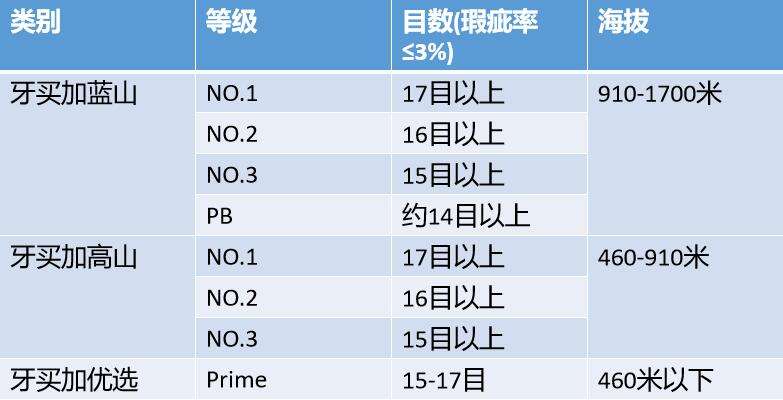
However, authentic Jamaica Blue Mountain coffee is not something that can be called such based on any random label. In fact, only Arabica Typica variety coffee grown at an altitude of910 meters to 1,700 metersin the Blue Mountains of Jamaica can be officially certified as "Jamaica Blue Mountain Coffee." Coffee produced at lower altitudes is classified as either Jamaica High Mountain Coffee (grown at 460 to 910 meters) or Jamaica Prime Coffee (grown below 460 meters). This classification system is strictly enforced by the Jamaica Coffee Industry Board (CIB) to ensure the quality of every batch of Blue Mountain coffee.
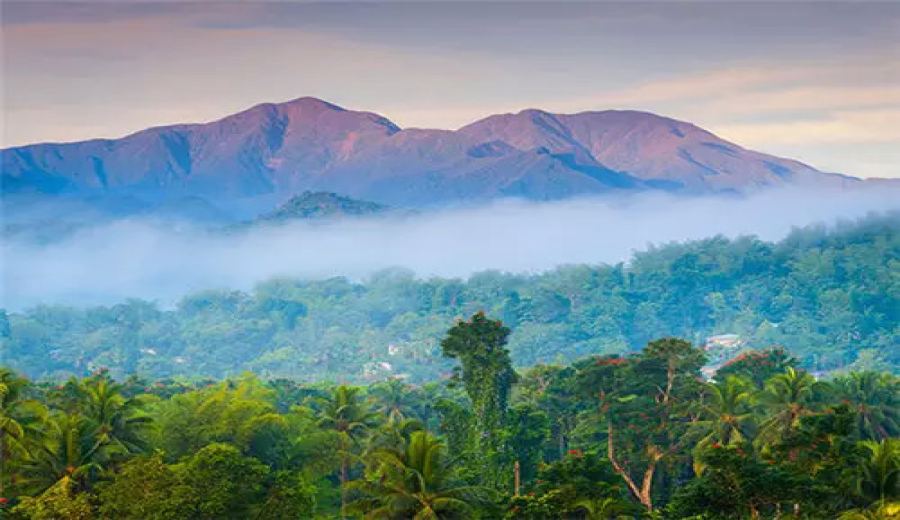
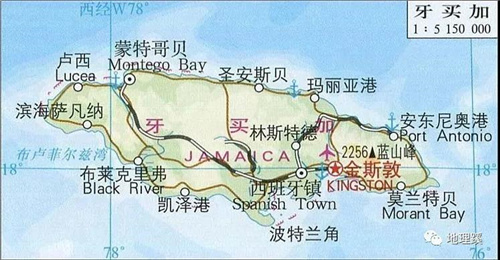
The Blue Mountain range is located in the eastern part of Jamaica. Due to its unique geographical location, surrounded by the Caribbean Sea, on sunny days, sunlight reflecting off the blue waters casts a shimmer onto the mountain peaks, making them appear to be enveloped in a bluish halo from afar—hence the name "Blue Mountain." However, not all coffee grown in the Blue Mountain region can be called Blue Mountain coffee; only those grown at qualified altitudes and meeting CIB certification standards can proudly bear this title.
The climate in the Blue Mountain area is cool and humid, with an average annual temperature of about27 degrees Celsius. It is perpetually shrouded in mist, which provides good shade and reduces the impact of strong afternoon sunlight on the coffee cherries. Additionally, the steep terrain means coffee trees can only be planted on rugged slopes, and harvesting relies entirely on skilled female workers who pick ripe red cherries one by one by hand. Overripe or underripe beans can severely affect the final flavor. Moreover, the region’s mineral-rich volcanic soil is another key factor contributing to the extraordinary flavor of Blue Mountain coffee.
Jamaica Blue Mountain coffee is further subdivided into four grades based on altitude and quality, from highest to lowest: No. 1, No. 2, No. 3, and PB (Peaberry, or round beans). Among these, No. 1 is the highest grade, requiring bean size to be17 mesh or larger, with a defect rate below2%, and a moisture content of around13%. The green beans feature plump, uniformly sized particles with an attractive bluish-green hue. These strict criteria result in an optimal balance of aroma, acidity, sweetness, and body, which is also the fundamental reason for its high price and unforgettable taste.
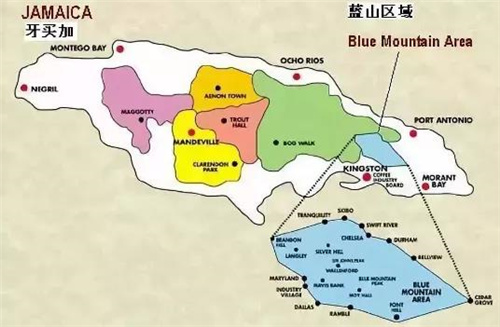
The main growing regions of Jamaica Blue Mountain coffee are concentrated in four areas: St. Andrew, St. Mary, St. Thomas, and Portland. These four regions cover a total area of approximately6,000 hectares, which is only one-third of the entire plantable area of the Blue Mountains, highlighting their rarity. In reality, only less than15%of the island’s annual coffee production earns the right to be labeled as Blue Mountain. Notable processing facilities and cooperatives, such as the Mavis Bank Central Factory (M.B.C.E), the Blue Mountain Coffee Cooperative Factory (M.H.C.C.T.), and Wallenford, often display exclusive certification stamps on their barrels, which also serve as symbols of quality.
Among them, the Clifton Mount Estate is one of the oldest coffee farms in the region, having started coffee cultivation as early as the mid-18th century and even becoming the largest estate on the island by the late 19th century. After 1978, it came under the management of the Sharp family, who significantly improved the growing environment and built the BMCP—the largest coffee processing facility in Jamaica. The estate has also earned Rainforest Alliance certification, adhering to environmentally sustainable production processes, even recycling water used in processing. The wooden barrels of Blue Mountain green beans shipped from here often bear the green Rainforest Water Frog certification mark, one of the exclusive packaging certifications for Blue Mountain coffee.
Jamaica Blue Mountain coffee primarily uses the ancient and stable Typica variety. Introduced in the 18th century, this variety has adapted to the island’s unique microclimate, developing relatively strong disease resistance—especially against common coffee berry diseases. Typica coffee trees have reddish-copper leaf tips, commonly referred to as "red-topped coffee," with smooth, elongated oval leaves, few branches, white flowers that grow at the base of the leaves, and overall lower yields. However, this also gives each coffee bean greater potential for concentrated flavor.
Traditionally, Blue Mountain coffee has only been processed using the washed method, but in recent years, to meet diverse market demands, some estates—such as Clifton Mount—have also released limited batches using the natural process. The washed processing flow includes: fruit flotation to remove impurities, fermentation for 8 to 12 hours to remove the mucilage, water washing and cleaning, then drying by sunlight or machinery to achieve a moisture content of 12–14%, followed by strict screening and warehousing. This traditional method best highlights the cleanliness and delicate balance of sweet and sour notes in Blue Mountain coffee, and is widely recognized by coffee critics as the method that best represents the spirit of Blue Mountain.
For brewing, it is recommended to use freshly roasted Blue Mountain coffee beans (ideally within 5 days post-roast) and allow a 4 to 7-day rest period for the flavors to fully develop. A medium-dark roast is recommended to highlight nutty and cocoa notes, and pairing with a KONO filter can enhance the body. Specific parameters are as follows: coffee dose15 grams, first blooming with30 grams of water for 30 seconds, then pouring in small circular motions centered to125 gramsfor the first pour, waiting for the bed to drop before pouring to225 grams. Total brew time should be controlled to around2 minutes.
In terms of flavor profile, washed Blue Mountain highlights dark chocolate and nutty aromas, with a silky-smooth mouthfeel and a well-balanced interplay of sweet, sour, and bitter notes. The natural version, on the other hand, features subtle berry acidity—like black plum and mulberry—alongside rich dark chocolate and nutty scents, accompanied by complex layers of slight fermentation. Regardless of the processing method, both showcase the unique elegance and depth of Blue Mountain coffee, making it a classic flavor not to be missed by any coffee enthusiast.
The above content is compiled by CoffeeHunters, a coffee news website.


