








Introduction:Coffee from Costa Rica's Tarrazú region is renowned for its clean, bright profile and pronounced sweetness, making it a daily favorite for many coffee enthusiasts. This article delves into the classic flavor profile of Tarrazú washed beans and compares the unique characteristics of honey-processed beans such as anaerobic heavy honey, helping you understand how different processing methods influence the sweetness and complexity of coffee. It also provides practical V60 pour-over brewing parameters to guide you in achieving the best Tarrazú coffee experience.
Costa Rican coffee has long been celebrated for its clarity of flavor, bright acidity, and natural sweetness, with the Tarrazú region being a top choice for many coffee lovers. This article will explore the region’s background and altitude conditions, introduce you to Costa Rica’s eight designated coffee regions, and focus on the classic flavor traits of Tarrazú washed beans, further comparing them with honey-processed beans like anaerobic heavy honey. Additionally, we’ll detail the processing steps for white honey, yellow honey, red honey, black honey, and anaerobic heavy honey, along with practical V60 pour-over brewing parameters to help you fully highlight the sweetness and regional characteristics of honey-processed beans.
 First, according to the classification by ICAFE (Costa Rican Coffee Institute), the country has eight major coffee-growing regions: Tarrazú (Tarrazú), Western Valley, Tres Ríos, Guanacaste, Turrialba, Orosi, Brunca, and Central Valley. These regions have all signed quality improvement agreements, with processing facilities only purchasing ripe coffee cherries to ensure stable coffee quality—this is why Costa Rica almost exclusively cultivates Arabica varieties.
Among these eight regions, some areas are located at just a few hundred meters above sea level, but many high-quality regions are found in volcanic terrain above 1,200 meters. Coffee grown in such high-altitude zones typically exhibits livelier acidity, richer mouthfeel, and more complex aromas. A certain brand selects Tarrazú coffee grown at elevations above 1,500 meters, classifying it as part of a high-altitude premium region.
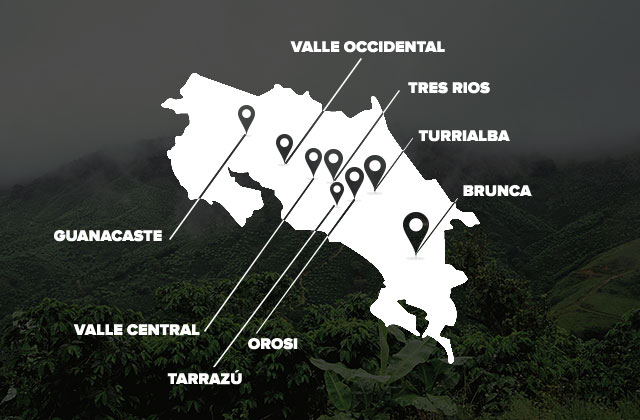 Tarrazú is located southeast of Costa Rica’s capital, San José, and is one of the country’s most famous coffee-producing regions. Sheltered by the Pacific slope mountain range, this area enjoys an outstanding ecological environment and is home to numerous endemic bird species and native forests, making it highly suitable for coffee cultivation. Tarrazú coffee is mostly planted in high-altitude small valleys and slopes, yielding beans that are dense in texture and bluish in color, indicating excellent physical quality. The region covers approximately 22,000 hectares of coffee farms, mostly small plots of about 2.5 hectares each, with an annual output of around 650,000 quintals. Up to 95% of the coffee produced here is classified as Strictly Hard Bean (SHB), indicating high elevation growth, greater bean density, and intense flavor.
The Tarrazú coffee beans selected by a certain brand are of the Caturra and Catuaí varieties, grown at altitudes over 1,500 meters, and processed using traditional washed methods. Washed processing effectively removes the mucilage layer, resulting in clearer acidity and a more defined flavor profile—making it the best way to showcase the region’s “origin flavors.” These so-called terroir flavors refer to the unique taste expressions shaped by the region’s specific climate, soil, and altitude conditions—such as the citrus, nut, and subtle dark chocolate notes commonly found in Tarrazú.
Compared to the clean flavors of washed processing, honey processing retains varying degrees of fruit mucilage (pulp), imparting more sweetness and body to the coffee. Costa Rica’s honey processing is generally divided into four types: white honey, yellow honey, red honey, and black honey, with the main differences lying in the amount of mucilage retained and the drying methods:
White Honey:Removes 80–90% of the mucilage, with beans dried quickly in sunny, high-temperature environments, resulting in lighter-colored parchment.
Yellow Honey:Retains about 50% of the mucilage, requiring low wind and moderate sunlight during drying, with beans turned 3–4 times daily, and an overall drying period of about a week.
Red Honey:Retains 80–90% of the mucilage, typically dried on raised beds in shaded or overcast conditions, with less frequent turning, mostly concentrated in the morning and afternoon.
Black Honey:Retains nearly all the mucilage, requiring slow drying in full shade, with no turning initially, followed by once-daily turning, and the entire process can take up to three weeks.
In addition to the traditional honey processes, Costa Rica has recently developed the more innovative anaerobic heavy honey method. This technique combines anaerobic fermentation with honey processing, placing depulped but mucilage-covered coffee beans into sealed tanks for fermentation in an oxygen-free environment, usually for about 4 days, followed by drying on a greenhouse or raised bed for approximately 18 days, maintaining a temperature above 21°C throughout. This process enhances the fruitiness and sweetness of the coffee while adding more complex layers of flavor.
In terms of actual flavor expression, washed Tarrazú typically showcases clean, bright acidity with a clear flavor profile, often featuring citrus, stone fruit, gentle dark chocolate, and nutty notes, resulting in a refreshing and balanced cup—a very classic representation of Costa Rican flavors. In contrast, anaerobic heavy honey-processed coffee may present more intense sweet aromas, such as blueberry and tropical fruit, even with hints of wine-like notes and rich sweetness, offering a bolder and more layered flavor profile.
Below are the V60 pour-over brewing parameters commonly used by a certain brand, suitable for most Costa Rican coffees and ideal for highlighting the sweetness of honey-processed beans:
V60 Filter Cone
Water Temperature: 91°C
Coffee-to-Water Ratio: 1:15
Coffee Dose: 15 grams
Grind Size: 80% through a #20 Chinese sieve (approximately medium-fine grind)
Brewing Steps: Start with a 30-second bloom using 30 grams of water, then pour in a circular motion with a slow stream until reaching 125 grams for the first pour; when the water level drops close to exposing the coffee bed, continue pouring to 225 grams, then stop and remove the filter cone just before it finishes dripping, with a total extraction time of about 2 minutes.
With the above parameters and understanding of the processing methods, whether you prefer the clean, classic taste of washed Tarrazú or the sweet complexity of honey-processed variations, you’ll be able to better master the brewing essentials and enjoy the diverse charm of Costa Rican coffee.
The above content is compiled by CoffeeHunters, a coffee news website.


