







Introduction:Green Mountain Coffee and Blue Mountain Coffee may sound similar, but they are worlds apart. The former is a well-known American instant coffee brand, famous for its Keurig machines and K-Cups; the latter is a premium Arabica Typica variety grown in the Blue Mountains of Jamaica, globally recognized as high-quality coffee. This article delves into the differences between the two, covering brand background, growing conditions, grading systems, how to identify authenticity, and recommended brewing parameters to help you make a more informed choice.
In the coffee market, “Green Mountain Coffee” and “Blue Mountain Coffee” are often confused due to their similar Chinese translations. In reality, the two are not only unrelated but fundamentally different in product nature. Green Mountain Coffee (Green Mountain Coffee Roasters) is a brand originating from the United States, founded in 1981, known for its Keurig single-serve coffee machines and K-Cup system, primarily offering a convenient and quick instant coffee experience; whereas Blue Mountain Coffee (Jamaica Blue Mountain) is a top-tier Arabica Typica variety grown in the Blue Mountain region of Jamaica, subject to strict regional restrictions and grading standards, and is considered a dream coffee for enthusiasts worldwide.
Green Mountain Coffee: The Rise of a U.S. Brand and the K-Cup Business Model
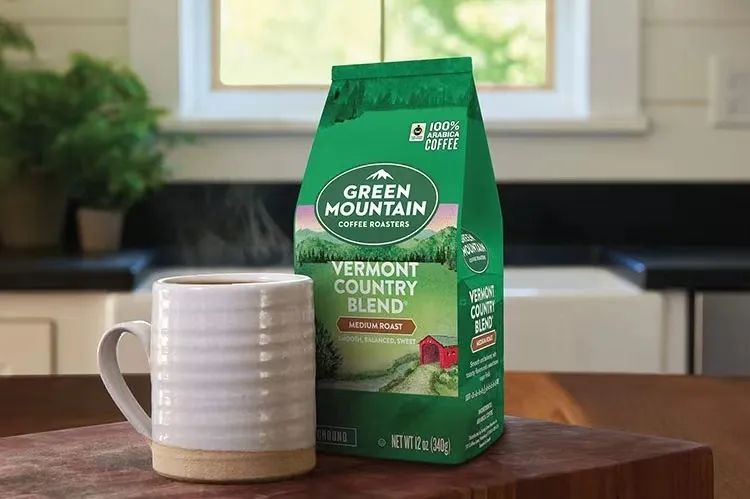
Green Mountain Coffee refers not to a type of coffee bean, but to the name of a brand. The company was founded in 1981 in Vermont, USA, went public on NASDAQ in 1993, and was acquired by a German consortium for $13.9 billion at the end of 2022. Its success did not come from coffee sales, but from a revolutionary business model — the Keurig single-serve coffee machine and K-Cup system. The K-Cup is a patented paper cup-like container that holds a filter and a measured amount of coffee grounds, which, when used with a Keurig machine, can quickly brew a cup of coffee with consistent flavor. Each Keurig machine is priced at around $100, but the real profit comes from each 24-count pack of K-Cups, averaging $12, or about $0.50 per cup. There are currently over 16 million Keurig machines in use across the United States, with an annual consumption of up to 6 billion K-Cups.
Green Mountain Coffee initially started with roasted coffee beans, but due to rising bean costs, it transitioned to developing the Keurig machine and K-Cup system, successfully creating a new market. Its K-Cups are also made available for use by other beverage brands, charging about 6 cents per cup in licensing fees, forming a stable profit model. In summary, Green Mountain Coffee is a brand that built its empire on convenient coffee solutions, which is entirely different from the premium Blue Mountain Coffee from Jamaica.
Blue Mountain Coffee: A Coffee Legend from the Jamaican Highlands
The reason Blue Mountain Coffee is so valuable lies not only in its flavor but also in its strict regional definition and rare production. The Blue Mountains are located in eastern Jamaica, where coffee cultivation was first introduced during British colonial times by Governor Nicholas Lawes, but it long remained overlooked. It wasn’t until 1932 that the Jamaican government began promoting coffee cultivation policies to reduce dependence on sugarcane, and in 1953, the Jamaica Coffee Industry Board first established the regional and quality standards for Blue Mountain Coffee.
According to the regulations,only Arabica Typica variety coffee beans grown at elevations between 910 and 1700 meters, within the four regions of St. Andrew, St. Mary, St. Thomas, and Portland, can be called “Jamaica Blue Mountain Coffee” (Jamaica Blue Mountain). These four regions cover a total area of only about 6,000 hectares. Coffee grown at elevations between 460 and 910 meters is classified as “Jamaica High Mountain Coffee” (Jamaica High Mountain), while beans grown below 460 meters are labeled “Jamaica Supreme Coffee” (Jamaica Supreme), with both quality and price decreasing progressively.
Blue Mountain Coffee is further divided into several grades, ranked from highest to lowest as follows:
- Blue Mountain No.1 (Blue Mountain No.1): Also known as Blue Mountain #1, screened with an S-17/18 sieve, with less than 2% defective beans, representing the highest quality.
- Blue Mountain No.2 (Blue Mountain No.2): S-16/17 sieve, slightly smaller in size but still with less than 2% defects.
- Blue Mountain No.3 (Blue Mountain No.3): S-15/16 sieve, less than 2% defects, with smaller bean size.
- Blue Mountain Peaberry (Blue Mountain Peaberry / P.B): Over 96% round peaberries, with less than 2% defects, rare and highly regarded.
- Blue Mountain Triage (Blue Mountain Triage): A blend of the above grades, with less than 4% defects, consisting of beans that didn’t pass the sieving process.
Authenticity and Purchasing of Blue Mountain Coffee
It used to be commonly said that “all Blue Mountain Coffee is bought by the Japanese” or “there’s no real Blue Mountain Coffee in China,” but with market liberalization, these notions are outdated. In 1969, after Jamaica was hit by a hurricane, Japan’s UCC company provided aid, and in 1972, Jamaica signed an agreement with Japan, allocating 90% of its Blue Mountain quota to Japan, with the rest split between Europe and the U.S. However, Japan did not consume all of it domestically but resold some to other markets such as Hong Kong, Taiwan, and South Korea. It wasn’t until after 2010, as Jamaica sought market diversification, that China officially began importing Blue Mountain Coffee, with the first container arriving at Ningbo Port in 2011.
Blue Mountain Coffee is exported in wooden barrels, available in two sizes: 70 kg large barrels and 15 kg small barrels. Authentic Blue Mountain Coffee comes with origin farm certification, such as the famous Clifton Mount Estate, one of the few Blue Mountain plantations certified by the Rainforest Alliance. Its original barrelled beans come with certification documents, serving as important proof of authenticity.
Blue Mountain Coffee beans are of the Typica variety, with pure genetics and often processed via the washed method, resulting in clean and balanced flavor characteristics. For roasting, a medium-dark roast is recommended to bring out a profile of balanced acidity, sweetness, and bitterness, along with a rich and rounded body — ideal for coffee lovers who enjoy delicate flavors.
Brewing Recommendations & Flavor Profile for Blue Mountain No.1
If you have acquired Blue Mountain No.1 (Blue Mountain #1), it is recommended to use freshly roasted beans (ideally within 5 days post-roast) to fully appreciate its flavor potential. Below are professional pour-over brewing parameters for reference:
- Coffee dose: 15 grams
- Water temperature: 87°C
- Coffee-to-water ratio: 1:15
- Grind size: Medium (approximately 75% passing through a Chinese standard 20-mesh sieve)
- Filter: KONO dripper
Brewing steps:
- First, pour 30 ml of hot water for a 30-second bloom
- For the second stage, pour water in small circles up to 125 ml, then stop
- When the coffee bed is about to become exposed, continue pouring until the total volume reaches 225 ml
- Total brew time is approximately 2 minutes (including bloom)
In terms of flavor, Blue Mountain No.1 exhibits intense dark chocolate aroma and a full-bodied mouthfeel at higher temperatures, accompanied by a distinct almond aftertaste. As it cools, it reveals notes of roasted hazelnut, creamy sweetness, along with soft acidity and caramel sweetness. The overall flavor profile is layered and complex, with a long-lasting finish — making it one of the finest representations of premium coffee.
The above content is compiled by CoffeeHunters, a coffee news website.


