







Introduction:Delve into how Yunnan’s small-grind coffee evolved from a single coffee tree introduced by French missionaries into China’s largest coffee-growing region. This article takes you on a journey through the four core producing areas—Baoshan, Pu’er, Dehong, and Lincang—analyzes the differences between Typica and Catimor varieties, and offers practical brewing parameter suggestions to help you better appreciate the unique charm of this high-value-for-money coffee bean.
In recent years, Yunnan small-grind coffee has gradually gained attention in the specialty coffee scene. Although its international fame may not yet rival that of Ethiopia’s Yirgacheffe or Panama’s Geisha, its outstanding cost-performance ratio and distinctive regional flavors have quietly won over many coffee enthusiasts. Starting from its historical roots, this article explores the development of Yunnan coffee—from the first coffee tree in Zhukula Village in 1902 to the formation of the four major producing areas of Baoshan, Pu’er, Dehong, and Lincang—and provides an in-depth analysis of the characteristics of the main planted varieties, including the traditional Typica and the currently dominant Catimor. It also shares practical brewing techniques and parameter recommendations.
In recent years, with the rapid growth of the domestic coffee consumption market, Yunnan coffee has gradually entered the view of more coffee enthusiasts. Although in terms of fame and price, it still struggles to compare with internationally renowned regions like Yirgacheffe, Indonesian Mandheling, or Panama Geisha, in terms of cost-performance, Yunnan coffee is absolutely worth a deep taste. In particular, the small-grind coffee from the Baoshan producing area, with its distinct regional characteristics, serves as the best entry point for understanding the flavors of Yunnan coffee.
Tracing back to the planting history of Yunnan coffee, it dates as early as 1902, when a French missionary named Tian Deneng brought coffee seeds from Vietnam and planted the first coffee tree in Zhukula Village, Binchuan County, Dali, Yunnan. Surprisingly, descendants of these coffee trees still grow and bear fruit today, with over thirty trees remaining locally, serving as living witnesses to the origin of Yunnan coffee. After the founding of the People’s Republic of China in 1952, the Yunnan Academy of Agricultural Sciences distributed 80 kilograms of coffee seeds to farmers in Ludian Dam, Baoshan, for trial planting. The results confirmed that the local environment was very suitable for coffee cultivation, with excellent quality performance, and since then, the scale of Yunnan coffee planting has gradually expanded.
The year 1988 marked an important turning point in the development of Yunnan coffee. That year, Nestlé entered China to establish a joint venture and set up a coffee agronomy service department dedicated to cultivating varieties adapted to the local soil and climate, providing technical support to improve yield and quality, and purchasing coffee based on the U.S. spot price. This series of measures laid the foundation for Yunnan’s coffee industry and led to its first industrial boom.
To date, Yunnan has become China’s largest coffee-growing province, accounting for over 98% of the country’s total production. According to data from 2019 to 2021, Yunnan’s coffee planting areas were 1.57 million mu, 1.50 million mu, and 1.39 million mu, respectively, with green bean yields of 145,000 tons, 135,100 tons, and 140,300 tons, highlighting its significant position in the domestic market. By the end of 2024, Yunnan’s coffee planting area reached 1.193 million mu, with production hitting 150,000 tons, ranking 13th globally. Moreover, in 2024, exports amounted to 32,500 tons, a year-on-year increase of 358%, showcasing its international market potential. In addition to Nestlé, international brands such as Starbucks and Maxwell House have also successively entered Yunnan, actively building their local coffee supply chains.
Yunnan’s four major coffee-producing areas—Baoshan, Pu’er, Dehong, and Lincang—are all located in tropical regions between 15 degrees north latitude and the Tropic of Cancer, with elevations generally ranging from 1,000 to 2,000 meters. The terrain is primarily mountainous and hilly, coupled with fertile soil, abundant sunlight, plentiful rainfall, and significant diurnal temperature variations, all of which contribute to the unique flavor profile of Yunnan small-grind coffee: “rich but not bitter, fragrant but not overpowering, with a hint of fruity notes.”
Dehong is one of the earliest regions in Yunnan to introduce coffee. In 1951, the Cotton Experimental Station in Luxi County first introduced seeds from the China-Myanmar border and conducted small-scale cultivation, marking the beginning of the local coffee industry and earning it the reputation of “Hometown of Chinese Coffee.” Additionally, Dehong is home to the nation’s important coffee seed gene bank—the Ruili Coffee Germplasm Resource Nursery under the Ministry of Agriculture—one of the first tropical crop germplasm resource nurseries in China.
The planting history of Baoshan coffee dates back to the mid-1950s, when patriotic overseas Chinese Mr. Liang Jinshan introduced the first coffee seedlings from Southeast Asia. In 2010, Baoshan small-grind coffee obtained national geographical indication protection product certification. The local average annual temperature is about 21.3°C, with extreme highs reaching 40.4°C, and almost no frost, making it recognized as one of the most suitable environments for growing small-grind coffee. International experts have praised Baoshan small-grind coffee as “rich and mellow, with bright fruit acidity and a long-lasting aftertaste, making it a premium coffee.”
Lincang, located in the southwestern part of Yunnan and bordering Myanmar to the west, features diverse terrain with elevations exceeding 1,000 meters and a climate with distinct dry and wet seasons, mainly divided into a dry season and a rainy season (the latter concentrated from June to September). Coupled with significant diurnal temperature variations, it is highly suitable for high-altitude coffee cultivation. A certain coffee brand established its own estate here and launched its first self-produced beans in 2020—the brand’s 2013 coffee beans, using the Typica variety and a natural (sun-dried) processing method.
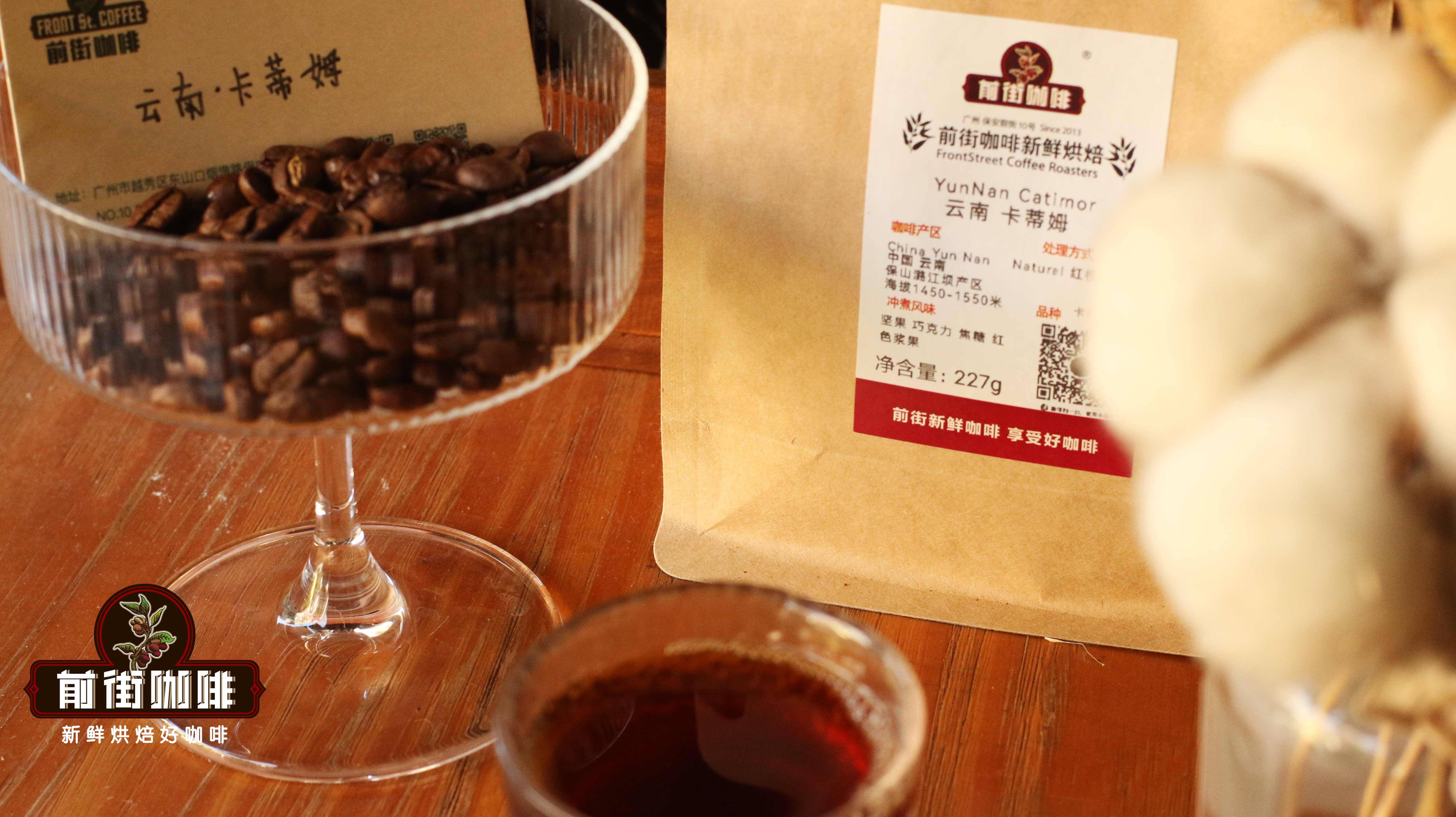
In terms of varieties, Yunnan coffee initially focused on Typica, one of the oldest varieties of Arabica, but due to its weaker disease resistance and limited yield, it was gradually replaced by Catimor, which boasts strong disease resistance and high yield. Catimor is a hybrid of Timor and Caturra, carrying some Robusta genes. Although early cupping profiles were relatively simple, with advancements in planting and processing techniques, today’s Yunnan Catimor has demonstrated captivating traits such as nuttiness, black tea notes, and sweet-tart plum acidity, making it the representative variety of Yunnan coffee.
For home brewers looking to prepare Yunnan small-grind coffee, it is recommended to choose a medium roast to preserve its unique herbal aroma and gentle acidity. It is suggested to use a V60 dripper, with water temperature controlled at 91°C, grind size at 80% through a standard 20-mesh sieve, a coffee-to-water ratio of 1:15, and approximately 15 grams of coffee grounds. The specific steps are: start with a 30-second bloom using 30 grams of water, then pour 95 grams of water in a thin stream in small circles from the center outward. When the coffee bed has descended halfway, pour another 100 grams of water in circles. The total extraction time is about 2 minutes. These parameters fully highlight the nutty and brown sugar notes of Yunnan coffee, while a lower temperature can also bring out the plum acidity and black tea finish.

The above content is compiled by CoffeeHunters, a coffee news website.


