







Introduction:Kenyan coffee is renowned for its bright acidity, berry, and cherry tomato flavors, making it a favorite among specialty coffee enthusiasts worldwide. But beyond its flavor profile, do you know about Kenya’s growing regions, coffee grading system, and classic cultivars? This article will take an in-depth look at major regions such as Nyeri and Kiambu, explore the stories behind well-known varieties like SL-28 and SL-34, and explain the official grading standards of Kenyan coffee beans. Additionally, we’ve compiled practical pour over brewing parameters—including grind size, water temperature, brew ratio, and pouring technique—to help you master this uniquely flavorful specialty bean.
Walk into any specialty café, and if you’re looking for a coffee origin that’s almost always present, Kenya is often the top choice. This coffee is widely praised for its unique bright acidity, rich berry flavors, and tomato-like fruitiness, and it frequently scores highly in international cupping competitions. However, aside from its impressive taste, many consumers still know little about Kenya’s growing regions, variety evolution, or grading system. This article will take you on a journey from Nyeri to Kiambu, exploring the geographic features and harvest rhythms of each major producing area, analyzing the origins of classic cultivars like SL-28 and SL-34, explaining the logic behind Kenya’s official coffee grading, and finally offering a complete set of pour over brewing recommendations to give you a more comprehensive understanding of this “familiar yet mysterious” specialty coffee bean.
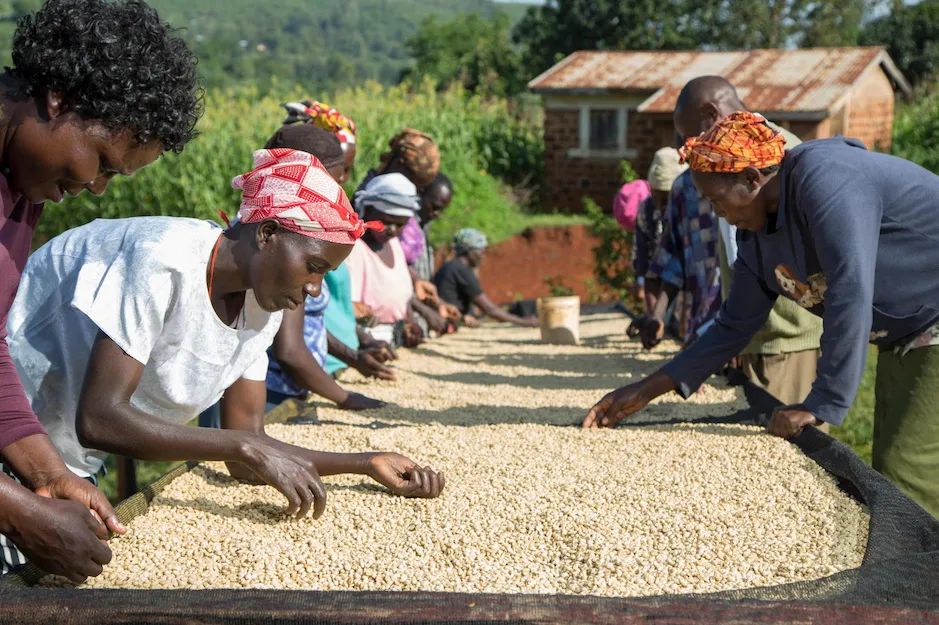
 Kenyan coffee is primarily grown in highland areas at elevations between 1,500 and 2,100 meters, with two harvest seasons each year—spring and autumn. To ensure only fully ripe cherries are picked, farmers must make multiple trips into the fields for inspection, usually up to seven times. As most producers are smallholders, the freshly picked beans are sent to cooperative washing stations for processing, where the pulp is removed and the beans are fermented and washed. They are then delivered to cooperatives in their “parchment” state for unified management. Ultimately, all green beans are evaluated based on actual quality and traded at a fair average price. This system has operated stably over the years, balancing the interests of both producers and consumers.
Major Coffee Growing Regions in Kenya
Nyeri (NYERI): Located in central Kenya, adjacent to the majestic Mount Kenya, this region is known for its mineral-rich red soil, making it an ideal place for cultivating high-quality coffee. The area mainly operates under a cooperative model formed by smallholder farmers, with two harvests per year, among whichthe main production season from October to Decemberis particularly outstanding in quality. The elevation range is1,200 to 2,300 meters, and the main varieties include SL-28, SL-34, Ruiru11, and Batian.
Murang’a (MURANG'A): As an important inland producing region, this area was once a settlement for early missionaries and now hosts around 100,000 coffee farmers. Similar to Nyeri, Murang’a is dominated by smallholders, with fertile soil and a location in the volcanic belt. The main harvest seasons areOctober to December and June to August, with elevations ranging from1,350 to 1,950 meters. The main varieties planted are also SL-28, SL-34, Ruiru11, and Batian.
Kirinyaga (KIRINYAGA): Neighboring Nyeri, this region shares similar geographic conditions and also benefits from volcanic soils. Most of the coffee here is produced by smallholders, and there are several high-performing wet mills. The elevation is1,300 to 1,900 meters, with the main production season in autumn, and the varieties are largely the same as those in neighboring regions.
Embu (EMBU): Located near Mount Kenya, around 70% of the local population is engaged in small-scale farming, with tea and coffee being the main cash crops. Though its output is not as high as other major regions, the quality is stable, at an elevation of about1,300 meters.
Meru (MERU): Situated at the foothills of Mount Kenya and the Nyambene Hills, this region is one of the important birthplaces of early Kenyan coffee cultivation. Most of the coffee here is grown by smallholders on mountain slopes, at elevations of1,300 to 1,950 meters. In addition to SL-28 and SL-34, varieties such as K7 and Ruiru11 are also planted.
Kiambu (KIAMBU): Located in north-central Kenya, it boasts the country’s highest-altitude coffee-growing areas, but also faces threats from dieback disease. The terrain is diverse, with coffee cultivation mainly by smallholders and a few estates, at elevations of1,850 to 2,200 meters, and the varieties are equally diverse.
Kisii (KISII): Located in southwestern Kenya, adjacent to Lake Victoria, this is a smaller-producing region mainly operated through cooperatives. The elevation is1,450 to 1,800 meters, and the varieties include common ones as well as Blue Mountain and K7.
Trans-Nzoia, Keiyo & Marakwet (TRANS-NZOIA、KEIYO & MARAKWET): Located in western Kenya, this area has gained attention in recent years and mostly relies on the terrain of Mount Elgon. The region is dominated by diversified agriculture, with coffee cultivation playing a supplementary role, at elevations of1,500 to 1,900 meters, and the main varieties are SL-28, SL-34, Ruiru11, and Batian.
Classic Varieties of Kenyan Coffee
The unique flavor of Kenyan coffee owes much to its cultivated varieties. Among them,SL-28 and SL-34are the two most highly regarded varieties in the specialty coffee world. Both originated from the breeding program of Scott Laboratories in the 1930s, led by Guy Gibson, and were standouts among 40 experimental varieties. These two varieties possess highly distinctive berry and citrus acidity, with SL-28 being considered the key to the bright, acidic aroma of Kenyan beans. However, they have relatively weak resistance to leaf rust, posing higher cultivation risks.
To improve disease resistance, the Kenya Coffee Board introducedRuiru11and laterBatianvarieties. Ruiru11 was the first officially certified disease-resistant variety, though it has limited acceptance in the specialty market. However, Batian is gradually gaining market attention due to its better flavor potential and disease resistance performance.
Kenya Coffee Grading System
Kenya has an extremely rigorous coffee grading system, mainly based on bean size, hardness, and shape. From highest to lowest, the grades are:AA (or AA+), AB, PB (peaberry), C, E, TT, T. Among them,AA (passing through a 17–18 mesh sieve)is the highest grade, and if the flavor profile is particularly outstanding, it may be labeled as AA+.AB (15–16 mesh)is the most common grade,PB (peaberry)is categorized by shape rather than size. Other grades such as C, E, TT, and T mostly consist of smaller-sized or defective beans.
Recommended Pour Over Brewing Parameters
Due to being grown in high-altitude volcanic soils, Kenyan coffee beans are hard and large, which can lead to channeling or clogging during brewing. It’s recommended to use a medium to high-quality grinder and pre-sift the grounds with a sieve to remove fines. The ideal grind size isapproximately 75% passing through a 20-mesh standard sieve. For medium-light roasts, you can adjust to 80% passing rate, while medium-dark roasts are recommended at 75%, with actual sieve test results as the guideline.
For water temperature, it is recommended to set it at93°Cto fully bring out the unique fruity sweetness (such as cherry tomato) and bright acidity of Kenyan beans. The recommended brew ratio is1:16, which allows the coffee to maintain a rich mouthfeel while achieving excellent balance between acidity and sweetness. When using a small V60 filter, it is recommended to use at least15 grams of coffee grounds; for a larger size, start with25 grams.
For pouring technique, avoid excessive large-circle pouring that may cause channeling. Instead, use small circles from the center outward, controlling the flow speed. First, pour30ml of water for a 30-second bloom; second, pour120ml of water, moving from the center outward until the foam covers the entire surface, then return to the center, keeping the coffee bed height at half of the short ribs of the filter; third, pour90ml of water, using coin-sized circles, and let the coffee drip through completely. The total brew time should be controlled around2 minutes (±10 seconds allowance). This parameter setup highlights the tomato-like aroma and bold acidity of Kenyan beans, while maintaining good body and layered complexity.
The above content is compiled by CoffeeHunters, a coffee news website.


