







Introduction:Since its rise to fame in 2017, the Huacai (Hua Kui) coffee has captivated the specialty coffee community with its distinctive strawberry cream flavor and TOH (Taste of Harvest) competition championship prestige, becoming an essential must-try bean for many coffee enthusiasts. This article delves into the regional background, naming origins, and version evolution of Huacai coffee, while also providing professional roasting recommendations and V60 pour over parameters to help you fully grasp the characteristics and brewing techniques of this star-level natural-processed bean.
Since its popularity began in 2017, Huacai coffee beans have maintained a strong presence in the specialty coffee market. This natural-processed coffee from Hambella, Guji, Sidama, Ethiopia, is renowned for its intense strawberry cream aroma, and it also carries an exciting backstory of winning the TOH green coffee competition. This article will provide a detailed introduction to Hua Kui’s regional characteristics, naming origins, the evolution of different versions, and share practical roasting and pour over recommendations to help coffee lovers gain a deeper understanding of this much-talked-about bean variety.
[Regional Background: The Golden Zone of Sidama and Guji]
The authentic origin of Huacai coffee is the Hambella sub-region under Guji, Sidama, Ethiopia. Sidama is located in southern Ethiopia, originally part of the Oromia Region before being elevated to an independent administrative zone. It relies mainly on agriculture, with coffee cultivation concentrated around the East African Rift Valley. The region’s diverse soils, rich microclimates, and numerous native coffee varieties contribute to significant differences in flavor profiles across various areas. Notably, as regional divisions become more refined, sub-regions such as Guji and West Arsi under Sidama have gradually emerged as prominent players. Among them, Guji is known for its high altitude and fertile black soil (Vertisol), with an average elevation exceeding 1800 meters and notable day-night temperature variations—offering an ideal environment for growing specialty coffee. And Huacai hails from this golden zone.
[Hambella: The Highest-Elevation Coffee Sub-Region]
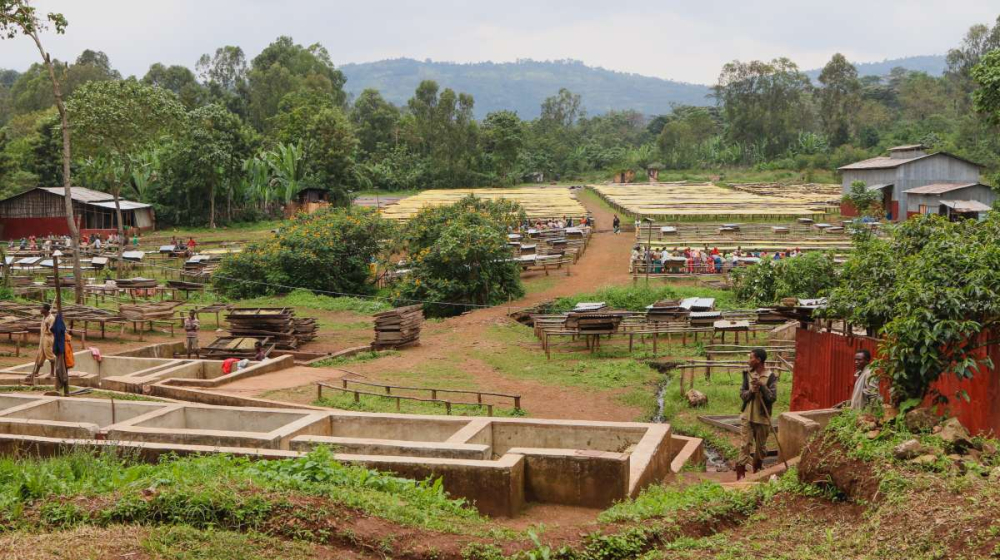
As an important sub-region of Guji, Hambella boasts a unique geographical position. To its west lies Kochere in Yirgacheffe, separated by a highland plateau about 30 kilometers wide and at an altitude of 3200 meters; to its east, south, and north, it borders other sub-regions of Guji. It is one of the highest-altitude coffee-growing areas in Ethiopia. These special geographical conditions endow Hambella coffee with intense fruity aromas and a rich mouthfeel, forming the foundational profile behind the unique flavors of Huacai coffee.
[The Naming Origins and Version Evolution of Huacai]
In 2017, Ethiopia’s DW Company submitted its coffee beans to the TOH (Taste of Harvest) green coffee competition. Among them, the natural-processed batch from the “Buku Abel” washing station in Hambella stood out with its prominent strawberry and cream aromas, winning the championship. These green beans were introduced to China by Beijing Hongshun Trading, and helped barista Li Jianfei secure second place in the China leg of that year’s World Brewers Cup. Because of its outstanding performance among many Geisha entries, it was dubbed “Huacai,” meaning the foremost among geisha entertainers—symbolizing excellence above all others.
Strictly speaking, only the 2017 TOH-winning natural batch from Hambella can be considered the authentic Huacai. However, subsequent beans produced by the same washing station were also included in the Huacai series, with the year followed by an “X.0” suffix—for example, Huacai 2.0 in 2018, Huacai 3.0 in 2019, and so on. As demand increased, DW expanded production to four washing stations, but the flavor gradually deviated from the original strawberry profile. Later batches such as Huacai 5.0 leaned more toward citrus notes. Huacai 6.0 in 2022, due to weather factors, suffered from poor bean appearance and a higher proportion of defective beans, affecting overall performance.
[Alternative Options and Flavor Profiles of Huacai Coffee]
Faced with the quality challenges of Huacai 6.0, some suppliers have turned to recommending new-season beans from the Buku washing station in the same region. This alternative bean is also sourced from Hambella, carefully processed by the Buku washing station, with plump beans and an appearance similar to traditional Huacai. Cupping results show that its flavor is dominated by orange blossom, citrus, honey, and grapefruit, with a strong juiciness, closely resembling the characteristics of Huacai 5.0, offering enthusiasts another high-quality option.
[Roasting Recommendations: Highlighting Sweet Fruit Characteristics]
Huacai green beans possess a unique fermented floral aroma reminiscent of coffee blossoms, distinctly different from the common grassy scent. The beans are irregular in size, mostly pointed at both ends, with a moisture content of around 11%, which falls within the ideal range. Due to their high density and hardness, it is recommended to extend the drying phase during roasting, rapidly increasing the temperature before first crack to build up energy. After first crack, careful control of development time is needed (recommended within 1 minute 30 seconds, not less than 1 minute), along with appropriate adjustment of air and heat to preserve small-molecule aromatic compounds such as floral notes. The suggested drop temperature is around 193°C, with the overall roasting time kept within 11 minutes. A light roast is advised to enhance the sweet fruit characteristics.
[Pour Over Parameters and Steps: V60 Three-Stage Extraction]
It is recommended to use a V60 #01 filter cone, with 15g of coffee, a water temperature of 90–91°C, a coffee-to-water ratio of 1:15, and a grind size of 80% passing through a 20-mesh standard sieve (Chinese standard)—a medium-fine pour over grind. Use the three-stage pouring method: first, preheat your equipment and add the coffee grounds. The first pour involves adding 30g of water for a 30-second bloom. The second pour consists of pouring 120g of water in a circular motion from the center outward, completed in about 1 minute. The third pour involves adding 90g of water when the coffee bed is nearly drained, then removing the filter once the dripping finishes. The total extraction time is approximately 2 minutes and 5 seconds. Under these parameters, Huacai coffee exhibits bright citrus acidity, a rich berry juice-like body, accompanied by the tea-like notes of lemon black tea and a long-lasting sweetness, delivering a complex and layered flavor profile.
The above content is compiled by CoffeeHunters, a coffee news website.


