







Introduction:Want to describe the flavor of a pour over coffee more precisely and understand its aroma and taste from a professional perspective? This article delves into the design logic and structure of the new Coffee Taster’s Flavor Wheel, helping beginners gradually grasp the subtle differences from fruit and floral notes to roasted aromas. With chart-based analysis, you’ll learn how to use the flavor wheel to enhance your tasting skills and build your own coffee flavor profile database.
The birth of the Coffee Taster’s Flavor Wheel stems from the growing demand for more accurate coffee evaluation as specialty coffee culture flourished. This concept was initially inspired by the wine tasting system, evolving from vague and general descriptions into a systematic and logical classification tool.
The first edition of the Coffee Taster’s Flavor Wheel was released in 1995, categorizing flavors into positive and negative groups, primarily providing the industry with a common language. It wasn’t until 2016, after years of research and reorganization, that the widely used flavor wheel we know today was officially launched—featuring a more detailed structure and better reflecting the various flavor characteristics perceived during actual tasting.
To deeply understand this flavor wheel, it’s essential to know that its design is based on rigorous scientific foundations. The SCAA (Specialty Coffee Association of America, now SCA), in collaboration with the World Coffee Research (WCR), Kansas State University in the U.S., the University of Agriculture in Germany, and multiple representatives from the coffee industry, conducted flavor analysis and sensory testing on over 105 coffee samples from 13 major producing countries. These efforts culminated in the World Coffee Research Sensory Lexicon, which became the theoretical basis for the new flavor wheel.
Next, the research team partnered with the University of California, Davis, using traditional sensory evaluation and statistical methods. They invited 72 professional tasters to rank and classify each flavor attribute in the lexicon, ultimately transforming this data into the familiar circular flavor chart we use today.
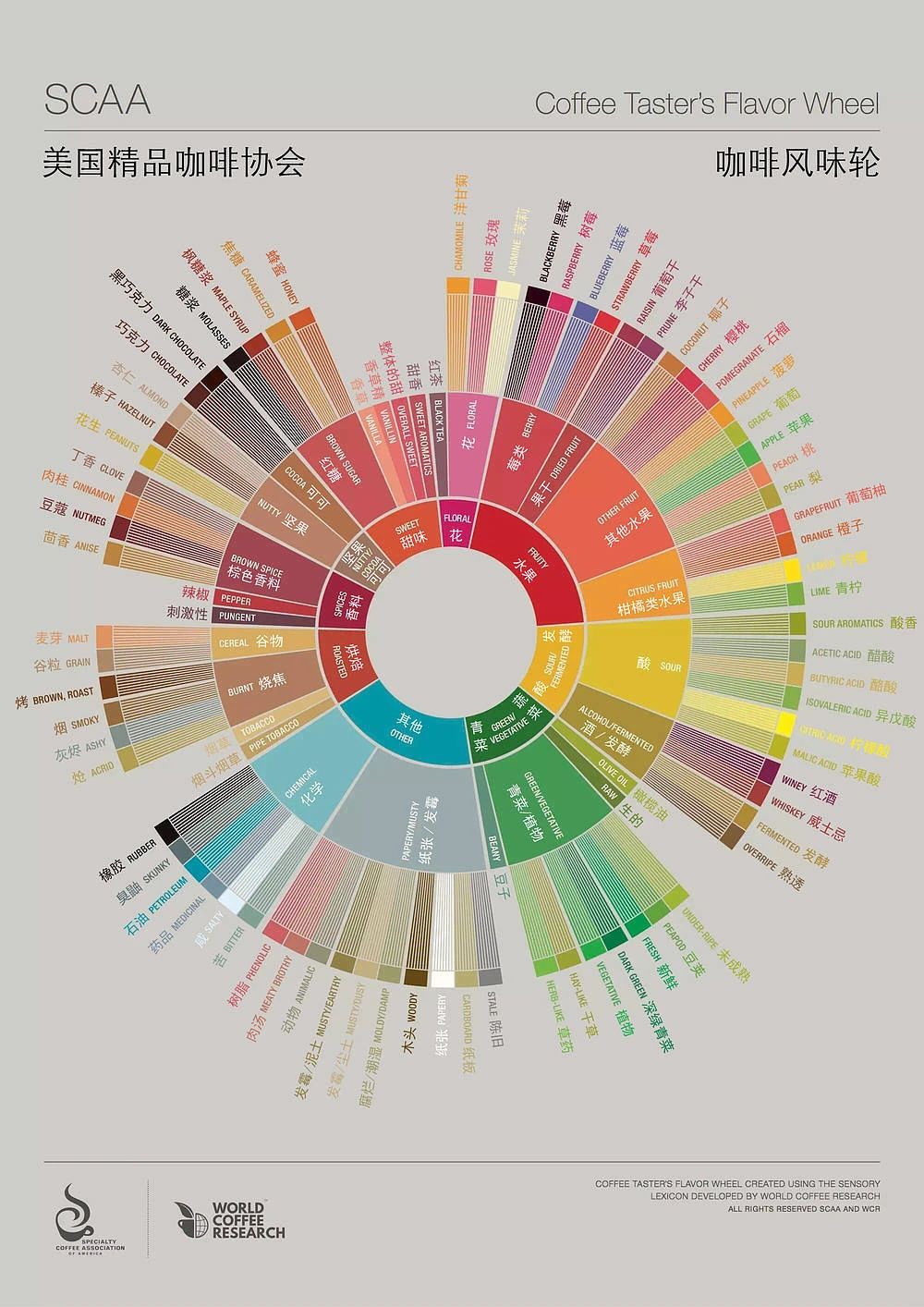
Notably, the visual design of this edition of the flavor wheel was also meticulously crafted, with color schemes handled by the renowned London creative agency One Darnley Road. Each color block was chosen with intent—for example, herbal notes are mostly presented in grass green, while citrus tones use bright orange. The goal is to enable users to instantly associate colors with actual flavors, enhancing intuitive recognition.
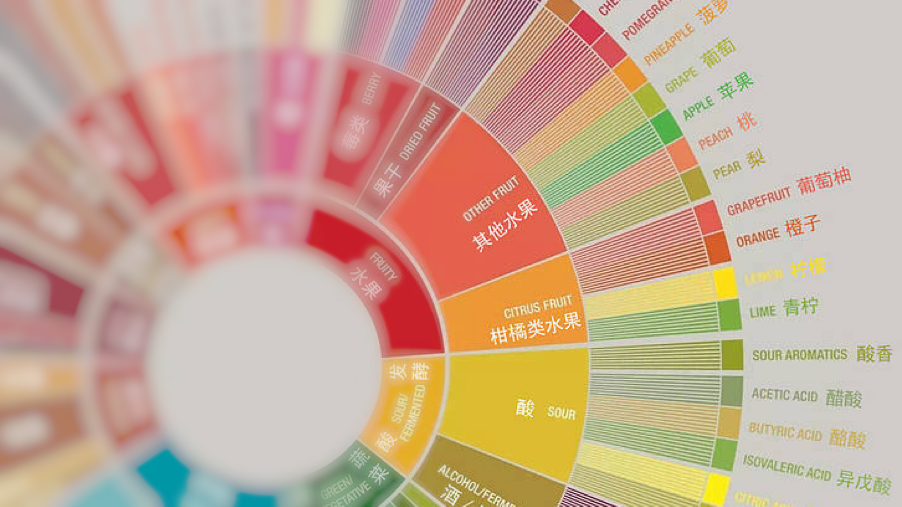
The overall flavor wheel is divided into three levels: inner ring, middle ring, and outer ring. The inner ring represents the most basic “category classes,” covering nine major categories: herbal, sour/fermented, fruity, floral, sweet, nutty/chocolatey, spicy, roasted, and other. This is the first step in flavor classification, giving tasters a general sense of direction for different tastes.
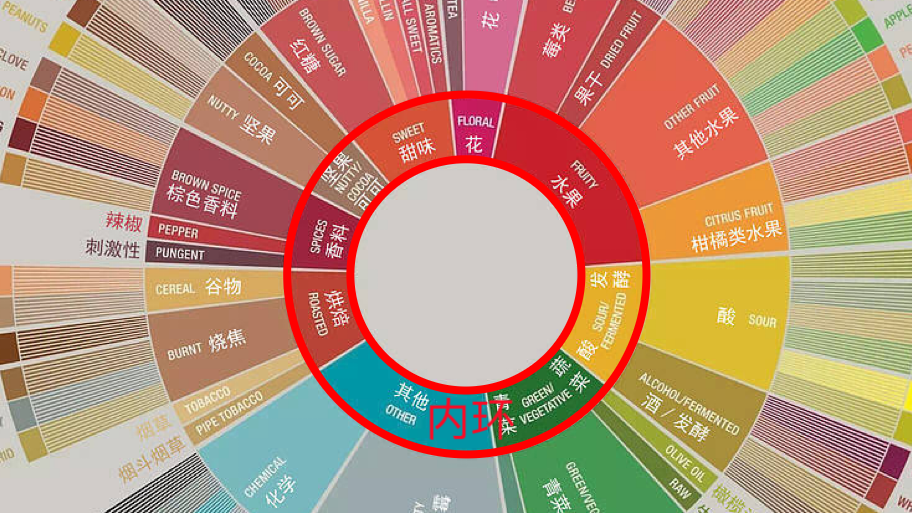
The middle ring provides subcategories under each of the inner ring classifications. For example, under the fruit category, it is further divided into citrus, other fruits, dried fruits, and berries—helping users narrow down their choices and define flavors more accurately.
The outer ring is the most detailed level of the flavor wheel, listing specific flavor descriptors. For instance, within the citrus category, you can find specific fruit names such as lime, lemon, orange, and grapefruit. This logic of classification—from broad to specific—enables even beginner coffee enthusiasts to progress from “I taste something like lemon” to “This belongs to the citrus subgroup of the fruit category, possibly specifically lemon.”
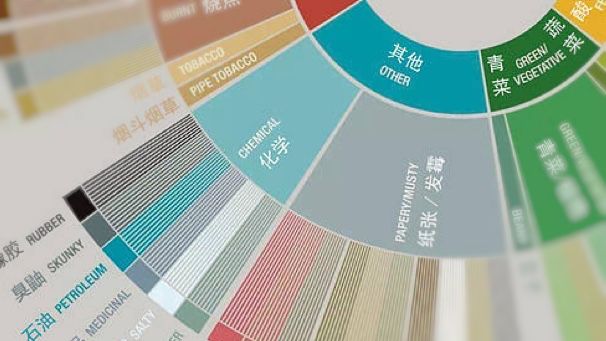
Additionally, the spatial arrangement of the various categories on the flavor wheel carries meaning. For example, blueberries and strawberries, both belonging to the berry group, are positioned relatively close to each other, indicating that their flavor profiles are quite similar; whereas blueberries and raspberries are slightly farther apart, showing differences in their flavor contours. The same principle applies to floral notes—for instance, rose and jasmine are positioned near each other, but clearly distinct when compared to citrus categories. This helps tasters understand the relationships and differences between various flavors.
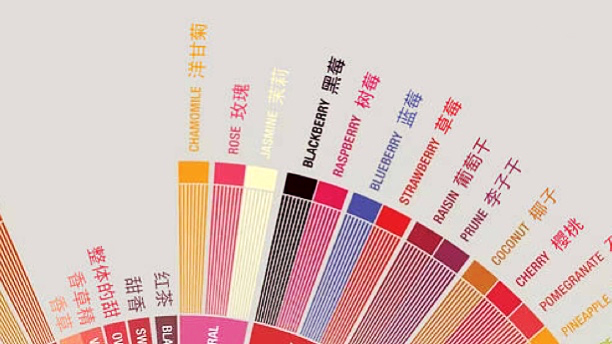
Color usage also plays an important role in the flavor wheel. The color blocks of many common food flavors closely resemble the actual colors of those foods—for example, white floral notes are usually shown in yellowish-white, common rose aromas are marked with magenta, and herbal florals like chamomile are displayed in orange. Thanks to this design, even those unfamiliar with flavor names can intuitively associate colors to quickly grasp the general direction of a given flavor.
However, the flavor wheel is just a tool. To truly sharpen your sensitivity to coffee flavors, it must be paired with real-life tasting and sniffing practice. It’s recommended to regularly interact with actual foods listed on the flavor wheel—such as citrus, nuts, and spices—to develop your olfactory and taste memory. At the same time, by consistently trying single-origin coffees from different regions and processing methods and comparing those experiences with the flavor wheel, you can gradually build your own flavor database and evaluation system.
The above content is compiled by CoffeeHunters, a coffee news website.


