







Introduction:Arabica coffee beans, renowned for their delicate aroma and diverse flavors, are the top choice for specialty coffee, accounting for over 70% of global production. This article delves into the grading system of Arabica, its major producing regions, and details the distinctive flavors and processing methods in Brazil, Colombia, Panama, and other regions—helping you choose beans based on origin characteristics to elevate your brewing experience.
Coffee belongs to the Rubiaceae family, with about eighty identified species, but the main types used for daily consumption can be divided into three categories: Arabica, Robusta, and Liberica. Among them, Arabica stands out with its elegant balance of acidity and sweetness and rich aroma, making it the mainstream for single-origin and specialty coffee, accounting for over 70% of global coffee production. From the nutty-chocolate notes of Brazil to the citrus and dark cocoa layers of Colombia, and the Geisha of Panama or the Jamaica Blue Mountain, Arabica coffees from different regions each showcase unique terroir expressions. The following will provide a comprehensive introduction to the grading system of Arabica and the characteristics of globally renowned producing regions.
From a botanical perspective, coffee is an important crop under the Rubiaceae family, with over 100 known coffee species globally, about 80 of which have been formally recorded. However, only Arabica, Robusta, and Liberica are widely cultivated and used for beverage production. Traditionally, Arabica is often used for single-origin coffee or high-end blends, while Robusta is commonly found in instant coffee or as the base for espresso. As a result, many people habitually regard Arabica as synonymous with premium coffee, though flavor preferences are inherently subjective with no absolute hierarchy.
Arabica coffee originated in Ethiopia and later spread to other parts of Africa and some mountainous regions in Asia. Currently, about 70% to 75% of global coffee production comes from this variety. Due to its relatively weak resistance to pests and diseases, Arabica thrives at altitudes above 1,500 meters, where beans grown in such conditions often exhibit richer flavor profiles. High-quality Arabica beans typically boast pronounced sweetness, acidity, and aromatic complexity, which are key reasons why they are considered the top choice for specialty coffee.
Notable Arabica sub-varieties include Typica, known for its excellent acidity and high cupping scores, and one of the oldest coffee varieties still in existence. Meanwhile, Geisha, which has garnered significant attention in the specialty coffee scene in recent years, captivates coffee enthusiasts with its refreshing floral notes and delightful acidity. One specialty coffee shop once offered over fifty single-origin and specialty Arabica beans from various regions, catering to diverse palates and offering opportunities for further tasting exploration.
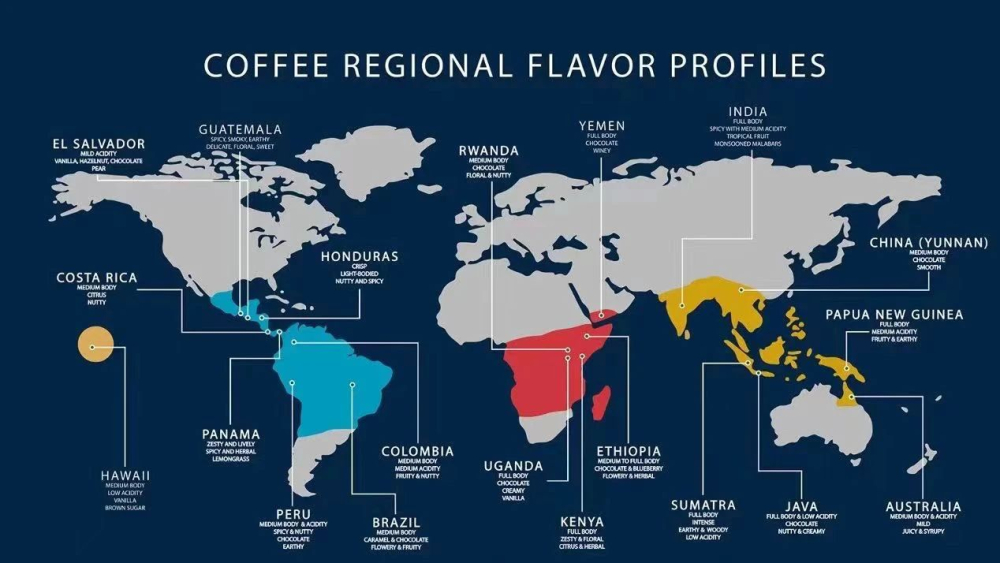
As the world’s largest coffee producer, Brazil has long ranked first in both planting area and annual output, and is also the second-largest coffee-consuming country globally, only behind the United States. Since coffee cultivation began in 1727, Brazil has leveraged its vast fertile lands and favorable climate, particularly in the key producing regions of Minas Gerais, São Paulo, and Paraná in the southeastern part of the country. However, due to frequent frost damage in the south in recent years, some growing areas have gradually shifted northward. Currently, large estates in the Cerrado region of Minas Gerais have introduced advanced irrigation systems and mechanized equipment, and are experimenting with diversified planting—including disease-resistant varieties like Catiguá alongside traditional Arabica cultivars such as Bourbon.
Brazilian coffee generally features low acidity, sweet and smooth taste, accompanied by subtle grassy notes and mild bitterness, achieving an overall balanced flavor with a comfortable aftertaste. The Bourbon variety from Fazenda Rainha, a representative plantation, is characterized by prominent nutty and chocolate tones paired with moderate caramel sweetness, delivering a silky texture and distinct layering. In terms of planted varieties, Arabica types such as Bourbon, Mundo Novo, and Catuaí are grown, along with the disease-resistant Catiguá. Common processing methods are predominantly natural (sun-dried), with some using honey processing. Brazil’s grading system evaluates beans based on screen size and defect count, with the highest grade being 'No.2', requiring fewer than eleven defects in a 300g sample and a screen size between S17 (6.75mm) and S18 (7mm).
Colombia is the world’s third-largest coffee producer, with most of its coffee grown on small farms at elevations of 1,000 to 2,000 meters in the foothills of the Andes Mountains, enjoying two harvests per year. Managed and promoted by the Federación Nacional de Cafeteros de Colombia, the country actively fosters the development of specialty coffee. Local farmers adopt shaded cultivation, hand-picking, and water-saving equipment to produce high-quality coffee with distinctively American characteristics. Colombian coffee is mainly washed-processed, often featuring citrus notes, nutty aromas, and layers of dark cocoa, with fine acidity and an overall rich, smooth mouthfeel.
Planted varieties include Caturra, Castillo, and Colombia Typica, with washing as the primary processing method. Harvest seasons fall between October and January, and April and June. Grading is based on screen size, with beans over S17 (6.75mm) classified as 'Supremo' and those between S14 (5.5mm) and S16 (6.5mm) as 'Excelso'.
Panama has become a focal point in the specialty coffee world in recent years, home to renowned farms such as Finca Esmeralda, Finca Deborah, and Ninety Plus. Varieties grown locally include Geisha, Caturra, and Catuaí, with Geisha being the most iconic representation of Panama’s unique coffee profile—especially those from Finca Esmeralda, which receive high praise. Panamanian Geisha coffee is celebrated for its bright floral notes, vibrant acidity, and complex layers, making it a dream coffee for many enthusiasts. The harvest season runs from September to March, with washed processing as the main method, supplemented by sun-drying or mechanical drying.
Panama’s grading system is based on altitude, with higher elevation correlating to higher grades. It is mainly divided into two tiers: 'Strictly Hard Bean' (SHB) and 'Hard Bean' (HB), reflecting intense flavors and firm body.
Guatemala is a classic volcanic country, with the Antigua region surrounded by three volcanoes. Volcanic ash soil provides rich nutrients, contributing to its distinctive coffee flavors. A specialty coffee shop once selected local Santa Ana coffee beans, supervised by Lamastus Family Estates and processed by the largest washed-processing facility in the area, Las Pastores. These beans exhibited intense floral and tea-like aromas, along with zesty lime acidity, and a honey-like sweetness in the aftertaste, all wrapped in exceptional cleanliness and layered complexity. Main varieties include Bourbon, Caturra, and Catuaí, mostly processed via washed or natural methods. Grading is based on altitude: above 1,300 meters is 'Strictly Hard Bean' (SHB), 1,200 to 1,300 meters is 'Hard Bean' (HB), and 900 to 1,050 meters is 'European Preparation Washed' (EPW).
The above content is compiled by CoffeeHunters, a coffee news website.


