







Introduction:Faced with the wide array of grinders on the market, many coffee enthusiasts often don’t know how to choose. This article starts with burr types, providing a detailed analysis of the structural principles, grind particle characteristics, and their practical effects on extraction and flavor for flat, conical, and flat-conical (ghost-tooth) burrs. It also offers practical grind setting suggestions for popular models such as the Hario Mini Mill, Baratza Encore, and Zhenghuangxing M520A, helping you select the most suitable grinding combination based on different brewing methods and taste preferences.
The variety of grinders on the market makes it a challenge for both beginners and more experienced coffee lovers to choose a grinder that suits them. In fact, there is no so-called “best burr type”—each has its unique strengths and limitations. This article will explore the design differences between flat, conical, and ghost-tooth burrs, and how they influence the shape of coffee particles, extraction uniformity, and final flavor expression. It also compiles practical grind range recommendations for common home and entry-level professional models to help you find the most suitable grinding solution for your brewing habits.
Choosing a grinder ultimately comes down to your actual usage needs and personal taste preferences. The world of coffee has no absolute standard answers—diversity is where its charm lies. Below, we’ll take you through a comprehensive understanding of how to make the most suitable choice based on burr principles, particle characteristics, extraction impacts, and practical machine parameters.
Even when the grind size is adjusted to what seems like the same setting—such as a universal “4”—coffee ground with flat, conical, and ghost-tooth burrs can still show significant differences in fineness, uniformity, and the final flavor profile. This isn’t due to differences in the beans, but rather because the structure and operation of the burrs lead to varying particle shapes, which in turn affect the evenness of extraction and the layering of flavor expression.
The key to a grinder lies in its burrs. Currently, they are mainly divided into three types: flat, conical, and ghost-tooth (flat-conical). These three burr types, due to their different cutting mechanisms, produce coffee particles with distinctly different shapes. The shape of the particles directly affects the speed of water flow, the uniformity of extraction, and ultimately determines the flavor performance of the coffee. Even with the same extraction yield, uneven particle distribution can noticeably impact the balance of mouthfeel.
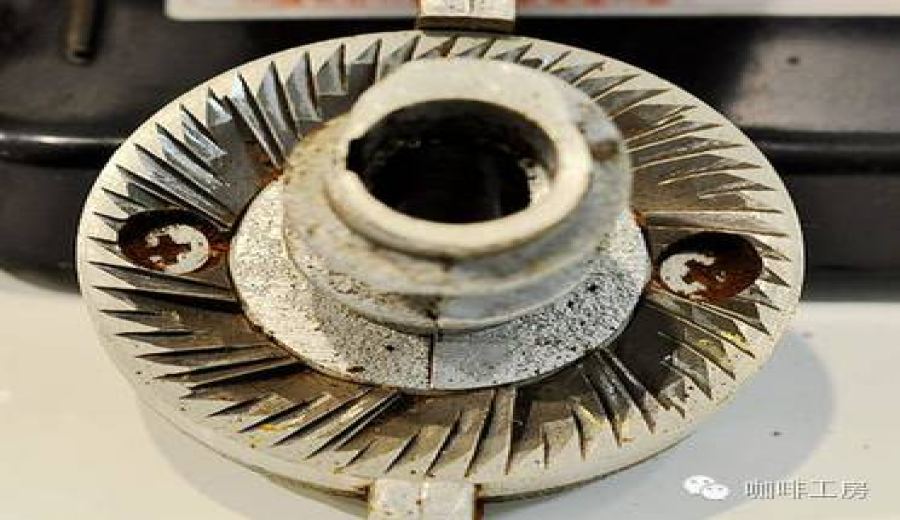
Flat BurrComposed of two parallel burr plates, during operation, the lower burr rotates and throws the coffee beans outward to the periphery, then cuts them within the blade zone. This type of burr produces coffee particles that are mostly flaky. Its advantage is the ability to quickly enhance extraction yield and aroma release, but due to the shearing effect, it tends to produce more fine particles. If the extraction time is too long, it can easily bring out woody off-flavors and astringency. Suitable for situations where you want an explosive aroma but need to control extraction time carefully.
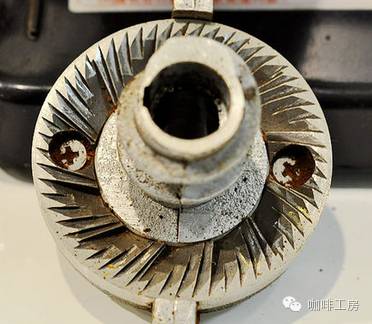
Conical BurrUses a conical burr paired with an outer ring structure. Coffee beans are naturally ground downward under the influence of gravity and rotational pull, reducing collisions and compression between beans. As a result, the proportion of fine particles is significantly lower than with flat burrs, and the particles are mostly blocky. This structure gives the coffee particles a longer water absorption path, with a more gradual initial release of compounds, making it suitable for longer extraction times while still maintaining a refreshing mouthfeel and avoiding over-extraction off-flavors. Conical burr models generally offer higher grind uniformity and are a popular choice among many professionals and advanced users.
Ghost-Tooth BurrHas received considerable attention in recent years. It can produce coffee particles that are closer to round in shape, with a more uniform distribution of coarseness. The fit between particles is tighter, and water flows through more slowly, resulting in more thorough and balanced overall extraction. Coffee made with ghost-tooth machines is usually clean in flavor, with a three-dimensional profile and fewer fine particles. However, due to the more complex manufacturing process, the price is usually higher, making it an ideal choice for high-end enthusiasts.
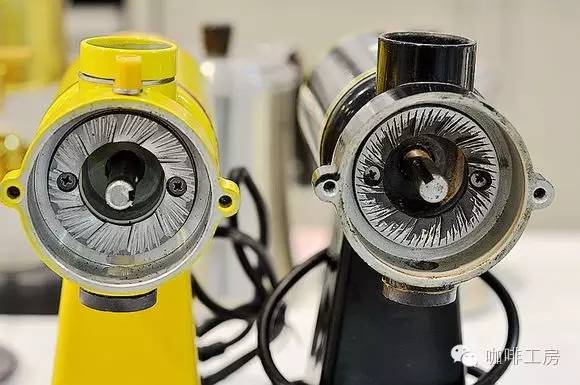
If all three burr types are set to the same grind setting—such as the commonly used “4”—the perceived coarseness of the particles may appear similar to the naked eye, but when it comes to their shape, distribution, and actual extraction performance, there will be significant differences.The Zhenghuangxing Flat Burrandthe Baratza Encore (referred to here as “小飞鹰圆刀”)are common examples, each showcasing different grinding characteristics and extraction potentials.
From the microscopic structure of the particles, the flaky particles produced by flat burrs have relatively smooth but flatter surfaces, creating greater resistance when in contact with water; the blocky particles from conical burrs have more protruding structures, which can easily lead to uneven water channels; while the rounded particles from ghost-tooth burrs are tightly packed, allowing for more stable and uniform water flow, which helps improve overall extraction yield and flavor balance. These subtle differences are ultimately reflected in the taste and aroma of the coffee.
In actual tasting, using the same beans, dose, water temperature, and grind setting, flat burrs often present a bolder but more one-dimensional flavor profile; conical burrs showcase a rounder, more layered mouthfeel; and ghost-tooth burrs deliver a cleaner, more three-dimensional, and fuller flavor experience, suitable for coffee lovers who pursue delicate expression.
Overall, burrs are not necessarily better just because they are more uniform or have fewer fine particles. Overly uniform particles can lead to monotonous flavors and over-extraction, while overly inconsistent particles can cause off-flavors and uneven extraction. The real key lies in choosing the burr type and grind settings that best bring out the potential of the beans, based on your personal brewing method and taste preferences.
Common home or entry-level models such as the Hario Mini Mill (Fuji Royal R-220), Baratza Encore (小飞鹰), and Zhenghuangxing M520A each have their recommended grind range:Hario Mini Mill setting #4.5is suitable for lighter flavors or reducing the burnt bitterness of dark roasts;#3.5~#4is suitable for most light to medium-dark roasts;#3is suitable for bold flavors, but dark roasts should be used with caution.Baratza Encore setting #4is also suitable for milder flavors,#3~#3.5works for most roast levels,#2.5but bold flavors are suitable here, though dark roasts are advised to be avoided.Zhenghuangxing M520Ahas similar recommendations, and adjustments can be made using the same logic.
In addition, different brewing methods also have specific grind requirements: siphon pots generally recommend around setting 3; pour over typically uses 3.5–4.5 (adjust according to dose and technique); French press recommends 4.5–5; moka pots often use a coarser grind around setting 2. It’s important to note thatthe smaller the grinder setting number, the finer the particles, and the higher the coffee concentration. For example, with the Baratza Encore, pour over usually falls within#3.5~#3as a safe range. Using #2.5 can enhance intensity, but it demands higher technical skill and parameter control, so it’s recommended to try only after becoming familiar with the process.
In summary, when choosing a grinder and grind settings, consider the bean roast level, brewing method, personal taste, and equipment characteristics. There is no absolutely perfect setup—only the combination that best suits the current context. Through continuous experimentation and adjustment, you will gradually discover the grinding solution that best highlights the flavors of your coffee.
The above content is compiled by CoffeeHunters, a coffee news website.


