







Introduction:Want to dive deeper into the sun-dried coffee from Ethiopia’s Sidamo Guji region? This article takes you through the background of the Lion King Coffee from Sidamo, the characteristics of its native variety, the sun-drying process, roast curve settings, all the way to practical V60 pour over parameters, thoroughly breaking down this uniquely flavorful coffee bean. Whether you're a coffee novice or an advanced enthusiast, you’ll gain key insights to enhance your tasting and brewing experience.
Sidamo is one of Ethiopia’s most representative specialty coffee regions in the south, known for its diverse flavor profiles. Among them, the Lion King, a sun-dried coffee bean, is a classic representation of the region’s floral, fruity aromas and bright acidity. This article will take you from the growing environment, varietal traits, processing techniques, green bean appearance, roast strategy, all the way to pour over parameters, helping you deeply understand this highly acclaimed coffee.
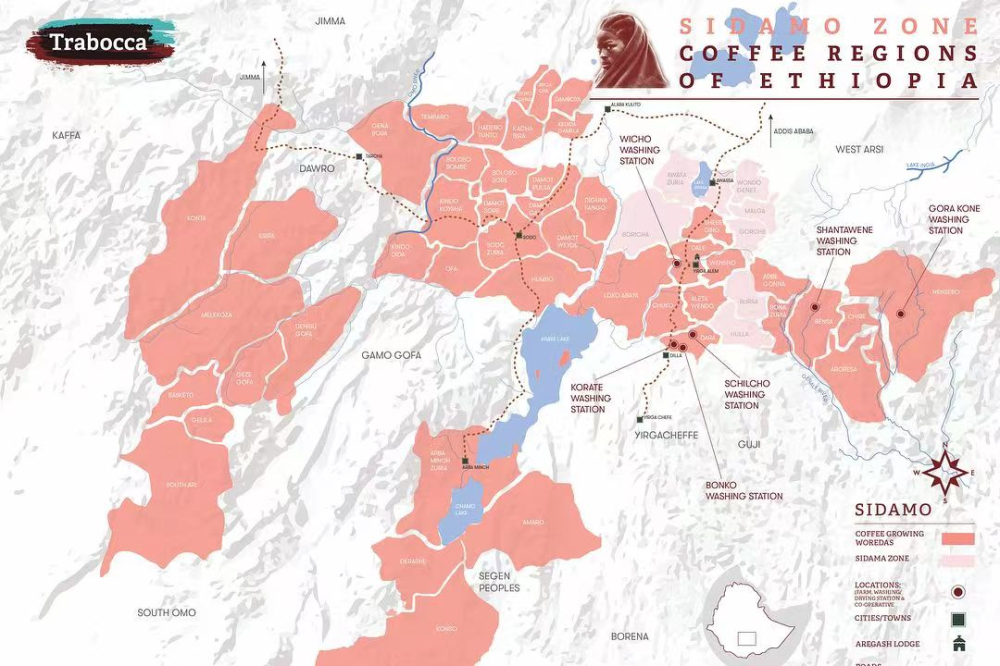
Sidamo is located at the southern edge of the Ethiopian Highlands, with terrain that includes high mountains, plateaus, valleys, and plains. The altitude ranges approximately between 1800 to 2000 meters. The climate and microclimatic conditions are complex, and the region benefits from nutrient-rich volcanic soil that is deep and well-draining—providing an ideal environment for coffee cultivation. The soils here are often dark brown or brown in color, with a surface layer rich in organic matter, thanks to natural cycles and fallen leaves and roots from surrounding plants, giving coffee from different areas unique personalities and flavors.
This batch of Lion King coffee comes from the Dara region in Sidamo Province and is produced by the local Xilsa Cooperative, which was established in 1976 and is part of Ethiopia’s second-largest SCFCU cooperative union. This coffee is made from local native varieties, harvested in 2017, and processed using the traditional sun-drying method. It showcases intense floral and fruity aromas along with a sweet profile, making it a must-try for coffee lovers who appreciate natural processing methods.
Speaking of the Guji region, it is a sub-region that has been independently designated in recent years, carved out from Sidamo. Located southeast of Yirgacheffe, its geography and terroir are similar to those of Sidamo, but it has gradually developed a more distinctive character. Many professional evaluation platforms such as CR gave Sidamo coffees scores between 92 and 94 between 2010 and 2012, indicating the very high quality of its green beans.
The sun-drying process is one of the most traditional methods of coffee processing, also known as natural coffee. Compared to the washed method, sun-drying better preserves the pulp aroma of the coffee cherry, giving the coffee a richer fruitiness and sweetness. The process includes: harvesting ripe coffee cherries, removing defective and unripe beans, separating ripe from unripe fruits through water floatation, then spreading the dense, ripe cherries on drying beds to dry for two to four weeks, reducing the moisture content from about 70% down to 10–12%. Finally, a hulling machine is used to remove the outer husk, completing the process.
This Sidamo Lion King uses one of the nearly 2000 recorded native varieties within Ethiopia. Due to the large number of varieties and their varied forms, they are generally referred to as “heirloom varieties.” These coffee trees are mostly tall, relatively weaker in disease resistance, and mostly produce medium-sized beans, though there are also some shorter trees with small beans. They possess unique genetic diversity, which is also one of the key reasons for Sidamo’s varied flavor profiles.
In terms of roasting, the green beans of this variety are relatively small in size, with a greenish-yellow hue, slightly uneven in uniformity, and lower in moisture content. A light to medium roast is recommended, which can balance bright acidity with rich fruit aromas, while also highlighting the layers of tropical fruit notes. During actual roasting, since the beans come from high altitudes and have a dense structure, special attention should be paid to heat control and stability during the drying phase. It is suggested to set the charge temperature around 200°C and adjust the heat as needed to avoid scorching the bean surface. The optimal drop time is usually just before or during the first crack, which helps preserve a clean flavor profile and delicate aromas.
Taking the Yangjia 600g semi-direct-fire roaster as an example, it is recommended to set the drum inlet temperature at 200°C, initial air damper at 3, and after 30 seconds, adjust the heat to 160, maintaining a steady rise. Around 1 minute and 35 seconds for first crack return, at 4 minutes and 50 seconds when the bean surface turns yellow, reduce the heat to 120 and increase the air damper to 4 to promote even drying. Overall, this Lion King sun-dried bean carries soft floral notes and clear fruit flavors, with a smooth mouthfeel and rich layers, making it a highly distinctive naturally processed coffee.
For brewing recommendations, the best way to showcase its flavor characteristics is undoubtedly pour over. It is recommended to use a V60 filter cone, with a grind size around the fine sugar range (approximately 80% passing through a #20 sieve), a dose of 15 grams, water temperature controlled at 91–92°C, and a coffee-to-water ratio of 1:15. Specifically, start with a 30-second bloom using 30 grams of hot water, followed by a pulse pour: the first pour to 125 grams then pause, then slowly circle-pour up to a total of 225 grams. The total extraction time is about 2 minutes and 3 seconds, which fully brings out the floral and fruity aromas along with a rich mouthfeel. It is perfect for coffee lovers who enjoy bright acidity and fruity profiles.
The above content is compiled by CoffeeHunters, a coffee news website.


