







Introduction:Recently, the salary and benefits offered by Luckin Coffee in Hong Kong for recruiting baristas have sparked heated discussion, especially regarding the stark differences in Mandatory Provident Fund (MPF) provision between full-time and part-time staff. Mainland employees, after comparing the two, lamented the significant disparity in treatment, but netizens in Hong Kong pointed out that MPF contributions are actually a legal obligation for employers. This article delves into the differences in labor benefits between Hong Kong and mainland China, helping readers understand the relevant regulations and common misconceptions.
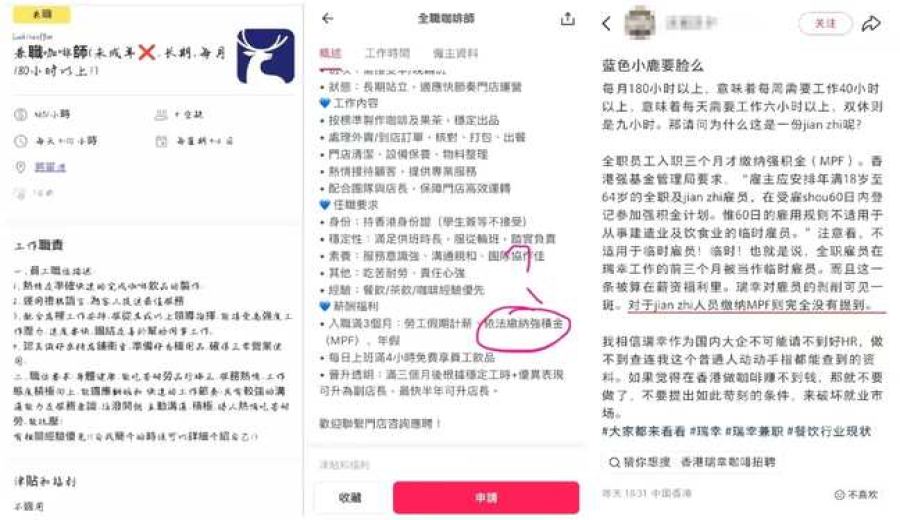
Recently, a social media post about Luckin Coffee recruiting baristas in Hong Kong sparked intense online discussion, with the focus on the differences in benefits between full-time and part-time roles, particularly the arrangements for MPF contributions. According to recruitment information shared by netizens, full-time baristas hired by Luckin in Hong Kong, upon completing three months of service, are entitled to benefits including paid labor holidays, legally mandated MPF contributions, and annual leave; however, the part-time job postings did not clearly specify whether MPF would be provided.
According to the regulations of the Hong Kong Mandatory Provident Fund Schemes Authority, as long as an employee is aged between 18 and 65, has a written or verbal employment contract with the employer, and has been employed for at least 60 days — regardless of being full-time or part-time, or the number of weekly working hours — the employer is required to enroll the employee in an MPF scheme and make contributions. In other words, as long as an employee has worked for 60 days, the employer is legally obligated to contribute to the MPF, rather than offering it selectively.
For this reason, many netizens were puzzled, even skeptical, as to why Luckin listed “legally mandated MPF contributions” as a benefit for full-time employees only after three months in their job ads. Some bluntly commented: “Shouldn’t this be a basic obligation? How did it become a benefit?” Especially when the part-time positions did not mention MPF, it further fueled discussions about the boundaries of employer responsibilities.
The post quickly resonated with Luckin employees on the mainland. Some mainland employees shared their own experiences, stating that most store staff at Luckin on the mainland are part-time, and typically need to work for at least six months and pass internal assessments to be promoted to assistant store manager before becoming full-time and eligible for the “five insurances and one fund.” Those who fail the assessment often remain part-time long-term. One employee admitted: “There are quite a few people who’ve worked a whole year and are still considered part-time.”
Therefore, when these mainland employees saw the welfare conditions for part-time staff at Luckin Hong Kong, most expressed surprise and envy. One commented: “In Hong Kong, they give you the five insurances and one fund after just three months, but at Luckin on the mainland, you have to become an assistant store manager before getting social insurance. The difference is huge.” Such comparisons have led many to re-examine the gap in labor benefits between the two places.
However, some netizens familiar with Hong Kong’s labor system stepped in to “educate,” pointing out that MPF and the mainland’s “five insurances and one fund” are fundamentally different in nature. MPF is a mandatory savings plan established in Hong Kong for employees’ retirement security, distinct from the mainland’s social insurance system, which covers multiple aspects such as medical care, pensions, and unemployment. More importantly, under current Hong Kong regulations,regardless of full-time or part-time status, as long as the employment relationship lasts at least 60 days, the employer must contribute to the MPF for the employee— and this includes employees in the food and beverage industry.
Many Hong Kong netizens left comments emphasizing that employers contributing to MPF is a legal responsibility, not an extra benefit. For example, one said: “Even working one day should entitle you to MPF, yet they dare say three months,” “I got MPF even as a student helper working just a few hours,” “Even working one day means you have to contribute.” These comments reflect a common belief in Hong Kong society thatit is a basic obligation for employers to provide MPF to employees according to the law, and it should not be mixed up with job benefits.
In the eyes of most Hong Kong netizens, if Luckin lists MPF contributions as a “benefit available only after three months of employment” in their recruitment info, it not only risks causing misunderstandings but may also lead to doubts about their understanding of local labor laws. They argue that employers should not package legal obligations as perks to attract talent — doing so not only blurs the lines of rights and responsibilities between employers and employees but may also mislead job seekers’ expectations.
What started as a discussion over a recruitment ad is, on the surface, a comparison of barista benefits in the two locations, but it actually reflects deeper differences in awareness of labor rights. For job seekers aiming to enter the coffee industry, whether in Hong Kong or on the mainland, it is essential to have a basic understanding of local labor laws and be clear about the scope of their own rights in order to better protect their own interests in the workplace.
The above content is compiled by CoffeeHunters, a coffee news website.


