








Introduction:Even many coffee beginners who follow recommended pour over parameters often encounter unstable flavor profiles. The key lies in the pouring technique!This article delves into four critical elements—water flow position, path, height, and speed—to teach you how to enhance extraction uniformity through stable pouring, resulting in a pour over coffee with rich layers and balanced flavors.
Many home learners who practice pour over on their own often report that, despite strictly following the parameters recommended by cafes, the brewing results are inconsistent—sometimes good, sometimes poor. Upon investigation, it turns out the issue almost always stems from the pouring process—Insufficient water flow stabilitydirectly affects how the coffee's flavors are presented.
Just like roast level and grind size,pouring technique is a key variable that impacts extraction. The distribution of where the water lands, the movement trajectory, the height at which it contacts the coffee bed, and the flow rate all alter the interaction efficiency between coffee grounds and water. According to SCA research data, the more stable the water flow, the higher the extraction uniformity. Next, we’ll break down the four core elements of pouring to help you master the secrets of stable brewing.
【Element 1: Pouring Position】Precisely Control the Contact Area of the Coffee Bed

Beginners are advised to first focus on where the water lands. Taking the V60 conical filter as an example, its inverted cone structure results in a thicker coffee bed in the center and a thinner one around the edges. If hot water directly impacts the thick central area, it can easily create channeling (bypass water), leading to under-extraction in some parts of the coffee grounds. The ideal approach is to control the pouring range to abouttwo-thirds of the coffee bed area(as shown in figure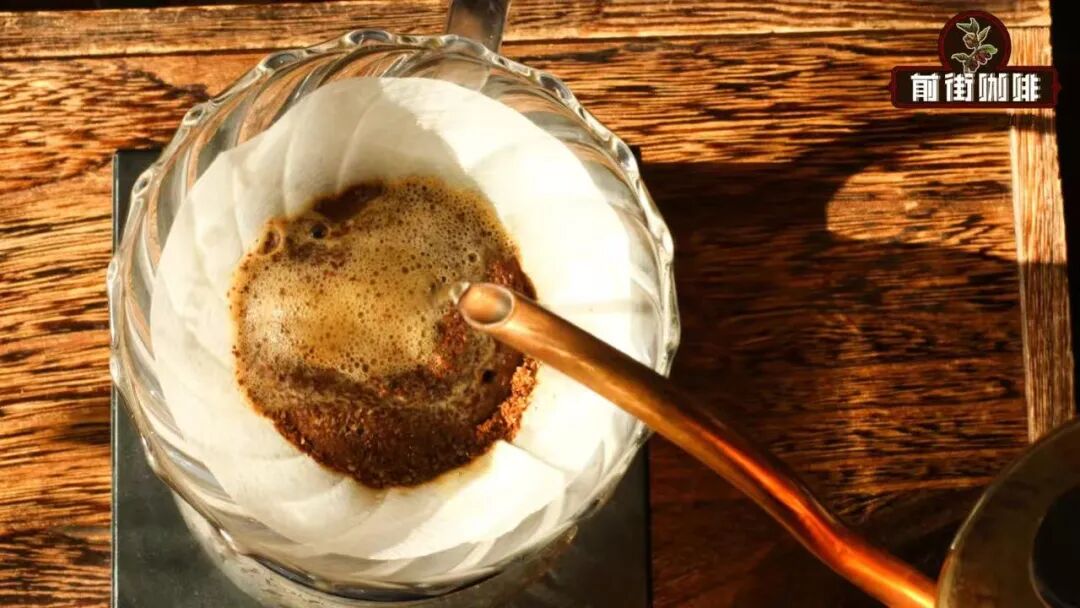 ), ensuring the water evenly penetrates the coffee layer. In practice, you can make slight adjustments based on the shape of your filter, but the principle is to avoid pouring in a single concentrated spot.
【Element 2: Pouring Path】Dynamic Stirring Enhances Extraction Efficiency

Pouring in a fixed single spot can cause local coffee grounds to saturate too early, while the outer areas receive insufficient contact. By usingcircular pouring(as shown in figure ), you can encourage the movement of the coffee bed, creating turbulence that promotes the dissolution of soluble substances. The principle is similar to stirring a granule medicine like Isatis root: when still, it dissolves slowly, but stirring accelerates diffusion. However, circular pouring isn’t the only option—stationary, deeper pouring is suitable for certain bean varieties. The two methods should be flexibly applied based on the beans’ characteristics (refer to figure
 ).
【Element 3: Pouring Height】Balancing Impact Force and Negative Effects

The height of the pour directly influences the intensity of the water’s impact:The higher the pour, the stronger the impact, which can lift more fine particles and increase extraction yield; but pouring too high can lead to three major issues—fine particles settling and clogging the filter paper (figure ), greater loss of water temperature (approximately 1–2°C drop for every 10cm increase), and the water stream breaking into droplets, reducing efficiency. Beginners are advised to maintain a distance of abouta fist’s length(around 15–20cm), which maintains sufficient turbulence while avoiding side effects (as shown in figure
 ).
【Element 4: Water Flow Rate】Regulating Extraction Time and Coffee Bed Structure

Flow speed determines how quickly water flows through:Faster pouring shortens extraction time, making it suitable for light roasts; slower pouring extends contact time, aiding in the release of deep roast flavors. A larger water flow will raise the height of the coffee bed (as shown in figure ), potentially altering the coffee-to-water ratio; a smaller flow allows for more precise control over the extraction rhythm. Special attention should be paid to inconsistent flow speeds, as fluctuating rates can disrupt extraction uniformity.
In summary, the core of stable pour over lies inmaintaining the continuity of the four pouring elements. Avoid frequent adjustments to position, height, or speed, so that the coffee grounds uniformly interact with the water. If you’re unsure about the starting parameters, you can refer to the three-pour method (detailed steps in extended reading). Remember, great pour over isn’t about piling up complex techniques, but about precise control over the details of the water flow.


The above content is compiled by CoffeeHunters, a coffee news website.


