







Introduction:Once a sensation in China’s beverage scene with its innovative tea drinks, Lele Tea is now facing the challenge of market contraction. Following the announcement that its last store in Zhengzhou will close in early 2026, the brand has continued to scale back its presence across multiple cities — a sharp contrast to its earlier ambition of expanding to 1,000 stores. This article reviews the current status of Lele Tea’s store adjustments in regions such as Central and North China, analyzes the market factors behind its strategic shift, and explores key elements for the sustainable operation of tea beverage brands.
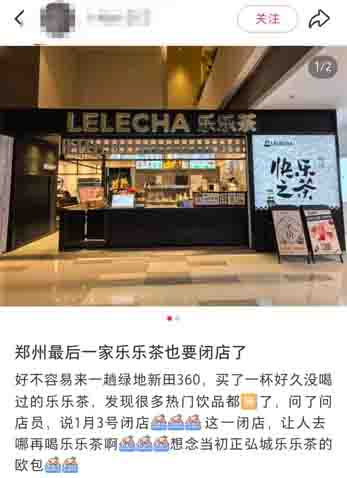
Lele Tea, known for its wildly popular “Apple Candy” series, has recently made headlines again — but this time not for product innovation, rather for a noticeable retreat in its market footprint. According to consumer feedback, the Lele Tea outlet located at Zhengzhou Greenland Xintian 360 Plaza will officially cease operations on January 3, 2026. This location is the brand’s last in the city, and its closure is expected to mark Lele Tea’s complete exit from Zhengzhou.
Looking back to the end of 2022, Lele Tea made its debut in Henan Province with its first store in Zhengzhou Zhenghong City. Thanks to its innovative flavors and strong brand appeal, it quickly garnered significant attention, subsequently expanding to nearby cities such as Nanyang and Xinxiang. However, in just three short years, the brand has gone from rapid expansion to successive withdrawals — not only have the flagship Zhenghong City store and the Yonghe Time Gallery branch in Zhengzhou already closed, but according to information on the brand’s mini program, currently only the aforementioned Greenland Xintian 360 Plaza store remains open in Zhengzhou.
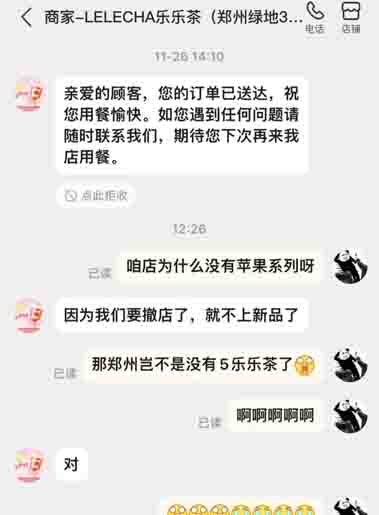
Many local consumers have expressed surprise and disappointment, with online comments such as “I’ll never be able to drink Vienna again” and “I ordered two cups just the other day, and today I see the closure news” flooding social media — reflecting both the brand’s influence in the local market and the loyalty of its customer base. It is worth noting that since the upcoming closure was announced, the store has stopped participating in new product promotions, and some popular drinks have also been removed from the menu. Only by speaking with the staff were customers able to learn the specific closure timeline.
In fact, Lele Tea’s market adjustments are not limited to Zhengzhou. Based on feedback from social media platforms and data from the brand’s outlets, Lele Tea stores in several other cities — including Zhangzhou, Handan, and Weihai — have quietly ceased operations within this year. In addition, operating locations in cities such as Fuzhou, Quanzhou, and Qingdao are down to just one struggling outlet each, signaling a significant contraction in the brand’s nationwide footprint.
Looking back at the brand’s expansion journey, in 2022 Lele Tea received an investment of over 500 million yuan from Nayuki, which promptly accelerated its nationwide store opening efforts and opened up franchising opportunities, leading to a rapid rise in the number of outlets. By 2024, the company had revealed that its total number of stores was close to 500, and it set a clear goal of “breaking through 1,000 stores by the end of 2024,” planning to add 600 to 800 new stores to accelerate market penetration.
However, according to data from the narrow-door restaurant insights platform, the actual number of Lele Tea stores currently in operation is 392. Although there may be technical discrepancies between this figure and the official numbers, it is still evident that the brand is far from reaching its 1,000-store milestone. This gap not only casts a shadow over the brand’s future development, but also raises concerns among consumers about whether “the last Lele Tea store near them might disappear before they know it.”
Industry observers note that tea beverage brands often face pressures such as market saturation, localization challenges, and rising operational costs during expansion. Lele Tea’s current round of store adjustments may reflect a transitional phase in which the brand’s strategy is shifting from “pursuing volume” to “refined management.” For consumers, aside from keeping an eye on the brand’s movements, they can also take the opportunity to personally experience its signature products — such as the controversial yet revamped “Apple Candy” series or the classic and beloved “Vienna” — while the stores are still open, seizing the last chance to enjoy these offerings.
The above content is compiled by CoffeeHunters, a coffee news website.


