







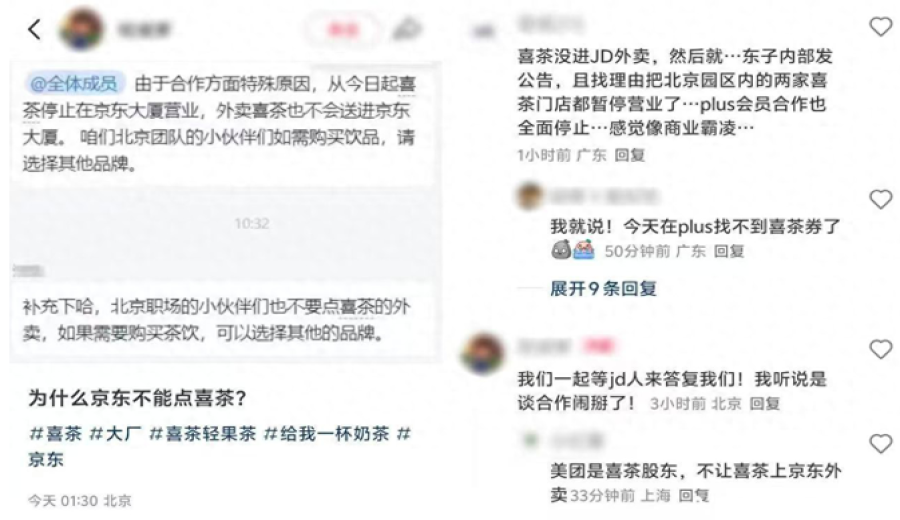
Introduction:Recently, the news that HEYTEA temporarily closed its two stores at JD.com’s Beijing headquarters sparked widespread market discussion, with rumors suggesting a possible link to JD.com’s restrictions on internal partnerships and power struggles with food delivery platforms. Was it a temporary maintenance issue or the result of commercial maneuvering? This article delves into the collaboration strategies between tea beverage brands and food delivery platforms behind the incident, helping readers understand the delicate positioning and challenges of modern tea beverages within the food delivery ecosystem.
Recently, the sudden suspension of operations at HEYTEA’s two stores located at JD.com’s Beijing headquarters has been widely circulated on social media. Internal notices suggest that JD.com may have restricted HEYTEA products from entering office areas and even prohibited partnerships with the brand. This move quickly triggered public speculation about the relationship between the two parties, with many linking it to the fact that HEYTEA has not yet joined the JD.com food delivery platform. Some also recalled HEYTEA’s past stance of resisting food delivery services.
Subsequently, an insider from JD.com clarified that the rumors were untrue and that the store closures were mainly due to temporary water and electricity maintenance, not due to any commercial dispute with JD.com. The two stores have now resumed normal operations. Although the official explanation cited technical reasons, the incident still reflects the strategic choices and potential power struggles tea beverage brands face when dealing with major food delivery platforms.
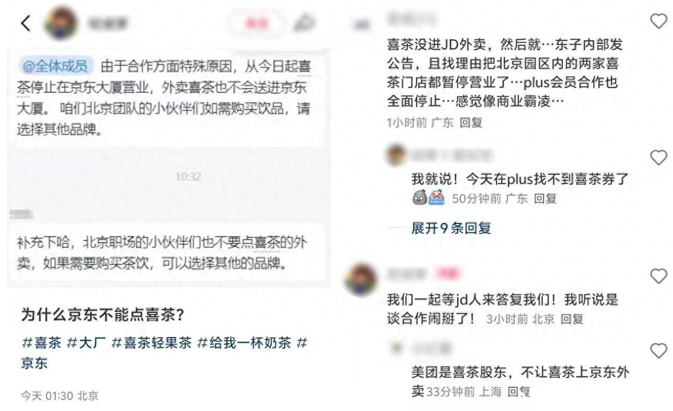
The incident originated from a post circulating on social media titled “Why Can’t You Order HEYTEA on JD.com?”, which garnered considerable attention from netizens. The post mentioned that due to special considerations by the partner, HEYTEA had stopped providing services in the JD.com building from a certain date, and delivery orders could no longer be sent to that area. In addition, internal chat records advised Beijing office workers to avoid purchasing HEYTEA through food delivery platforms and to opt for other tea beverage brands instead.
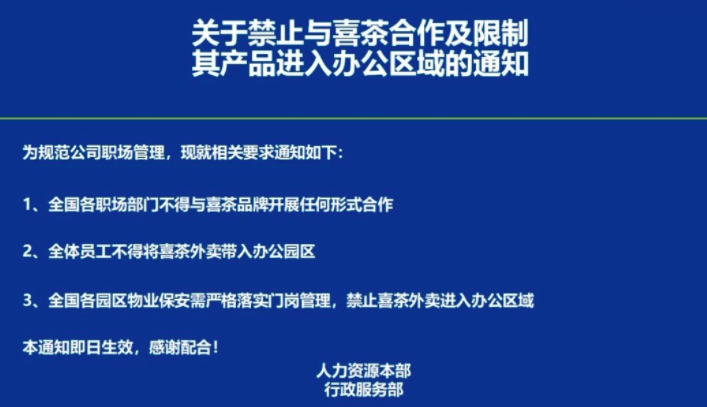
What’s more, an official document with a blue background and white text leaked, titled “On Prohibiting Cooperation with HEYTEA and Restricting Its Products from Entering Office Areas.” The document stated that all workplace departments nationwide must not establish partnerships with HEYTEA and that all campuses are prohibited from allowing HEYTEA deliveries into office areas. This document further fueled public speculation about deteriorating relations between the two parties.
According to multiple JD.com employees, the official mini-program shows that the two HEYTEA stores located in Buildings 1 and 2 of the JD.com headquarters are in a “temporarily closed” status. On-site photos show that the stores indeed had their lights turned off and doors closed, with no staff on duty at the time, and equipment still left inside, giving the appearance of a temporary withdrawal. Meanwhile, some JD.com Plus members found that their HEYTEA coupons stored in their accounts could no longer be used, adding to the mystery of the incident.
Notably, these two HEYTEA stores opened in 2020 and were reportedly among the top-performing stores nationwide in terms of sales. Therefore, this sudden closure came as a surprise to many and led to speculation about whether friction had emerged between HEYTEA and JD.com.
As the incident unfolded, netizens speculated that the strained relationship might be related to HEYTEA’s continued absence from the JD.com food delivery platform. Recently, JD.com has been actively expanding its food delivery business, having successively partnered with well-known brands such as Mixue Ice Cream & Tea, Luckin Coffee, and Cotti Coffee. It has also attracted consumers through discounts and free delivery fees in an attempt to carve out a place in the food delivery market.
However, as one of the leading brands in the tea beverage market, HEYTEA has consistently chosen not to join the JD.com food delivery platform. Observers have pointed out that in 2018, Meituan invested 400 million yuan in HEYTEA, becoming its second-largest shareholder. As a result, some speculate that this may be a potential reason for the tense relationship between JD.com and HEYTEA, perhaps indicating that JD.com is intentionally avoiding overly close collaboration with Meituan-affiliated brands.
Nevertheless, industry insiders have also recalled that HEYTEA has historically maintained a rather conservative attitude toward food delivery platforms, publicly stating that delivery is only a supplement to dine-in services. In 2022, the brand even took the lead in resisting food delivery services. Although the brand’s acceptance of delivery has increased somewhat since then, it remains cautious and does not easily participate in promotional activities on third-party platforms. As a result, some believe that this incident is more likely due to HEYTEA not being ready to collaborate with JD.com, rather than solely because of its relationship with Meituan.
As online discussions heated up, this so-called “commercial power struggle” incident drew increasing attention. Until yesterday, an insider from JD.com responded to the media, stating that the rumors were false, that all operations were normal, and that consumers were welcome to enjoy HEYTEA within the JD.com campus. If this statement is true, then the real reason for the temporary closure of the stores may, as initially explained, simply be temporary technical or facility maintenance.
Overall, regardless of the underlying reasons, this incident highlights the strategic choices tea beverage brands make when facing different food delivery platforms, as well as the fierce competition among platforms to secure brand resources. For consumers, understanding the commercial dynamics behind these events can also provide better insight into the logic and limitations behind each platform’s services and promotions.
The above content is compiled by CoffeeHunters, a coffee news website.


