







Introduction:Recently, Colombia’s domestic coffee purchase price hit a monthly high, with the average price in November rising 13% month-on-month, drawing market attention. Both production and export volumes have rebounded, but challenges such as the Red Sea shipping crisis and rising fertilizer costs have placed multiple pressures on both the export and cultivation sectors. This article provides an in-depth analysis of price trends, regional conditions, and future challenges to help readers grasp key changes in the global coffee supply chain.
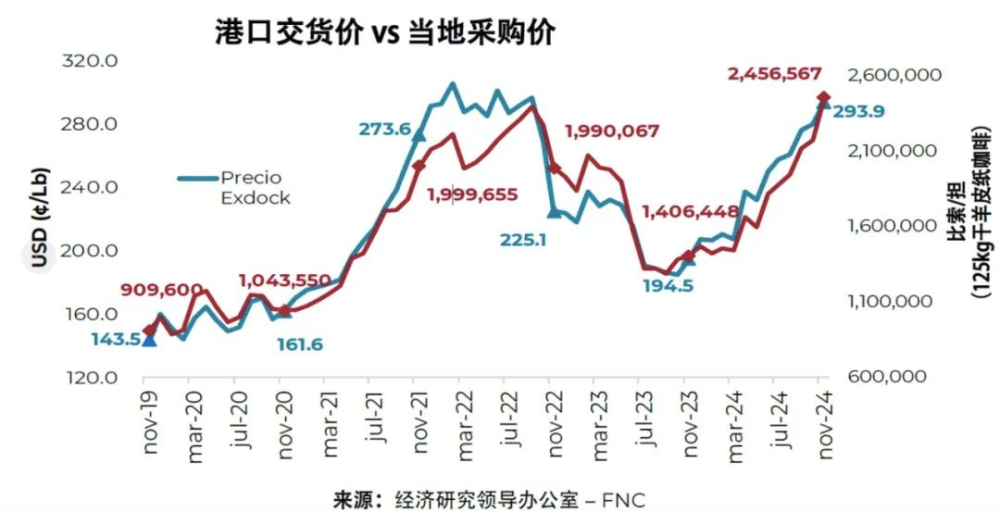
Major news has emerged from Colombia’s coffee-growing regions: driven by international market momentum, the country’s average domestic coffee purchase price rose 13% month-on-month in November to 2,456,567 Colombian pesos per carga (125 kilograms of parchment coffee), equivalent to approximately $557 USD. This set a historical high for the month and also refreshed the recent monthly closing price record.
At the same time, port-delivered prices also increased by 5% compared to the previous month. Year-over-year, from November 2023 to November 2024, Colombia’s domestic coffee purchase prices have risen cumulatively by 74.7%, while port-delivered prices have climbed 51.2%, indicating strong market demand coexisting with supply-side pressures.
Along with the price increase, there are clear signs of a recovery in Colombia’s coffee production. Over the past few years, the country’s coffee industry has been battered by the alternating impacts of El Niño and La Niña phenomena, leading to abnormal weather and prolonged low yields. However, this year, weather conditions have gradually stabilized, and with an expansion in planted area, coffee production has rebounded markedly, and exports have also increased accordingly.
Official data shows that in November 2024, Colombia produced 1.76 million bags of coffee (60 kilograms per bag), a significant 37% increase compared to the same period last year, marking the highest output for the month in nearly 29 years. The boost in production is also directly reflected in export performance: October exports reached 1.039 million bags (60 kilograms per bag), up 14.4% year-on-year.
However, alongside export growth, Colombian port transportation is facing numerous challenges. Due to shipping route diversions caused by the Red Sea crisis and geopolitical instability, several major routes have had to be rerouted, leading to extended vessel waiting times. Some ports are experiencing severe congestion and even facing container shortages.
These issues have resulted in large numbers of coffee containers being stranded at docks. Exporters not only face the risk of delays but also have to pay additional storage, demurrage, and pre-stacking fees, leading to higher overall export costs and reduced operational efficiency. In addition, the industry is concerned that after the inauguration of the new U.S. president, stricter trade policies may be introduced, potentially further increasing tariff costs for exports to the U.S.
Another noteworthy factor is the continuous rise in fertilizer costs. As a major agricultural nation, Colombia has long relied on fertilizer imports, especially with the expanding cultivation areas for coffee, corn, and bananas, which has increased fertilizer demand in tandem. However, impacted by international geopolitics and a strong U.S. dollar, the depreciation of the Colombian peso has led to continuously rising costs for imported fertilizers. Even though the government and agricultural groups are actively seeking alternative solutions, it remains difficult to fully resolve the supply shortage in the short term, further burdening coffee farmers’ production costs and acting as a hidden driver behind rising coffee prices.
Looking at the global market, the two major coffee-producing regions—Brazil and Vietnam—have both experienced severe weather this year, resulting in sharp declines in production and causing a contraction in global market supply. Although Colombia’s production has recovered this year, the increase is still insufficient to completely fill this supply gap. Therefore, the international market generally expects coffee prices to remain at a high level for the foreseeable future.
The above content is compiled by CoffeeHunters, a coffee news website.


