








Introduction:Starbucks continues to expand in China’s county-level markets, now covering over 1,000 county-level regions. Some of its stores even outperform those in first-tier cities. Recently, a Starbucks located by Dongqian Lake in Ningbo, with an exterior resembling an old village house, has sparked widespread discussion. Blending traditional architectural elements with a modern interior design, it has become a prime example of integrating rural cultural tourism with brand presence. This article takes you in-depth into the design philosophy, location strategy, and market response of this distinctive outlet.
In recent years, Starbucks has been aggressively expanding into county-level towns in the Chinese market. Its stores now span over 1,000 county-level administrative regions. Many outlets in non-first-tier areas have operational performances that even surpass some urban locations. As the brand gradually penetrates local business districts and even residents’ daily lives, a Starbucks outlet on Taolv Street in Dongqian Lake, Ningbo—whose appearance resembles an old village house—has recently caught the public’s attention.
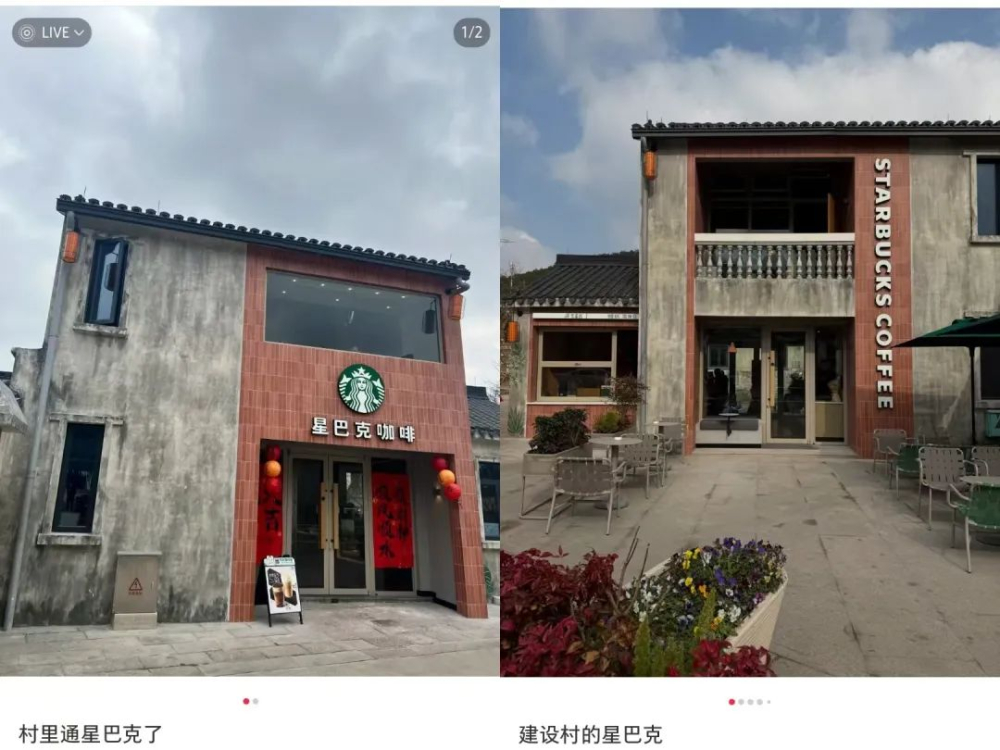
From photos shared by netizens, it can be seen that this Starbucks is located in Jianshe Village on Taogong Island in Dongqian Lake, Ningbo. The store is a two-story building, with a courtyard on the first floor and a balcony on the second. Next to it is a separate small building offering “Fika” (quick pick-up) service. The overall exterior retains many original features of a typical small-town building—half cement walls paired with half red bricks, and the roof tiles remain unchanged, presenting the simple and rustic look of a traditional Ningbo village house.

As the Lunar New Year approaches, the shop owner has hung red lanterns and pasted couplets on the storefront. Combined with the moss-covered tiles on the roof, the overall look blends seamlessly with the surrounding residential houses. Even unedited photos taken with a regular phone exude a strong rural atmosphere, sparking enthusiastic discussion and creative comments from netizens.
Many netizens showed their sense of humor with comments such as “Auntie, drinking latte in the fields again at noon,” “Grabbing a latte on the way home after transplanting rice seedlings,” or “After a day’s hard farm work, I bought a matcha frappuccino from the east end of the village.” These made this Starbucks instantly become a representative of the so-called “village café” trend online, with a vivid and approachable image.
Many netizens from other regions also expressed amazement at the development level of the area, commenting things like “No wonder it’s in the free-shipping zone,” “Zhejiang’s villages are really wealthy,” or “Your countryside, my countryside—it’s not the same,” reflecting the current state of integrated rural economic and cultural tourism development in the Jiangsu-Zhejiang region. It’s worth mentioning that currently, there is only one known example referred to as the “Village Bucks.”
However, despite its nostalgic exterior, the interior of this Starbucks is completely modern. The counter, seating area, and overall layout all follow the brand’s standard design. From materials to spatial planning, everything is the same as in urban outlets. In other words, while the building’s exterior adopts a rural vernacular style, the actual customer experience remains consistent with that of a typical Starbucks.
It is understood that although this Starbucks in Ningbo’s Dongqian Lake Taolv Street area is dubbed a “village store,” its actual location is within the core area of the Dongqian Lake Tourist Resort. The concept highlights a cultural tourism experience where village and marketplace coexist, aiming to restore the traditional ambiance of the historical Taogongshan marketplace. Therefore, its main clientele still consists primarily of tourists, and it is not yet easily categorized as a typical “village café” serving local villagers.
Starbucks’ choice of location and design for this outlet is not only an innovative attempt in brand visual identity but also reflects its deep understanding of local culture and the trends in tourism consumption. By integrating a modern café into the vocabulary of vernacular rural architecture, it has successfully created a store image with strong local recognition, without deviating from the brand’s consistent quality and service standards.
In summary, this Starbucks village-style outlet in Dongqian Lake, Ningbo, is not only a successful implementation of the brand’s downward expansion strategy but also provides a reference direction for cultural tourism commercial projects in other regions. How to preserve local characteristics while delivering a consistent and high-quality consumer experience will be an important challenge for future brand expansion.
The above content is compiled by CoffeeHunters, a coffee news website.


