







Introduction:During the Spring Festival, Luckin Coffee implemented an intense shift system in some of its stores, requiring outlets with inventory levels below 200 to be staffed by a single employee managing all operations from morning until night. This arrangement puts frontline staff under triple pressure—production efficiency, personal needs, and sudden order surges. This article delves into the practical details of this scheduling model, employee feedback, and practical suggestions on how to maintain service quality under extreme working conditions.
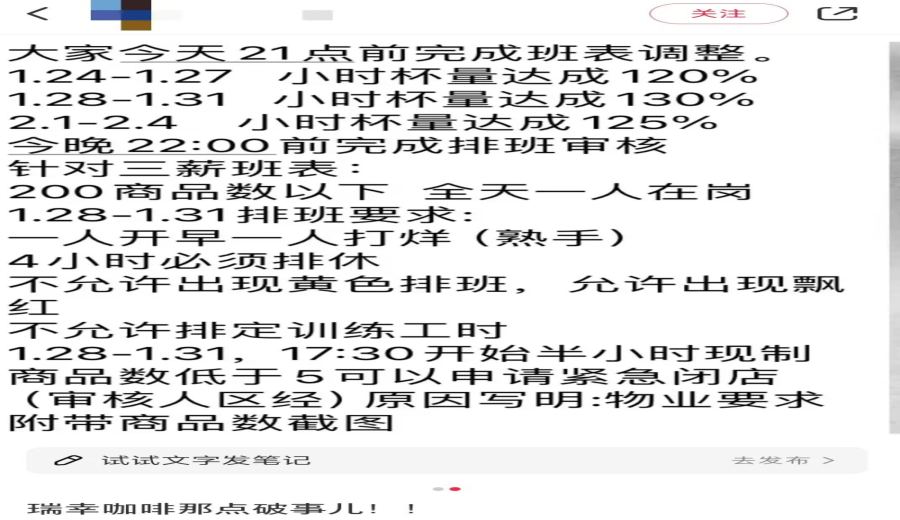
The Spring Festival, which should be a time for family reunions, has become an unprecedented challenge for some front-line Luckin Coffee employees this year. It is reported that the Guangzhou branch of Luckin Coffee recently issued an internal notice adjusting Spring Festival schedules, stipulating that stores with product inventory below 200 must be staffed by a single employee throughout the holiday period, covering everything from opening to closing.
This means that the on-duty staff not only have to handle basic tasks such as coffee preparation, takeaway packaging, and store cleaning alone, but also respond promptly to potential order surges while maintaining both serving efficiency and customer service quality. Many employees admitted that this scheduling method subjects them to the triple squeeze of personal needs, unexpected situations, and performance pressures.
According to the notice,during the Spring Festival holiday from January 28 to January 31,if a store’s product inventory is below 200, a “one-person opening, one-person closing” system will be enforced, with both roles required to be filled by experienced staff. The mid-period will be covered by the same person on duty all day, with the regulation thatat least four hours of rest must be scheduled every four hours.In addition, if an emergency situation such as the need to close the store temporarily arises—for example, if an employee has to briefly step away to attend to personal needs—they must apply to the regional manager in advance and provide a screenshot of the current product count as supporting evidence.
As soon as this scheduling strategy was announced, it sparked heated discussion among frontline staff. Many said that although three times the regular salary is offered for Spring Festival shifts, the actual work pressure far exceeded expectations. Especially when one person has to single-handedly keep the entire store running, balancing speed of service with cleanliness and customer care, it’s easy to get overwhelmed when orders suddenly spike.
Those familiar with Luckin’s operational model know that “instant service rate” has always been a key internal performance metric, with strict management requirements for the preparation and packaging time of each beverage. However, when all these indicators fall on a single individual, the pressure naturally multiplies. Not only do they have to precisely control the brewing time for each cup of coffee, but they also face potential equipment malfunctions, customer complaints, and the need to respond to delivery orders in real time—all of which are major tests both mentally and physically.
What adds to employees’ frustration is that while they might have previously found ways to be flexible about attending to personal needs during their shifts, under the current rules, even needing to close the store briefly to handle such matters requires prior reporting to the regional manager and providing a real-time screenshot of the product inventory. One employee joked, “Even going to the toilet requires an application—that’s stricter than the King of Hell.”
In fact, many Luckin frontline workers have accumulated various “tricks” to cope with high-intensity work in the past, such as using the system to forcibly close the store and putting up signs when the counter is unattended, to inform customers that online ordering is temporarily unavailable and avoid complaints. However, according to the latest management notice, such “emergency measures” are no longer allowed and must go through formal application procedures, further increasing employees’ psychological burden.
In summary, while the “one-person full-day shift” model during this Spring Festival ensured operational continuity and provided triple-pay incentives, it also placed frontline staff under unprecedented work intensity and mental stress. Finding a balance between efficient operations and humane management will be a key area for the brand to continuously improve in the future.
The above content is compiled by CoffeeHunters, a coffee news website.


