







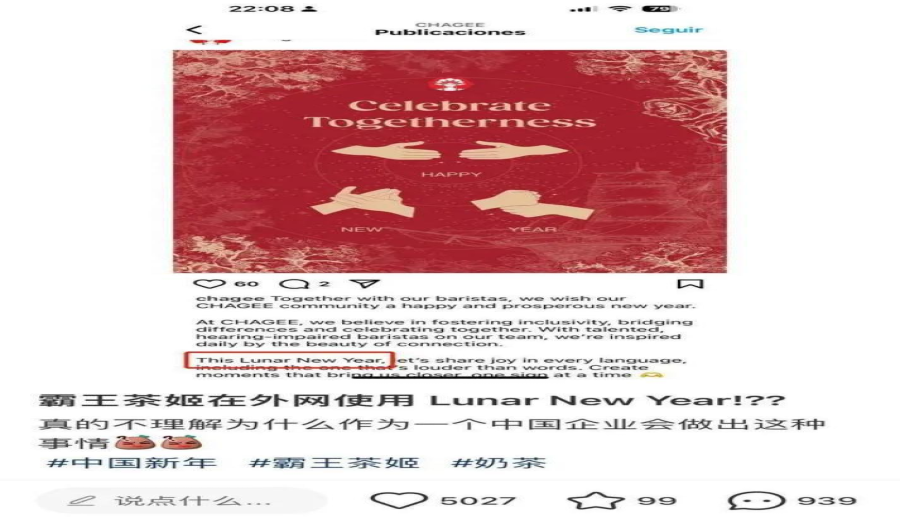
Introduction:After the successful inscription of the Spring Festival on the UNESCO Intangible Cultural Heritage list, the well-known tea chain brand Heytea sparked controversy when overseas social media platforms translated the Spring Festival as "Lunar New Year." Netizens questioned the brand’s failure to accurately convey the cultural significance of this traditional Chinese holiday, arguing that it was inconsistent with the brand’s philosophy of "uniting the world through Eastern tea." The brand only issued an apology in the comments section, which was criticized as lacking sincerity. This article analyzes the origins of the controversy over the English translation of the "Spring Festival" and explores linguistic sensitivity in cross-cultural communication.
On the first New Year following the successful inscription of the Spring Festival on the UNESCO Representative List of the Intangible Cultural Heritage of Humanity, the renowned tea chain brand Heytea found itself embroiled in controversy due to a post on an overseas social media platform. Netizens noticed that the brand’s content on its international accounts referred to the "Spring Festival" as "Lunar New Year," rather than the more commonly used "Chinese New Year" or "Spring Festival." This wording quickly sparked heated discussion online, with many netizens believing it failed to accurately reflect the cultural essence of China’s Spring Festival.
In fact, there have long been multiple ways to translate the "Spring Festival" into English. For most Chinese speakers, "Chinese New Year" and "Spring Festival" are the most straightforward expressions, while "Lunar New Year" is often used to refer to the lunar new year celebrations across East Asia due to its broader scope. However, with the Spring Festival now inscribed on the UNESCO list, the English terminology for this traditional festival has come under public scrutiny.
Experts point out that the term "Lunar New Year" uses the word "Lunar," which literally means "of the moon," and strictly speaking, refers to the "lunar calendar new year." However, the traditional Chinese calendar is actually a lunisolar calendar, taking into account both lunar phases and solar positions. Therefore, from a calendrical perspective, "Lunar New Year" does not fully or accurately describe the uniqueness of China’s Spring Festival. Moreover, in international contexts, "Lunar New Year" often broadly refers to the New Year celebrations of several East Asian countries, including Korea’s "Seollal," Vietnam’s "Tết," and Mongolia’s "Tsagaan Sar," further blurring the distinct cultural identity of China’s Spring Festival.
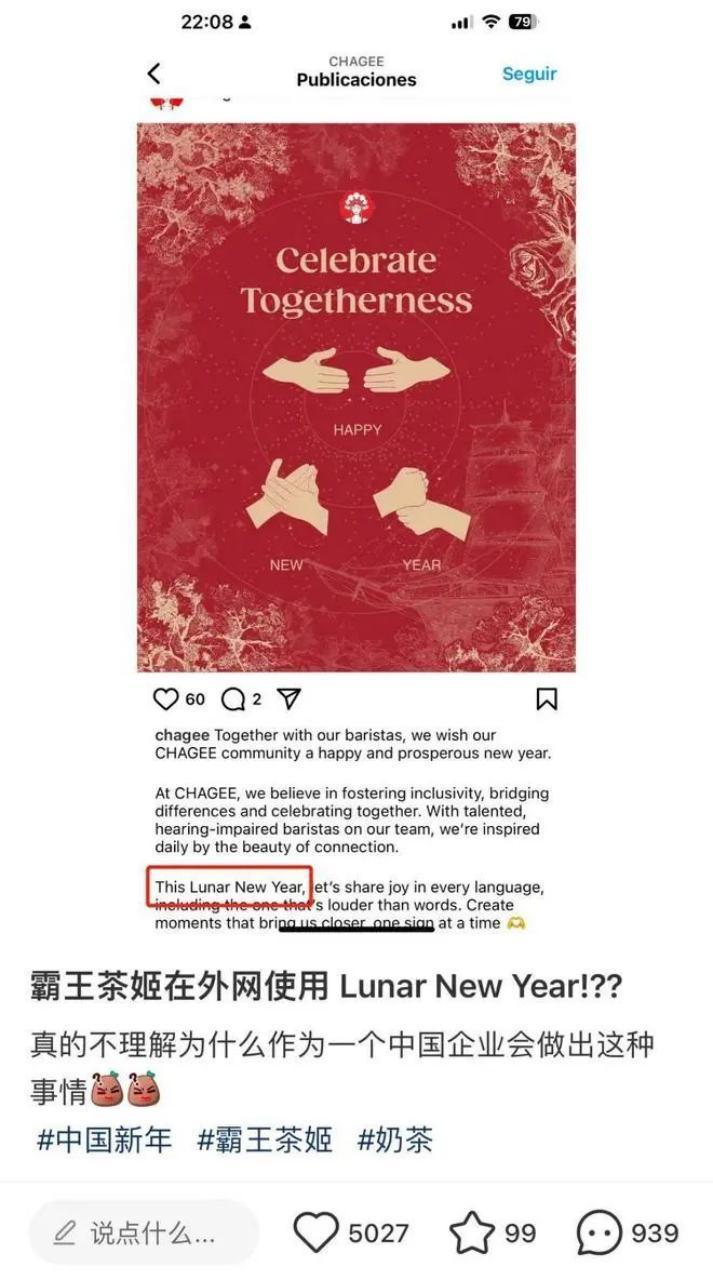
It is precisely because of these subtle yet important differences that many netizens expressed dissatisfaction with Heytea’s use of "Lunar New Year" to refer to the Spring Festival on overseas platforms. They argued that as a tea chain brand with the philosophy of "uniting the world through Eastern tea," Heytea should have handled the expression of this important cultural symbol with greater caution in the first New Year after the Spring Festival’s UNESCO inscription. Netizens left numerous comments on the brand’s official page, demanding a formal response and the correction of the relevant terminology.
Faced with public pressure, Heytea posted a brief apology in the comments section of the relevant post on the evening of January 24. The brand stated: "We apologize for not aligning our overseas local teams on a more consistent usage of the term for the 'Spring Festival.' We will strengthen the management and communication of our overseas accounts in the future to ensure the accuracy of our messaging." Although the brand subsequently revised the wording in its overseas posts, this apology, published only in the comments section, failed to appease the dissatisfaction of netizens.
Most netizens felt that Heytea’s response, limited to the comments section, lacked a formal and public apology, and thus seemed insincere. They hoped the brand would issue a formal apology on all domestic and international platforms to demonstrate respect for cultural differences. However, a minority view held that since the brand had promptly corrected its mistake and issued a public apology, netizens might be overreacting.
This incident highlights the importance of linguistic accuracy and cultural sensitivity in cross-cultural communication. For brands like Heytea that are committed to internationalization, greater care must be taken in selecting terminology when dealing with festivals or traditions with deep cultural roots, in order to avoid unnecessary misunderstandings and cultural conflicts.The English translation of the Spring Festival may seem like a minor issue, but it is directly related to cultural identity and communication effectiveness.How to maintain cultural authenticity while engaging in effective cross-cultural communication is a challenge that all brands entering the international market must face.
The above content is compiled by CoffeeHunters, a coffee news website.


