







Introduction:Vietnam’s coffee production for the 2024/25 season is forecasted to decline by 5%–7%, falling to 28 million bags. Even with a slight rebound, Robusta coffee futures have still surged to $4,907 per ton, and may even breach the $5,000 mark. This article delves into how adjustments in output, weather impacts, and geopolitical crises are driving up coffee prices, and explores the real-world effects of this market trend on coffee farmers, traders, and the global market.
At the Asia International Coffee Conference held in Ho Chi Minh City, the Vietnam Coffee - Cocoa Association (VICOFA) released its latest forecast for Vietnam’s coffee production in the 2024/25 season. The data shows that the country’s total coffee output for this season is expected to be around 28 million bags. Although this is 1 million bags more than previously estimated, it will still be 5% to 7% lower than the previous season. This change in production has a significant impact on the global Robusta market.
It is worth noting that although the official production estimate in Vietnam has been slightly revised upwards, the tight supply - demand situation in the market has not eased. At the end of December last year, due to multiple factors such as supply shortages in the two major producing regions of Brazil and Vietnam, the strengthening of the US dollar against the Brazilian real, and the continuous rise in international shipping costs, the futures prices of both Robusta and Arabica coffee once soared. However, by early December, as some local traders in Vietnam released part of their inventories and Brazilian exporters increased their export efforts due to the exchange - rate advantage, the market supply improved and prices subsequently declined.
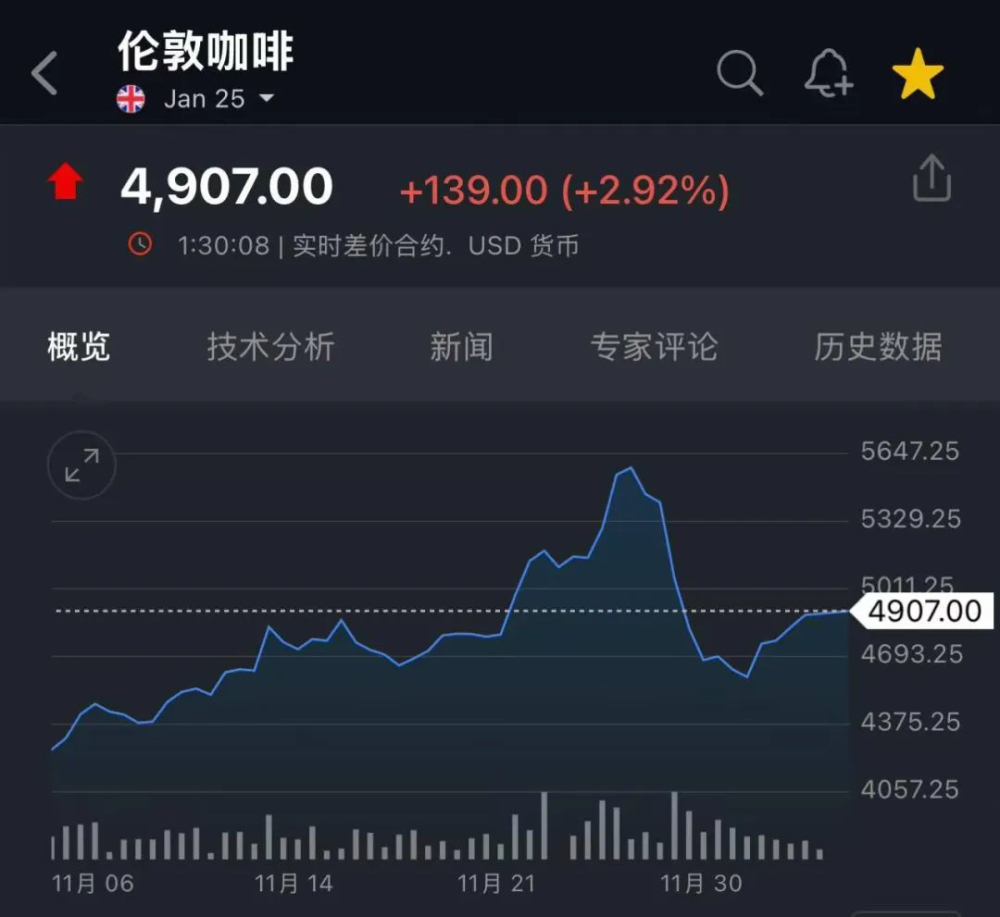
Even so, the official upward revision of the production estimate in Vietnam did not succeed in suppressing the Robusta futures price, which continued to rise all the way and finally reached $4,907 per ton. At the same time, the Arabica coffee futures price also moved up in tandem, rising by 3% to $315.75 per pound. Industry analysts pointed out that due to the intensification of market volatility, the Robusta coffee price may further break through the $5,000 - per - ton mark.
The upward trend in the international market has also been quickly reflected in Vietnam domestically. In the main coffee - producing areas in the central highlands, the spot price of Robusta has climbed to about 115,000 Vietnamese dong per kilogram, an increase of 5,000 to 6,000 Vietnamese dong compared with the previous season. This round of price increases has also directly boosted the overall export earnings of Vietnamese coffee.
According to statistics from the Vietnam Coffee - Cocoa Association, in the first 11 months of 2024, Vietnam’s cumulative coffee exports were close to 1.2 million tons, with a total export value of as high as $4.84 billion. Although the export volume decreased by 15.4% compared with the same period in 2023, the export revenue grew against the trend by 32.8%. This shows that under the high - price environment, the unit - price efficiency of Vietnamese coffee has been significantly improved.
However, behind the high market prices lies a high degree of uncertainty. Due to the fierce and unpredictable price fluctuations, many traders have become more conservative and are reluctant to enter the market for procurement easily; some coffee farmers have also chosen to hoard their beans temporarily and wait and see how the market develops. As a result, the November data on Vietnamese coffee exports showed a rare double decline in recent years — both the export volume and revenue decreased year - on - year.
The specific data shows that in November 2024, Vietnam exported only 50,605 tons of coffee beans, generating an income of $250.4 million, with an average price of $4,947 per ton. Compared with the same period last year, the export volume plummeted by 47.4%. Although the income only dropped slightly by 0.5%, the overall trend has clearly weakened.
Since the beginning of this year, the coffee - producing areas in Vietnam have faced multiple challenges from extreme weather. The severe drought at the beginning of the year led to the drying up of reservoirs in many places, the exposure of riverbeds, and a serious shortage of groundwater. Coffee trees generally showed symptoms such as yellowing and shedding of leaves, directly affecting growth and yield. Although the drought situation eased somewhat after the rainy season arrived in the second half of the year, due to the excessive damage in the earlier stage, the Vietnam Coffee Association estimates that the annual output will still be about 10% lower than the normal level.
To make matters worse, from September to October, Vietnam was hit by multiple typhoons in succession. Although the main producing areas were not directly hit, the strong winds and heavy rains still caused considerable damage to the coffee plantations, further reducing the expected output for this season, which is expected to be 5% to 7% lower than the previous season.Currently, it is the coffee harvest season, but medium to heavy rains continue to occur in the main producing areas in the central region, resulting in a significant slowdown in the harvesting progress..
In addition to natural conditions, the Vietnamese coffee industry also faces unstable external factors. The tense geopolitical situation, especially the continuous turmoil in the Red Sea shipping route, has led to persistently high international shipping costs, greatly increasing the cost and risk of Vietnamese coffee exports. Under the multiple pressures of limited supply, difficult transportation, and an uncertain market outlook, many coffee farmers have chosen not to rush to sell the coffee beans in their hands, hoping to support prices by controlling supply, which has further intensified the wait - and - see atmosphere in the market.
The above content is compiled by CoffeeHunters, a coffee news website.


