







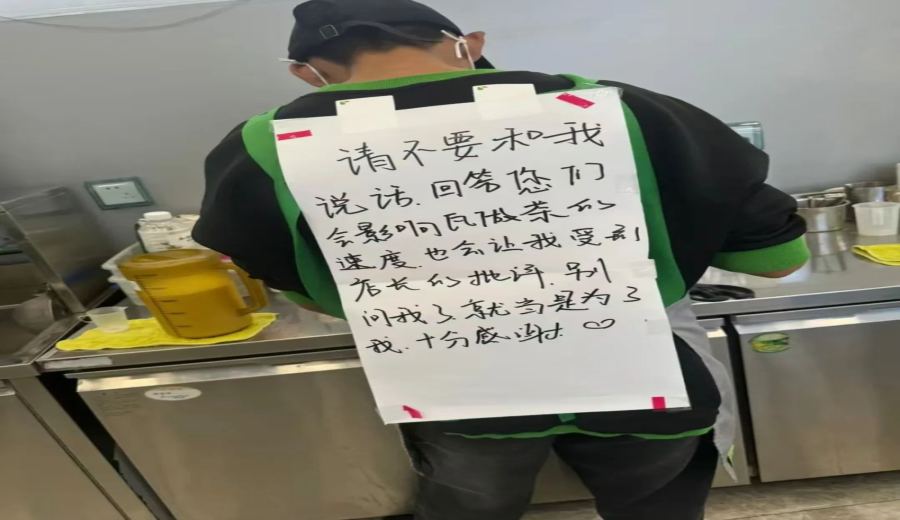
Introduction:Recently, a photo circulated online showing a tea shop employee with a note taped to their back that read, “Please do not talk to me,” citing that responding would affect their tea-making efficiency and might lead to scolding from the manager. This seemingly humorous sign actually reflects the common issue of multi-tasking among tea shop staff. Is it a form of self-protection by employees, or a tug-of-war between management and service? This article takes you behind the scenes to uncover the truth and possible solutions.
A customer at a tea shop noticed a bright, bold sign taped to the back of an employee who was preparing drinks. It read: “Please do not talk to me. Answering you will affect my tea-making speed and may get me criticized by the manager. Don’t ask me anything, just do it for me, thank you very much.” The note immediately caught the customer’s attention, who then took a photo and posted it on social media, sparking widespread discussion.
Netizen reactions were mixed—some saw it as the “last stand” of overworked employees, both humorous and poignant; others pointed out grammatical errors, noting that “您们” is incorrect and should be “你们”. Some also argued that most tea and coffee shops now offer mini-programs or online ordering, where customers can specify special requests when placing their orders, and usually don’t need to talk to staff when picking up their drinks, leaving them puzzled as to why such situations still arise.
However, from the perspective of many industry workers, the situation is not as simple as netizens imagine. Many tea shops, in an effort to control costs, often only schedule one employee per shift, forcing that person to juggle multiple tasks—including preparing ingredients, making drinks, and handling inquiries from customers and delivery drivers. During peak hours such as the start or end of shifts, or lunch and dinner times, order volumes surge, and many employees admit they simply can’t handle both making drinks and communicating with customers, risking mistakes due to divided attention.
To avoid constant interruptions during busy periods, some employees choose to post notes like “Please do not talk to me” on their backs. These serve as both a reminder to customers of the current situation and a way for the employees to focus better on their tasks, avoiding delays in drink preparation due to brief conversations.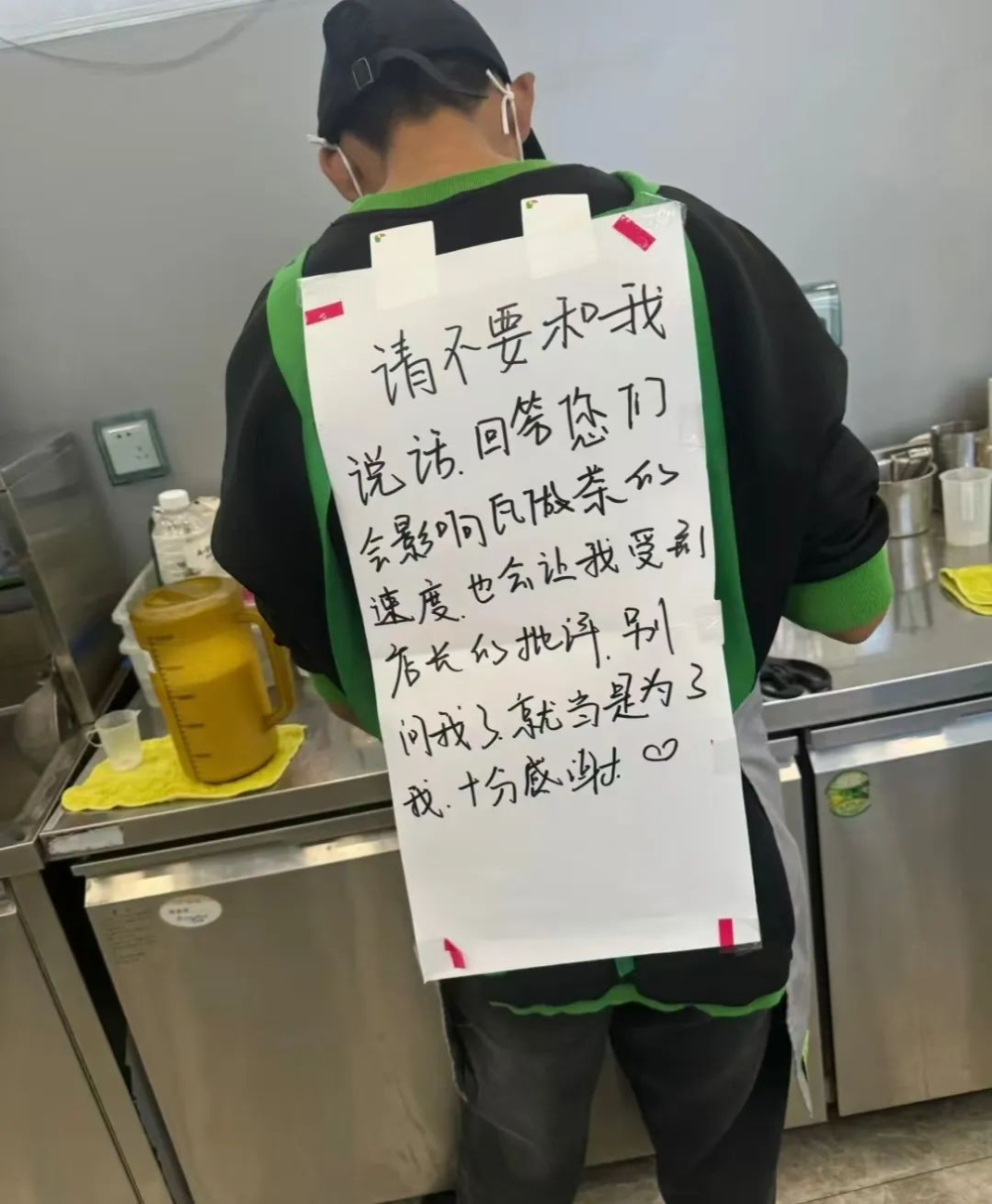
Some more introverted employees or those with mild social anxiety also mentioned that facing a barrage of customer questions, order reminders, or even casual chats can be overwhelming, leaving them unsure how to respond. Posting such signs helps reduce unnecessary conversations and allows them to maintain their work rhythm. Many netizens resonated with this, even jokingly saying, “I want to put one on my office desk too.”
Nevertheless, this practice has sparked some debate. Some netizens pointed out that these “Do not talk to me” notes essentially shift the responsibility of unreasonable work arrangements and staffing shortages from the management to a communication barrier between staff and customers. While employees may simply aim to improve efficiency and avoid distractions, such measures can create a sense of distance for customers, even leading them to feel the service attitude is poor, thus affecting the overall shopping experience.
Some consumers admitted that seeing such signs makes them worry about unfriendly staff attitudes or a lack of emphasis on customer service from the shop, which could negatively impact their impression of the brand. Some said bluntly: “If I see that sign, I just won’t say anything,” or “I don’t even want to go in after seeing it.” Therefore, finding a balance between ensuring employee efficiency and maintaining good customer interaction has become a key issue for tea shop operators to consider.
Industry observers have noted that instead of letting employees post potentially misunderstood signs, shops could adopt more neutral and professional approaches—such as placing a notice at the counter that reads, “During peak hours, please bear with us, we’ll serve you as soon as possible.” This can reduce unnecessary customer questions, protect the brand image, and give employees a bit of breathing room amid the rush.
In summary, the note taped to the back of a tea shop employee is not just a moment of humor and self-protection by a worker, but also reflects the broader gap between staffing levels and customer expectations in the tea shop markets in Taiwan and overseas. Finding a balance between cost control, efficiency, and service quality will be a shared challenge for both industry players and consumers in the future.
The above content is compiled by CoffeeHunters, a coffee news website.


