







Introduction:Colombia is a globally renowned producer of Arabica coffee. Its exported green beans are classified according to a rigorous grading system, among which Supremo and Excelso are the two most common grades. This article delves into the export standards set by Colombia’s FNC, exploring everything from bean size, defect rates to grading logic—helping you understand the practical differences between these two grades and how they influence coffee flavor and quality, so you can make more informed purchasing and brewing decisions.
Colombia has long ranked among the world’s top three coffee-exporting countries. Its Arabica coffee is widely appreciated for its rich, balanced flavor profile with notes of chocolate and nuts, making it a key base for many blends. Within Colombia’s export system, green beans are categorized under strict grading standards, with “Supremo” and “Excelso” being the two most commonly used grade names. These terms actually conceal details about bean size, defect control, and overall quality. Understanding them helps consumers choose coffee beans more precisely.
In Colombia, any green beans that meet export specifications typically bear the label “Excelso” on their sacks. In fact, Excelso is an export grade established by Colombia’s National Federation of Coffee Growers (FNC), and it is also one of the highest grades for the country’s green bean exports. However, to be classified as Excelso, green beans must pass multiple inspections, including bean size, defect rate, and appearance.
Specifically, to qualify for the Excelso grade, at least 50% of the beans in a 500-gram sample must be larger than 15 mesh, and all beans must be larger than 14 mesh. Additionally, the proportion of beans between 12 and 14 mesh must not exceed 5%. Beyond mesh size requirements, green beans must also have good appearance quality, including freedom from pests, uniform color, no off-odors, and a clean flavor, with moisture content controlled below 12.5%. More importantly, the total defect score must not exceed 24 points, calculated based on the number of primary and secondary defect beans in a 500-gram sample.
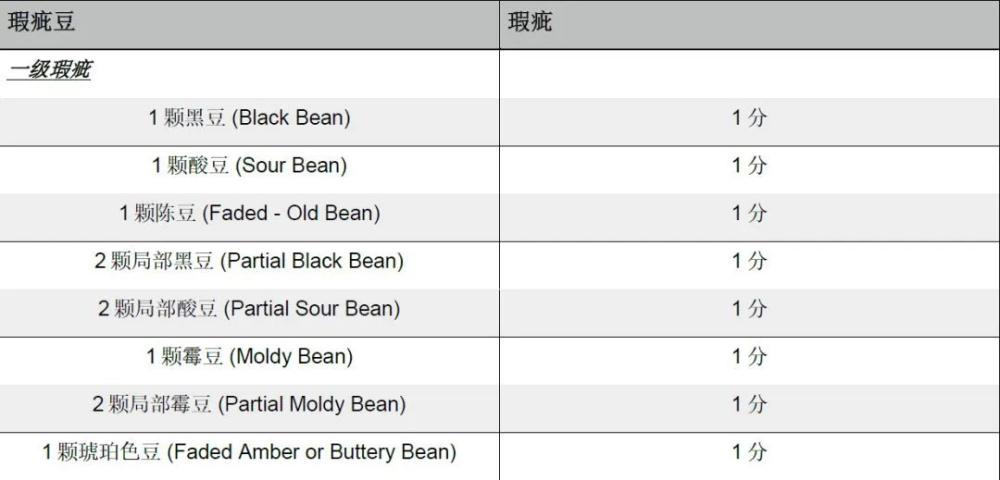
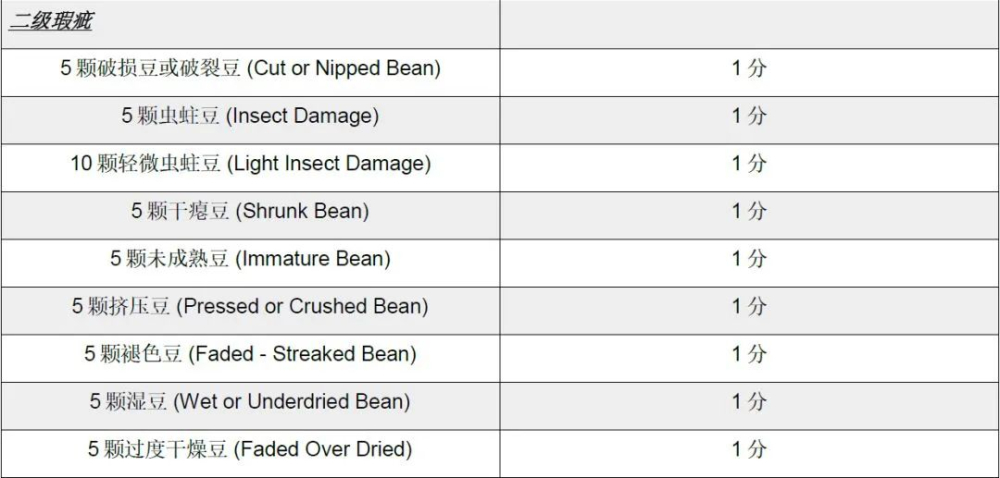
Regarding defect scoring, the FNC categorizes defects into primary and secondary levels, using a deduction-based evaluation system. For example, a severely black bean may deduct 2 points, while a slightly broken or discolored bean may deduct 1 point. The final cumulative score must remain within 24 points to meet export standards. This scoring system effectively filters out green beans with more consistent appearance and basic flavor performance.
Some coffee-producing countries do not use bean size as the main criterion for quality assessment. However, in Colombia and some Central and South American countries, larger and fuller green beans often indicate higher fruit maturity, which helps ensure even heat distribution during roasting, thereby delivering more consistent cup performance. As a result, bean size is an important metric in Colombia’s green bean grading system.
Colombia uses fixed-aperture sieves to grade coffee beans, with different mesh sizes corresponding to different sieve openings. For instance, a 17-mesh sieve allows only beans smaller than that aperture to pass through. Currently, the FNC mainly adopts the 12*60 sieve standard, meaning a 500-gram sample can contain a maximum of 12 primary defect beans and 60 secondary defect beans, and beans are graded according to the sieve size they pass through.
In practical grading, the common Excelso grade includes three main types: Excelso UGQ12*60 (1.5%), Excelso EP12*60 (10%), and Excelso Supremo12*60 (5%). Among them, Excelso UGQ12*60 requires beans to be larger than 14 mesh but allows up to 1.5% of beans between 12 and 14 mesh, with more than 50% of the beans needing to be larger than 15 mesh. Excelso EP12*60 requires most beans to be larger than 15 mesh but accepts up to 10% of beans smaller than 15 mesh (though still larger than 12 mesh). Excelso Supremo12*60 is a higher-tier size grade, requiring beans to be larger than 17 mesh, with only up to 5% of beans allowed to be smaller than 17 mesh (but larger than 14 mesh).
From this, it can be seen that “Supremo” is actually a grade name based on bean size. The percentage represents the “tolerance rate,” or the proportion of beans that do not meet the upper size limit. Meanwhile, “12*60” clearly indicates the allowable range of defect beans—up to 12 primary defects and 60 secondary defects in a 500-gram sample.
Although the vast majority of Colombian green beans meet export standards, a small portion may be disqualified from the Excelso grade due to size or defect issues. Such beans are usually labeled as “Product of Colombia” and can still be exported after passing basic phytosanitary requirements, but they are mostly used for industrial purposes such as instant coffee, rather than the specialty coffee market.
To ensure traceability, Colombian coffee farmers typically keep detailed records of each batch of green beans, including batch numbers and growing region information. In the actual market, green bean names often combine information such as country, growing region, grade, and mesh size. For example, a common label like “Colombia Huila Supremo SC17/18 FNC” clearly indicates beans sourced from Huila, belonging to the Supremo grade, meeting specific mesh size criteria, and adhering to FNC standards.
The above content is compiled by CoffeeHunters, a coffee news website.


