







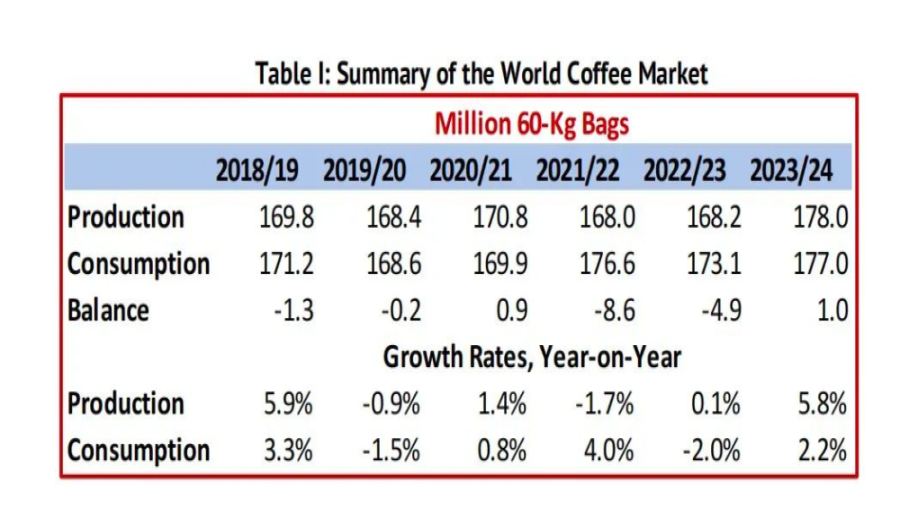
Introduction:The latest forecast from the International Coffee Organization (ICO) shows that global coffee production is expected to rebound by nearly 6% in the 2023/24 season, reaching 178 million bags. After experiencing stagnant growth and declining consumption in the 2022/23 season, what opportunities lie ahead for the global coffee market as weather conditions change and economies recover? This article provides an in-depth analysis of regional performance, consumption trends, and market supply-demand balance to help you stay on top of the latest industry developments.
According to a recent report published by the International Coffee Organization (ICO), global coffee production in the 2022/23 season only increased slightly by 0.1%, reaching 168.2 million bags, showing almost no significant growth. Behind this figure lies a clear disparity in performance among global producing regions — the Americas continued to expand production, while Asia, Africa, and Oceania saw significant declines due to climatic factors.
Specifically, total production in Asia, Oceania, and Africa fell by 4.7% and 7.2% respectively, totaling just 67.74 million bags (with Asia and Oceania at 49.84 million bags and Africa at 17.9 million bags). This decline in production was mainly driven by extreme weather events, particularly in major producing countries such as Vietnam and Uganda, which faced unfavorable rainfall and high temperatures, leading to a notable drop in yield per hectare. The production declines in these regions were partially offset by strong performance in the Americas.
Overall production in the Americas rose by 4.8%, totaling 100.5 million bags, with South America showing the most outstanding performance, with a growth rate as high as 8.4%, largely thanks to Brazil’s consecutive two-year recovery in output. Additionally, Arabica production in the Americas rose by 1.8% to 94.4 million bags, while Robusta saw a slight decline of 2.0%, amounting to 74.2 million bags.
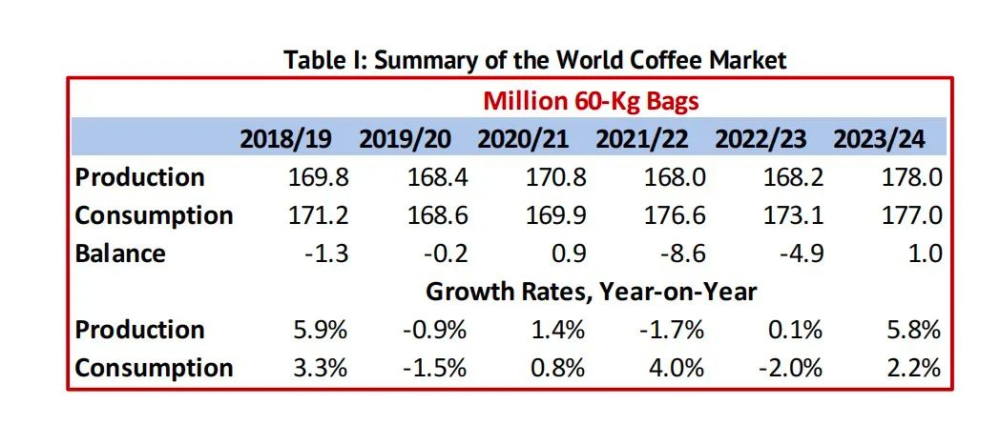
Looking ahead to the 2023/24 season, the global coffee market will face new challenges and opportunities. Although the El Niño phenomenon is expected to continue impacting major producing regions in Asia, particularly Indonesia and Vietnam — where prolonged high temperatures and drought may further threaten coffee cultivation — at the same time, as the impact of the global pandemic gradually fades and the economic environment improves, positive prospects are emerging for the coffee consumption market.
Looking back at the 2022/23 season, affected by post-pandemic effects including rising living costs, reduced real income, and global supply chain and inventory issues, global coffee consumption declined by 2%, dropping to just 173.1 million bags. However, with the gradual economic recovery, the ICO predicts that global coffee consumption will rebound in the 2023/24 season, potentially growing by 2.2% to reach 177 million bags. Among this, demand growth from non-coffee-producing countries will be a major driving force, with consumption in these countries expected to increase by approximately 2.1%.
Taking into account both production and consumption changes, the ICO estimates that the global coffee market in the 2023/24 season will see a slight surplus of around 1 million bags. This is primarily due to the projected significant rebound in global production by 5.8%, reaching 178 million bags. Among this, Arabica production is expected to climb to 102.2 million bags, while Robusta is also set to recover to 75.8 million bags.
It is worth noting that the standard weight of one bag of coffee is 60 kilograms, making this unit the unified benchmark in the industry when evaluating global production and market supply-demand. Whether you are a producer, trader, or coffee enthusiast, understanding the trends behind these figures can help you grasp the market dynamics and make more informed decisions.
The above content is compiled by CoffeeHunters, a coffee news website.


