







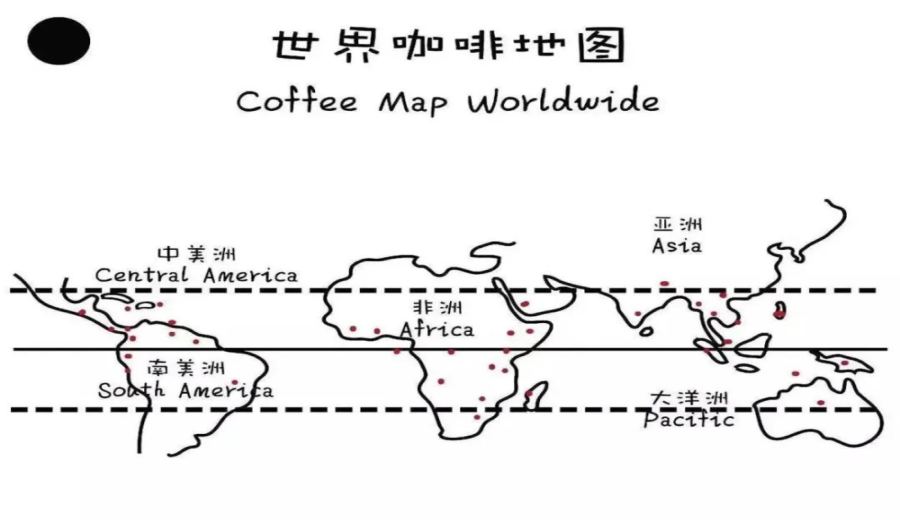
Introduction:Latin America is a globally renowned high-quality coffee-producing region, encompassing flavor-diverse countries from Brazil to Colombia, and on to Cuba and the Dominican Republic. This article will delve into both the major and niche coffee-producing nations in this area, including their historical backgrounds, regional characteristics, main varieties, and challenges. It aims to help readers understand the unique flavors and market conditions of different regions, serving as a practical guide to Latin American coffee.
Coffee trees have specific environmental requirements and can only thrive in the equatorial zone between the Tropic of Cancer and the Tropic of Capricorn, an area known as the "coffee belt," which is the primary source of specialty coffee worldwide. Among these, Latin America is known for its stable and balanced-flavor beans, covering Mexico, Central America, the Caribbean islands, and South America, making it a crucial global coffee supplier.
The region consists of thirty-three sovereign nations and some unincorporated territories, featuring not only globally well-known coffee powerhouses such as Brazil, Colombia, Costa Rica, Guatemala, and Panama, but also smaller producers that are gradually gaining attention among coffee enthusiasts, such as Cuba, the Dominican Republic, Venezuela, and the U.S. state of Hawaii. Let’s explore the coffee development trajectories of these countries one by one.
Cuba: A Historic Yet Challenged Coffee Region
Cuba’s coffee cultivation history dates back to 1748, when it was introduced from the neighboring island of Hispaniola. It wasn’t until 1791, with the arrival of a large number of French immigrants, that coffee cultivation truly took off. By 1827, the island had around two thousand coffee plantations, and coffee had become one of Cuba’s key export commodities. In the 1970s, Cuba’s annual coffee production once reached approximately thirty thousand tons.
However, since the collapse of the Soviet Union and the imposition of a U.S. trade embargo, Cuba’s coffee industry has suffered a heavy blow. Currently, annual production is maintained at only around six to seven thousand tons, and due to outdated equipment and poor transportation infrastructure, the industry faces significant hurdles in recovery. Most of Cuba’s terrain consists of low-altitude plains, with coffee-growing areas mainly concentrated in a few mountainous regions, and the main harvest season runs from July to December. Typica is the dominant variety locally, though small amounts of Bourbon, Caturra, Catuai, and Catimor can also be found.
Dominican Republic: Year-Round Production but Limited Exports
Coffee cultivation in the Dominican Republic began in 1735, introduced by Spanish colonists to what was then called Hispaniola—now the Dominican Republic. By the end of the 18th century, coffee had become the second most important cash crop after sugarcane. The country began exporting coffee in 1956, further promoted regional organization in the 1960s, and established processing facilities in 1967.
However, dramatic fluctuations in international coffee prices toward the end of the 20th century led many farmers to switch to other cash crops. Since the 1970s, domestic coffee consumption in the Dominican Republic has risen rapidly, even briefly surpassing that of the United Kingdom, resulting in a sharp decline in export proportions, with only about 20% of production currently being exported. Due to the lack of distinct seasons, coffee can be harvested almost year-round in the Dominican Republic, though the main season runs from November to May of the following year. The main varieties grown locally are Typica and Caturra.
Hawaii: Persistence and Revival in the Kona Region
Coffee was first introduced to Hawaii in 1817, but early cultivation efforts were unsuccessful. It wasn’t until 1825, when a governor brought coffee seedlings from Brazil, that planting began to take root locally. Unfortunately, in 1858, the region was hit by both aphids and coffee leaf rust, destroying most coffee farms, with only the Kona region on the Big Island surviving. It wasn’t until the 1980s, following the decline of the sugar industry, that coffee regained attention, sparking a Hawaiian coffee boom.
Today, the Kona region has become Hawaii’s most iconic coffee-producing area, with other islands also gradually resuming coffee cultivation. The main harvest season is from September to January of the following year, with Typica and Catuai being commonly planted varieties. Hawaiian coffee is beloved by many consumers for its mild acidity and rich body.
Venezuela: From Global Supplier to a Region in Recovery
Coffee was first introduced to Venezuela around 1730 by Jesuit missionaries, although at the time, the country was more famous for tobacco and cacao cultivation. It wasn’t until 1793 that large-scale coffee plantations began to appear. Between 1830 and 1855, Venezuela experienced its first coffee boom, with production accounting for about one-third of the global total at one point.
However, after the 1920s, with the rise of the oil industry and a shift in economic focus, coffee cultivation became increasingly privatized and restricted to public lands. Even so, the country maintained a certain scale of coffee exports until 2003, when the government introduced strict production restrictions that led to a sharp decline in output. Between 2009 and 2010, coffee exports amounted to just 19,000 bags. Due to government-controlled pricing that remained below cost, the overall industry is still slowly recovering. The main harvest season is from September to March of the following year, with Typica, Bourbon, Caturra, and Mundo Novo being the primary varieties.
The above content is compiled by CoffeeHunters, a coffee news website.


