







Introduction:Catimor is not a single coffee variety, but rather a group of hybrid cultivars developed with the goal of resisting leaf rust by combining genes from both Arabica and Robusta. Evolving from natural hybrids in East Timor to crosses with Caturra, Catimor has been widely planted across many countries, especially becoming the dominant variety in Yunnan. This article delves into the evolutionary background of Catimor, its main selected strains, explores its adaptability and flavor characteristics in Yunnan, and also provides practical references for cultivation and processing.
Coffee varieties can generally be divided into three main categories: Arabica, Robusta, and Liberica. Over time, through transplantation, mutation, and hybridization, numerous varieties have emerged that are suited to different environments and market demands. Examples include Caturra, Catuai, and today’s focus—Catimor—all products of human ingenuity and natural selection. This article will focus on Catimor—a hybrid cultivar group created to combat leaf rust—from its origins to its development in Yunnan, as well as its unique flavors and cultivation traits.
The history of coffee cultivation is one of constant adaptation and improvement. In 1869, coffee leaf rust first broke out in Asia, devastating coffee plantations dominated by Typica in regions such as India, Java in Indonesia, and Sri Lanka. To curb the epidemic, European growers began seeking disease-resistant alternatives, leading to the introduction of Bourbon to Brazil, where it mutated under local climatic conditions to produce varieties such as Caturra. However, by the 1970s, leaf rust struck again in the Americas, affecting Typica, Bourbon, and their mutations, resulting in significant yield losses and prompting countries to invest in the development of new resistant varieties.
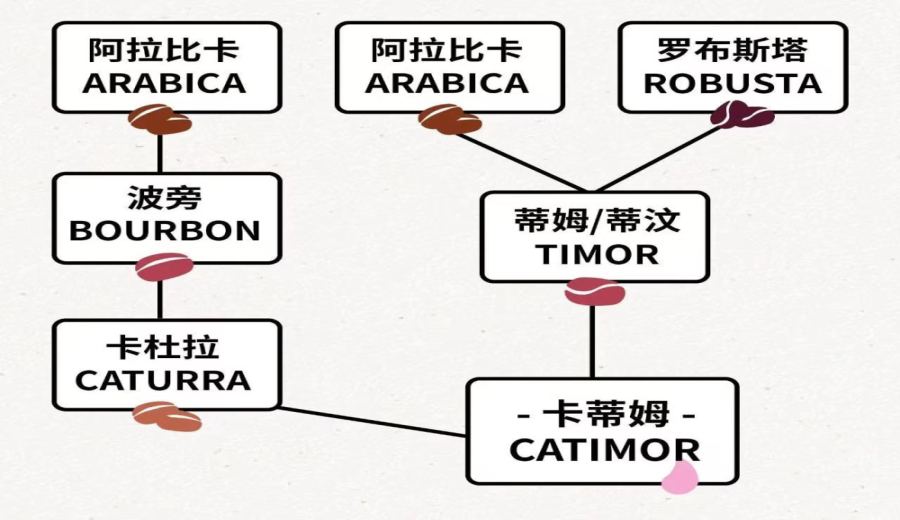
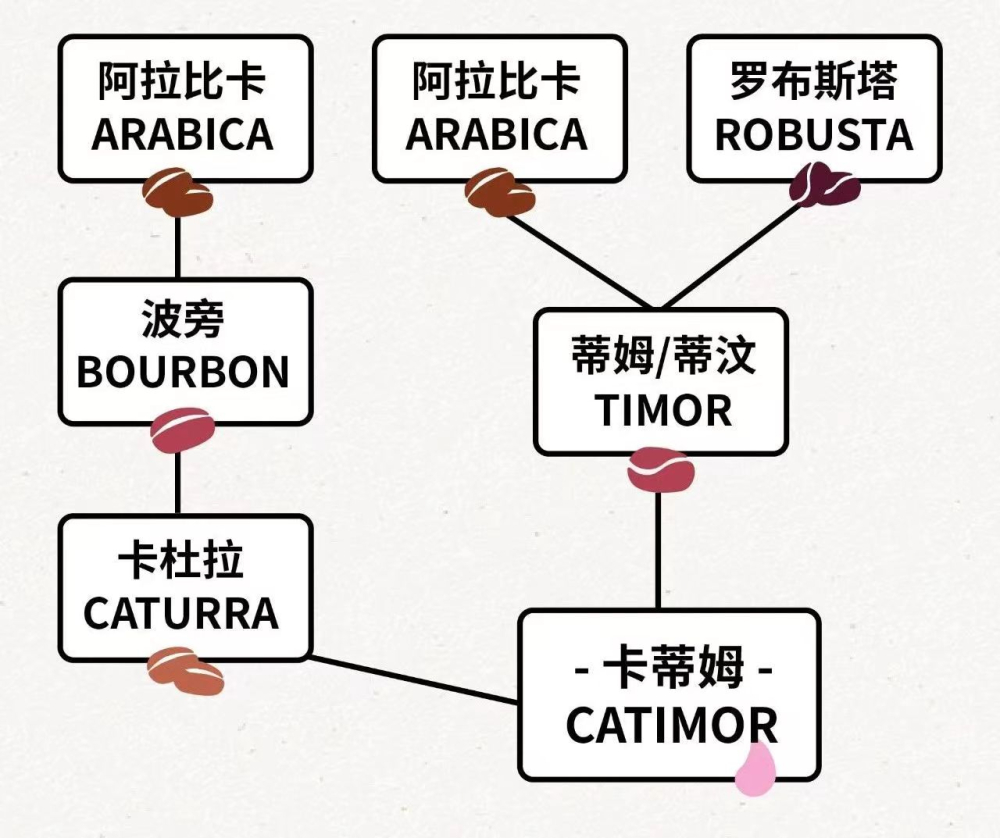
A key turning point occurred in 1920 in East Timor, where a natural hybridization between Arabica and Robusta produced what is known as the Timor Hybrid. Although classified as Arabica, this natural hybrid carried Robusta’s disease-resistant genes, becoming a foundational pillar for subsequent resistant varieties. Later, researchers crossed the Timor Hybrid with Caturra, giving rise to the first generation of F1 hybrid cultivar groups—today widely known as Catimor. This group not only retained the refined flavor potential of Arabica but also inherited Robusta’s strong disease resistance.
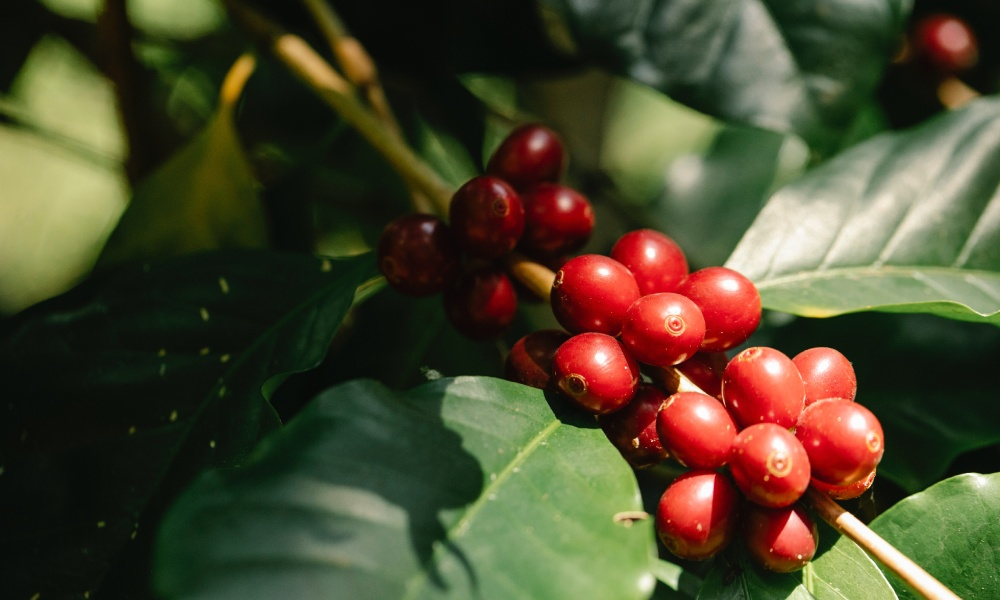
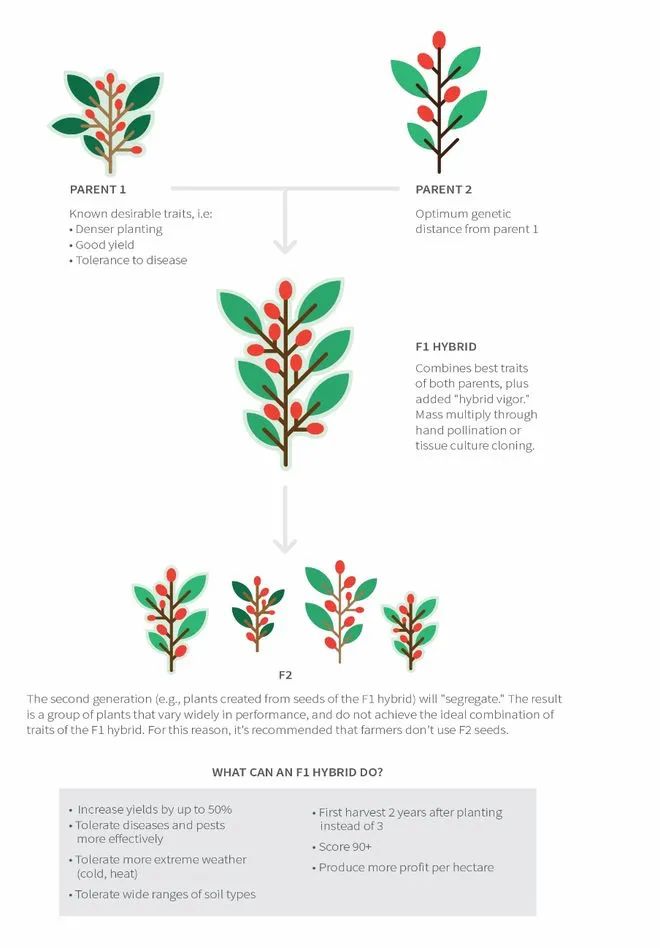
It is worth noting that Catimor itself is not a single stable variety, but rather a cultivar group represented by strains such as T8667. They share similar lineages but still require continuous selection to stabilize their traits. Additionally, the Timor Hybrid was crossed with other Bourbon variants to form other resistant cultivar groups, such as Sarchimor (code T5296). These varieties are generally suitable for planting at altitudes between 700 and 1000 meters, offering high yields, disease resistance, and adaptability to low-altitude warm climates, which led to their rapid spread in the Americas. Starting from the late 1980s, coffee research institutions around the world began investing in localized breeding of Catimor sub-varieties.
Taking Costa Rica as an example, the Tropical Agricultural Research and Higher Education Center (CATIE) introduced Portuguese H26 material and successfully bred the F5 descendant variety through crosses with strains such as T8667 and T5175. Additionally, the Costa Rican Coffee Institute (ICAFE) officially launched a variety called Costa Rica 95 in 1995. In Honduras, the coffee institute (HCAFE) developed the Lempira variety, suitable for planting at altitudes between 600 and 1000 meters. El Salvador’s coffee institute (ISIC) created Catisic, which thrives in acidic soils at elevations between 600 and 1200 meters.

In China’s Yunnan, the introduction and popularization of Catimor holds epoch-making significance. Before the 1960s, the region mainly grew Typica and Bourbon, but by the 1970s and 1980s, as leaf rust spread globally, growers faced serious challenges. In the 1990s, driven by foreign enterprises such as Nestlé, Yunnan began large-scale introduction of Catimor varieties from Central and South America. With their superior disease resistance and high-yield characteristics, these varieties gradually replaced traditional Typica. Although early yields were limited in flavor due to processing techniques and altitude constraints, and were mostly used for commercial blends or instant coffee, improvements in cultivation and post-harvest processing have gradually revealed the potential of Yunnan Catimor.
As a fusion of Arabica and Robusta, Catimor inherits traits from both. Its trees are relatively short with dense branching, capable of healthy growth without shade, and show high resistance to common diseases such as leaf rust and coffee berry disease, effectively improving fruit set and harvest efficiency. Moreover, Catimor fruits ripen quickly, and overall yields significantly surpass those of many traditional varieties. However, due to its Robusta genes, when grown at low altitudes, it can easily result in pronounced bitterness, intense astringency, and even moldy off-flavors. Even at higher altitudes (above 1200 meters), its flavor complexity often still struggles to match that of pure Arabica varieties such as Caturra or Catuai.
Industry experts note that Catimor grown at suitable altitudes in Yunnan and processed with precision can exhibit balanced flavors reminiscent of nuts, brown sugar, and plums, with a mellow and approachable mouthfeel. For growers, understanding Catimor’s characteristics, selecting appropriate altitude zones, and optimizing post-harvest processes are key to enhancing its flavor profile. For consumers, learning about the background of this variety can also lead to a deeper appreciation of the unique charm of Yunnan’s smallholder-grown coffee.
The above content is compiled by CoffeeHunters, a coffee news website.


