








Introduction:Do you know why coffee of the same variety can taste so different depending on the growing region? About 70% of a coffee’s flavor comes from its genetic variety, while the remaining 30% is shaped by the natural conditions of where it’s grown. This article dives deep into five environmental factors—latitude, altitude, soil, sunlight, and humidity—to explore how they influence a coffee’s balance of acidity and sweetness, body, and unique aroma, and reveals why beans from high altitudes and volcanic soils often have richer flavors.
We often hear baristas talk about “terroir,” a term that may sound abstract, but it actually refers to the unique flavor characteristics imparted by the environment in which the coffee beans are grown. While roughly 70% of a coffee’s final taste is determined by its varietal genetics, the remaining 30% comes from natural growing conditions such as latitude, elevation, soil type, hours of sunlight, and air humidity. It is the interplay of these elements that gives rise to the diversity of coffee flavors across different regions.
In other words, even if two batches of coffee beans share the same variety, processing method, and roast level, they may still exhibit vastly different acidity, sweetness, and body in the cup simply because they come from different geographical environments. That’s why we often say that to truly understand coffee, you can’t overlook the subtle influence of terroir.

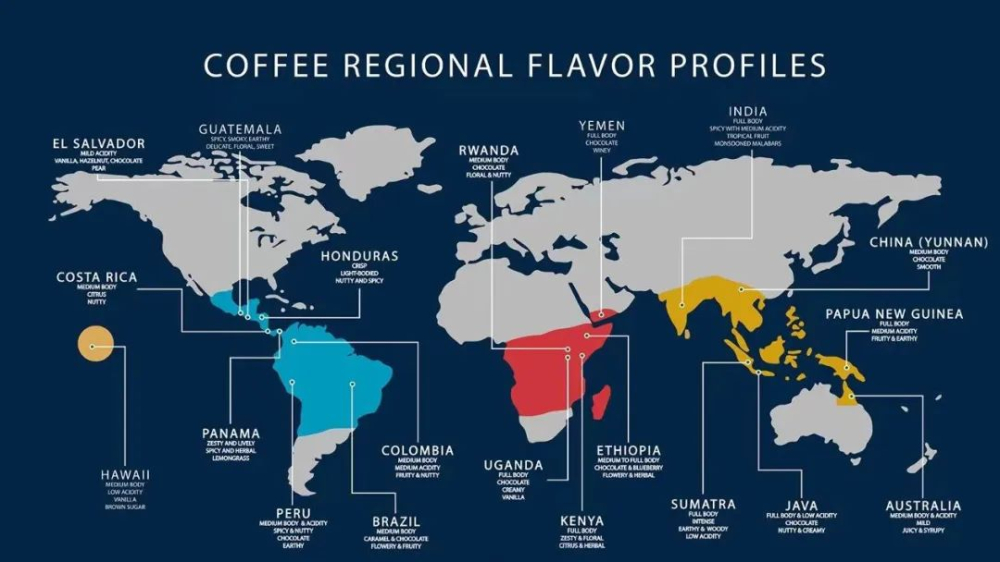
Let’s start with latitude. The world’s major coffee-growing regions are almost all located within the tropical zone between the Tropic of Cancer and the Tropic of Capricorn, an area also referred to in the industry as the “coffee belt.” Here, the climate typically remains between 16 and 25 degrees Celsius year-round, free from the threat of frost, and with stable annual rainfall of around 1600 to 2000 millimeters, providing ideal growing conditions for coffee trees. This latitudinal range not only ensures suitable temperatures but also promotes stable ripening of coffee cherries.
Next, let’s look at altitude. Many coffee enthusiasts know that coffee grown at higher elevations often has better flavor, but what’s the science behind it? The key lies in temperature. Generally speaking, for every 100 meters increase in altitude, the temperature drops by about 0.6 degrees Celsius. As a result, in high-altitude regions, coffee trees grow more slowly, allowing the cherries more time to accumulate nutrients and develop richer flavors. Data shows that for every 300-meter increase in altitude, the sucrose content in coffee cherries can increase by approximately 10%. These sugars are converted into aromatic compounds during roasting, especially those that bring bright acidity, resulting in a more vibrant and layered taste profile in high-altitude coffee.

The impact of soil on coffee flavor is also significant, particularly its mineral composition. Volcanic soil, rich in sulfates and sulfides along with high levels of potassium, is a hallmark of many renowned coffee-growing regions. These components help coffee beans develop unique acidity and complexity. For example, Kenyan coffees often exhibit a rounded acidity reminiscent of small tomatoes. In addition to the benefits of the washed processing method, the high phosphate content in the local soil plays a crucial role—it strengthens the structural acidity of the coffee, giving the overall flavor more dimension.
As for sunlight, it’s another major variable that affects the growth rhythm of coffee. Excessive sunlight raises ambient temperatures, accelerating the ripening of coffee beans and causing them to be harvested before their nutrients are fully accumulated. Such coffee tends to have a thin flavor and lack depth. To moderate sunlight intensity, many coffee farms plant shade trees above the coffee plants, reducing direct sun exposure to extend the fruit’s maturation period. This allows the beans to ripen slowly in a cooler environment, accumulating more sugars and flavor compounds, ultimately resulting in a more refined balance of acidity and sweetness.
Finally, there’s humidity. Moderate air humidity promotes the production of malic acid and sugars in the coffee pulp. Once absorbed by the beans, these components directly influence the final flavor profile. Especially when using special processing methods like honey or anaerobic fermentation, a humid environment helps the beans retain more sugars from the pulp, which are then released as juicy acidity and sweetness after roasting, making the overall cup feel fuller and more layered.
The above content is compiled by CoffeeHunters, a coffee news website.


