








Introduction:In recent years, stirring techniques in pour over coffee have become a focal point of interest for many coffee enthusiasts. But can this technique truly enhance flavor performance? This article delves into the application principles of stirring during the bloom and main extraction phases, combining practical test data and expert methods to explore its impact on extraction uniformity, sweetness, and flavor complexity. It also highlights potential issues such as fine particle clogging and bean quality, helping you more scientifically determine whether to use stirring and how to perform it correctly.
During the pour over process, the act of stirring the coffee grounds has gradually gained attention. Some baristas and enthusiasts believe that appropriate stirring can enhance the coffee’s sweetness and flavor complexity, while others remain skeptical about its actual benefits. This article will explore the timing, methods, and precautions of stirring in pour over from the perspectives of technical origins, practical operations, and experimental data, helping you evaluate more rationally whether this step is necessary.
When discussing the popularity of pour over stirring techniques, one cannot overlook Matt Perger, the 2012 World Brewers Cup (WBrC) champion. During that competition and in subsequent tutorial videos, he demonstrated a technique known as “Stir like a Bandit.” In the video, it’s clear that Matt uses a wooden stick to aggressively and swiftly stir the coffee bed in a cross pattern — first up and down, then left and right, and then up and down again — with fluid and purposeful movements.

In addition to Matt, Tim Wendelboe, a legendary figure in the roasting world from Northern Europe, also incorporates a similar stirring motion during the bloom phase in his YouTube instructional videos. He explains that the purpose is to ensure all coffee grounds are evenly saturated with water, preventing uneven wetting that could negatively affect subsequent extraction.
Moreover, Scott Rao, an authority in the American coffee scene, along with James Hoffmann, the 2017 World Barista Championship (WBC) champion, both hold positive views on stirring techniques. Notably, Amis, a barista from Taiwan, China, has taken stirring applications to new heights, becoming one of the key practitioners of this technique.
One of the core goals of pour over coffee is achieving uniform extraction. Stirring, as an auxiliary method, typically involves using tools like spoons or wooden sticks to apply moderate agitation to the coffee bed. The goal is to promote more comprehensive contact between water and coffee grounds, thereby improving overall extraction efficiency and flavor balance.
Generally speaking, stirring can be divided into two main phases: the first is during the bloom phase, and the second is during the water pouring phase of the main extraction. However, whether to stir, the extent of stirring, direction, and duration should all be adjusted based on specific objectives rather than followed blindly.
Stirring during the bloom phase, regardless of the method used, primarily aims to ensure that coffee grounds at different heights in the filter cone all come into contact with water. This reduces concentration differences between layers and establishes a solid foundation for subsequent flavor release. This step is especially critical in the early stages of coffee-water contact.
As for the main extraction phase, since the pouring itself already generates sufficient turbulence and provides the coffee grounds with more opportunities to “absorb” water and expand, the reliance on additional stirring is relatively lower. However, experienced baristas often choose to perform a gentle stir after the second pour, which helps release residual gases from the coffee grounds and further enhances overall extraction performance.
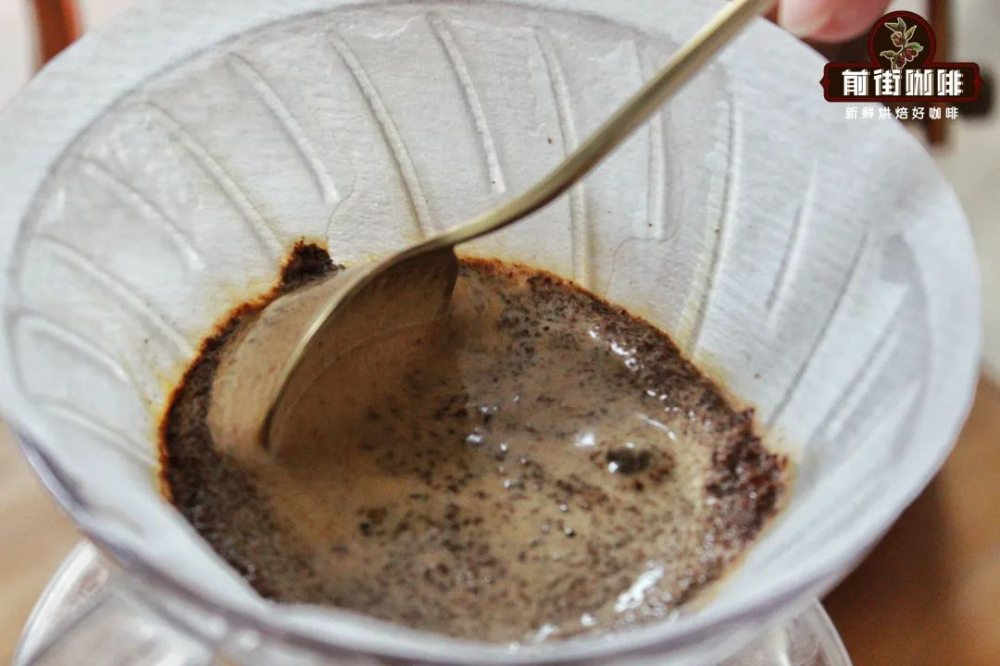
To verify the actual effects of different stirring methods, we conducted a comparative experiment. The experiment used coffee beans from the Guodingding Cooperative, with a coffee dosage of 15 grams, a coffee-to-water ratio set at 1:15, water temperature controlled at 91°C, and grind size referencing the 10th setting on the EK43s grinder. Three methods were tested: no stirring, a single stir during the bloom phase, and a single stir after the first pour.
The experimental results showed that without stirring, the total extraction time was approximately 2 minutes and 5 seconds, with flavors dominated by citrus notes, bright acidity, and a honey-like sweetness in the aftertaste. When a cross-shaped circular stir (first up and down, then left and right) was performed during the bloom phase, the coffee finished dripping in 2 minutes and 10 seconds, exhibiting more pronounced berry, lemon, and green tea notes, accompanied by soft white floral aromas and a clearer sweetness. In contrast, when stirring was done after the first pour using the same cross-stir method, the extraction time extended to 2 minutes and 13 seconds. Citrus fruit acidity was still present, but the aroma was noticeably weaker, and the aftertaste even had hints of licorice, indicating signs of over-extraction.
It’s important to note that while stirring can improve extraction uniformity and flavor performance, it also increases the risk of fine particles settling and clogging the filter holes. The more intense and frequent the stirring, the higher the chance that fine particles will move to the bottom of the filter, potentially slowing flow rate and increasing the risk of over-extraction, thereby affecting overall mouthfeel.
Additionally, because stirring techniques are essentially a form of “forced extraction” of coffee flavors, they also place higher demands on the intrinsic quality of the coffee beans. If flawed beans or improperly roasted beans are used, stirring may amplify their negative flavors. Therefore, if you aim to achieve better extraction through stirring, besides mastering the correct technique, you must also pair it with appropriate grind size, water temperature, and brewing rhythm—such as finer grind, slightly higher water temperature, and faster extraction parameters—to realize its full potential.
In summary, although the stirring technique in pour over coffee holds the potential to enhance flavors, it is not a universal solution. Since individual differences in beans, equipment, and techniques vary greatly, the actual outcomes can differ significantly. It is recommended to fully understand the characteristics of your coffee beans and consider the flow design of your filter cone before deciding whether to use stirring and how to execute it. Only then can you truly unlock the value of this technique in the pour over process.
The above content is compiled by CoffeeHunters, a coffee news website.


