







Introduction:As China gradually eases its pandemic prevention policies and economic activities begin to warm up, Starbucks, as an international coffee chain brand, is also entering a new phase in its performance and store expansion within the Chinese market. This article will provide an in-depth analysis of Starbucks’ latest operational performance in China, its future store expansion plans, as well as analysts’ views on its stock price and market outlook, bringing you the key insights.
Following China's adjustment of its pandemic prevention policies, social operations and consumer markets have gradually returned to normal, benefiting many foreign enterprises, with Starbucks being a clear example. Over the past few years, the repeated outbreaks of the pandemic had a significant impact on Starbucks’ operations, but now, with people returning to offices and social activities increasing, not only has Starbucks' stock price shown an upward trend, but its number of stores in China has also surpassed 6,000, demonstrating strong recovery momentum.
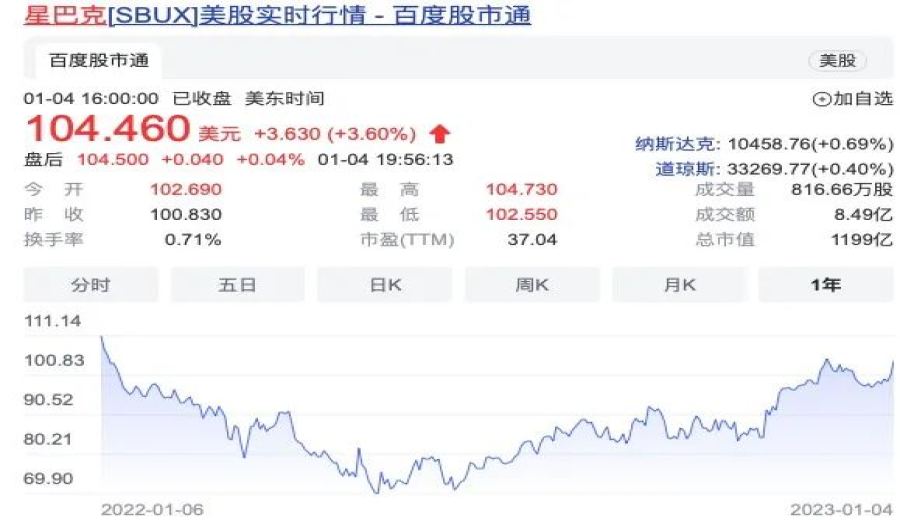
Bank of America recently raised its target stock price for Starbucks (SBUX) from the original $109 to $125, and continues to give it a “Buy” rating. As of the latest stock market data, Starbucks closed at $104.46 per share, up $3.63 from the previous day, with a market capitalization of approximately $119.9 billion and a price-to-earnings ratio as high as 37.04. Looking back over the past year, its stock price fell as low as $68.39 and peaked at $117.05, showing that the market still has high expectations for its future performance.
Even in the face of uncertainties brought by the pandemic, Starbucks did not halt its expansion. As of the fourth quarter of the 2022 fiscal year, Starbucks’ total number of stores globally (including company-operated and licensed stores) reached 35,711, an increase of 1,878 compared to the same period last year. Among them, the number of stores in the Chinese market was 6,021, 663 more than the same period last year, showing considerable growth compared to around 4,700 stores during the early stages of the pandemic. In addition, Starbucks’ global revenue increased by 11% year-on-year, with quarterly revenue reaching a record $8.4 billion, demonstrating the resilience and growth potential of its overall business.
In terms of quarterly performance, Starbucks achieved an earnings per share (EPS) of $0.81 in the fourth quarter of the 2022 fiscal year, higher than the market expectation of $0.73. Its net profit margin was approximately 10.18%, and the return on equity (ROE) reached 39.85%. Analysts estimate that Starbucks’ average earnings per share for this fiscal year will be around $3.41, indicating that its profitability remains competitive.
Particularly noteworthy is the strong performance of Starbucks’ digital sales in China. The sales of its “Star Delivery” delivery service grew by 35% year-on-year, accounting for about 24% of total sales; while orders placed via mobile devices accounted for 44% of overall revenue. Additionally, the number of active members in Starbucks Rewards increased by 29% compared to the third quarter, returning to over 17 million, nearly matching its historical peak, reflecting a gradual rebound in consumer loyalty.
Currently, Starbucks’ store expansion in China is still in an active growth phase. At the global investor meeting in September 2022, Starbucks set new goals for the Chinese market over the next three years: aiming to increase the number of stores in China to 9,000 by 2025. To achieve this goal, Starbucks expects to open a new store in China every 9 hours in the future, demonstrating its high level of emphasis and confidence in the Chinese market.
Compared to other international fast-food or restaurant brands such as McDonald’s (MCD) and Yum Brands (YUM), Starbucks’ expansion speed is significantly faster, which also means that its revenue will be more notably impacted by post-pandemic recovery. Nevertheless, the market generally expects Starbucks’ operating income in China this year to recover to 60%–70% of pre-pandemic levels, with the potential to steadily move toward long-term growth targets.
According to analysis by Bank of America, this wave of positive performance and store expansion expectations is mainly benefiting from China’s reopening policies. As people gradually return to offices and urban foot traffic increases, consumer behavior patterns are also returning to pre-pandemic norms, driving an uptick in Starbucks’ order volume. At the same time, more and more Chinese consumers are developing the habit of drinking coffee in the morning, making Starbucks increasingly seen as an “approachable luxury” in the Chinese market.
Within China’s coffee market, Starbucks positions itself between premium boutique brands such as GREYBOX and Peet’s, and mass-market brands such as Luckin Coffee, Costa Coffee, and Tim Hortons. Its pricing strategy is neither as expensive as some specialty coffees nor significantly lower than affordable chain brands, successfully attracting consumers who seek quality without wanting to overspend, further solidifying its market position.
The above content is compiled by CoffeeHunters, a coffee news website.


