








Introduction:Recently, well-known tea beverage brands such as Heytea, Nayuki, and Mixue Ice Cream & Tea have collectively adjusted their discount strategies on food delivery platforms, with some brands even directly canceling promotions, sparking widespread market discussion. This article delves into the cost pressures, platform commission mechanisms, and profit challenges in the price war behind these moves, helping readers understand the current business situation and future trends of tea beverage merchants.
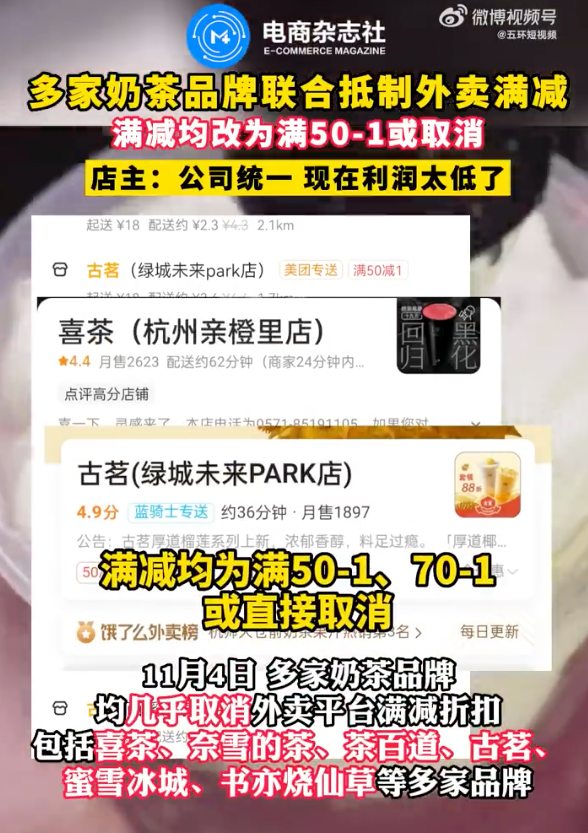
Recently, multiple tea beverage brands including Heytea, Nayuki Tea, Cha Bai Dao, Gu Ming, Mixue Ice Cream & Tea, and Shu Yi Herbal Jelly were exposed for simultaneously adjusting their discount strategies on food delivery platforms. The once-common "spend-and-save" promotions have now been significantly reduced—some brands have adjusted to offers like "spend 50 get 1 off" or "spend 70 get 1 off," while others have completely canceled all discount activities. This move quickly drew consumer attention, with related topics such as "multiple tea beverage brands jointly resisting delivery discounts" trending on platforms like Weibo and Baidu, garnering over 180 million views.
It is understood that this adjustment was implemented uniformly by multiple brands and took effect on November 1. Some store owners revealed to the media that this is a company-wide policy, covering well-known chains such as Heytea, Nayuki, and Gu Ming. Many shop owners admitted that the profit margin in the tea beverage industry is already limited, and the high commissions and delivery costs from food delivery platforms make operations even more challenging.
The news has drawn mixed reactions from netizens. Some consumers expressed understanding, believing that the high commissions of food delivery platforms and rising operating costs have squeezed profits. However, many others were puzzled, with comments such as "a cup of milk tea sells for 20–30 yuan and still isn’t profitable?", "delivery prices are higher than dine-in, and you cancel discounts—no wonder business is bad", and "the drink is 10 yuan in-store but 12 yuan for delivery, with a minimum order of over 20 yuan—how can you still be losing money?" These remarks reflect consumer skepticism about tea beverage pricing.
In fact, this wave of adjustments reflects the contradictory situation the new tea beverage industry is facing—price cuts alongside losses. Since 2022, multiple brands including Heytea and Nayuki have successively launched price reduction strategies, attempting to attract consumers with more affordable prices. For example, Heytea was the first to lower product prices, followed by Nayuki Tea, and Lelecha also adjusted its product line structure. However, while price cuts help boost customer traffic, they further squeeze the already limited profit margins.
According to public data, Nayuki Tea disclosed in its 2021 financial report that it incurred a full-year loss of 4.525 billion yuan, an increase of over 21 times compared to the previous year. Although Mixue Ice Cream & Tea has remained profitable for many years, its main earnings come from selling raw materials to franchisees and collecting franchise fees, rather than profits from direct brand operations. Even Heytea, which has adhered to a self-operated model, has begun adjusting its strategy by introducing a partner model in non-tier-one cities and closing its budget sub-brand "HeyTea Go," reflecting the overall severity of the market environment.
From the perspective of merchants, although the price of a cup of milk tea may seem not low, it encompasses multiple costs such as rent, decoration, labor, raw materials, delivery fees, and platform commissions. For delivery orders, platforms typically take a certain percentage of service fees. In some cases, after customers use coupons, the merchant’s actual income may approach zero or even result in negative gross profit. This is why many brands choose to adjust or cancel discount promotions to minimize further profit losses.
Additionally, it is worth noting that delivery not only increases time costs but also poses a significant challenge to the quality and taste of tea beverages. Compared to drinking on-site, the delivery process may affect the flavor of the beverage due to temperature and time, further impacting customer experience and repurchase willingness. As a result, some brands are beginning to reassess the cost-effectiveness of their delivery services and adjust their business strategies accordingly.

Overall, this collective adjustment of delivery discount strategies by tea beverage brands is not just a change in promotional tactics but also reflects the challenges of restructuring cost structures and transforming profit models faced by the new tea beverage industry after rapid expansion. For consumers, understanding the commercial logic behind these moves helps to view price adjustments and service changes more rationally. For businesses, finding a balance between cost control and quality maintenance will be key to sustainable operations in the future.
The above content is compiled by CoffeeHunters, a coffee news website.


