







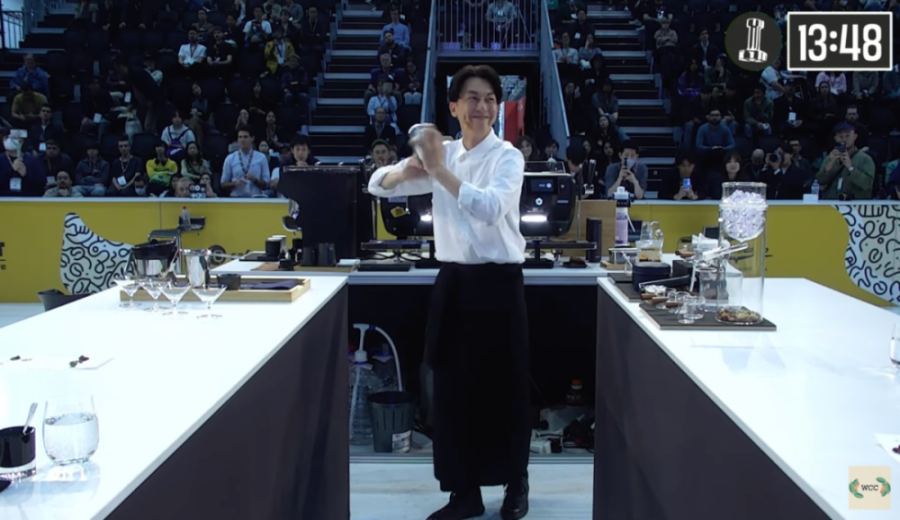
Introduction:At the 2022 World Barista Championship, Japanese competitor Takayuki Ishitani stunned the industry by securing fourth place with an innovative blend of Robusta and Panamanian Geisha. By dynamically adjusting the ratio of the two beans across the espresso, milk beverage, and signature drink segments, he masterfully blended the body and sweetness of Robusta with the delicate complexity of Geisha. This article delves into the details of his competition recipe and techniques, while also exploring the potential and value of Robusta in specialty coffee competitions.
On the stage of the 2022 World Barista Championship (WBC), Japanese competitor Takayuki Ishitani achieved an impressive fourth-place finish using a blend of Robusta and Panamanian Geisha, sparking widespread discussion within the industry. Instead of adhering to the traditional focus on Arabica, he adjusted the blend ratio of Robusta and Geisha for each of the three segments — espresso, milk beverage, and signature drink — showcasing precise control over flavor and mouthfeel.
The base beans for Ishitani’s competition recipe were sun-dried Robusta from high-altitude regions in Vietnam (around 1,000 meters), paired with sun-dried Geisha from Panama’s Hartmann Estate. This combination allowed him to enhance the body and sweetness of the cup without sacrificing the overall finesse of the flavors — particularly well-suited to the demands for body and balance in the competition setting.
For the espresso round, he used 19 grams of Panamanian Geisha and 1 gram of Robusta, totaling 20 grams of coffee grounds, extracted over 21 seconds to produce 40 grams of espresso. It is recommended to gently stir the shot about three times with a spoon before tasting to ensure even flavor release. This espresso presented pronounced notes of blood orange and pineapple, with a medium level of body, fine and smooth crema, laying a solid foundation for the subsequent milk and signature drinks.
In the milk beverage round, Ishitani adjusted the blend ratio, using 17 grams of Geisha and 3 grams of Robusta, again extracting for 21 seconds to yield 40 grams of espresso. With this ratio, the sweetness of the Robusta became more pronounced. When combined with milk, it delivered complex flavors of dark chocolate, blackberry, and vanilla, along with a rich and velvety mouthfeel, offering a highly satisfying drinking experience.
The signature drink segment was one of Ishitani’s highlights, where he created an espresso martini. First, he extracted 15 grams of Geisha and 5 grams of Robusta to form the espresso base. He then added 40 grams of a botanical distillate made by steaming rose petals, cardamom seeds, and hops together, along with 15 grams of syrup made from Japanese sugar and water. More uniquely, he incorporated 0.5 grams of a fermented liquid made from coffee grounds, water, and a unique Japanese microbial strain through a two-week anaerobic fermentation process — this boosted the overall umami and brought a distinctive lemongrass-like aroma.
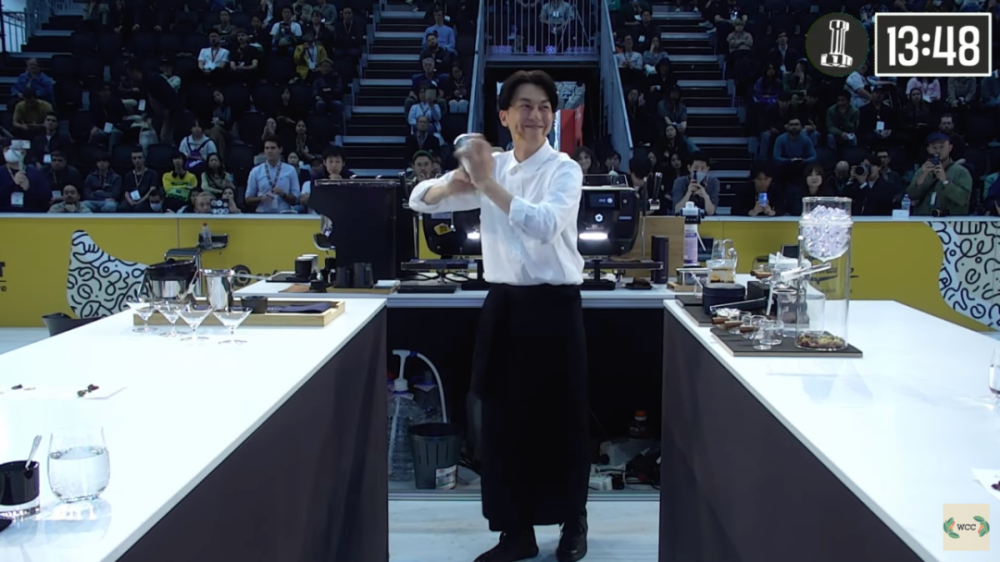
All ingredients were eventually shaken together in a cocktail shaker with ice. This not only allowed the flavors to meld thoroughly but also created a delicate, creamy foam layer. The final signature drink showcased a complex profile of berries, grapefruit, blood orange, and lemongrass, with a silky and full-bodied mouthfeel. The lingering aroma of dark chocolate in the aftertaste left a deep impression on the judges.
Notably, Ishitani maintained a low-key presence throughout the competition, delivering a sincere and straightforward performance. Though he spoke little, each step demonstrated his respect for coffee and his confidence. With simple yet highly creative blending and extraction methods, he broke many stereotypes about world-level competitions and prompted audiences to rethink the role of Robusta in specialty coffee.
Many people’s first reaction to the idea of “blending Robusta with Geisha” may be skepticism, or even the belief that it’s a waste of competition-grade beans. However, the World Barista Championship has never stipulated that only Arabica beans can be used. What matters more in the competition is whether competitors can present innovative ideas and demonstrate outstanding service and technical precision throughout their performances.
Although Robusta is often overlooked due to its perceived inferior flavor compared to Arabica, its strong body and natural sweetness make it a valuable component in blends. Especially in the mass market where balance and mouthfeel are prioritized, a moderate amount of Robusta can significantly elevate the overall cup profile — and this was one of the key factors behind Ishitani’s success.
His achievement reminds us that the value of a barista lies not only in technical excellence but also in a multifaceted understanding of coffee — including communication with customers, flavor design, innovation capabilities, and service mindset. As he put it: “As a barista, it’s not just about making coffee — you need to improve yourself holistically to truly touch people’s hearts.”
The above content is compiled by CoffeeHunters, a coffee news website.


