








Introduction:Luckin Coffee recently launched an open call on social media platforms for fans to suggest potential collaboration partners. Netizens showcased boundless creativity, ranging from classic anime characters and national food staples to boldly naming rival Starbucks. This wave of interaction not only demonstrates how brands can capture the attention of younger audiences through cross-industry collaborations, but also raises the question: what kind of collaboration strategy can successfully generate buzz and traffic? This article dissects Luckin’s collaborative thinking and the marketing logic behind it.
Luckin Coffee recently posed an interesting question to users on the Xiaohongshu social platform: “Which brand would you most like to see us collaborate with?” The brand encouraged fans to actively comment and boldly pitch ideas, humorously adding that “some suggestions might actually come true.” This move quickly sparked lively discussions among netizens, highlighting Luckin’s keen awareness of trending topics among young consumers.
Among the many comments, netizens’ imaginations ran wild—from classic cartoon characters such as Doraemon, Stitch, and Blue Cat, to well-known food brands like Laoganma, Want Want, Luobawang, and KFC, offering a truly diverse range of suggestions.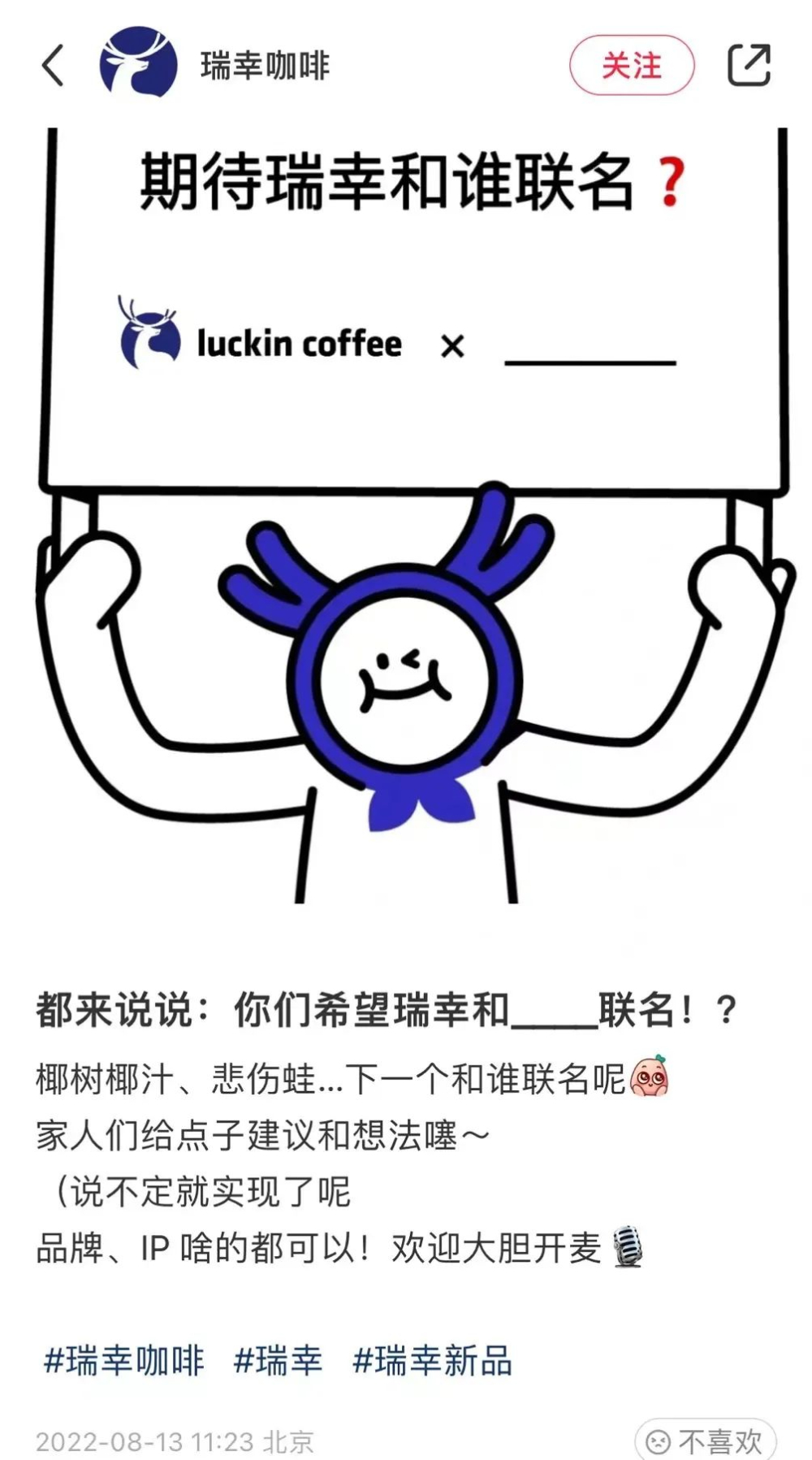
Most amusingly, many netizens directly named “Starbucks,” hoping to see this pair of “archrivals” in the coffee market join forces. Though bold, such a proposal underscores consumers’ craving for the freshness that cross-industry collaborations bring.

In fact, discussions pitting Luckin against Starbucks are nothing new. As early as July 29 of this year, when Luckin’s official Weibo account released a teaser poster for its collaboration with Sad Frog, a small green hand in the image triggered associations—some netizens jokingly wondered if it hinted at the green mermaid logo of Starbucks.
In the coffee industry, collaborative marketing is by no means a new concept, but cases that truly achieve a win-win outcome and generate buzz are few and far between. Successful collaborations not only provide brands with significant short-term exposure, but also extend the campaign's momentum through netizens spontaneously creating memes, sharing content, and collecting merchandise, thereby becoming a vital source of brand traffic.
Looking back at the first half of this year, Luckin’s collaboration with the Yeshu Group to launch the “Coconut Cloud Latte” stands as one classic example. This product combined a trendy internet-famous beverage with a highly recognizable, “earthy” packaging style, creating a striking visual and psychological contrast that successfully captured attention. Even though the product’s teaser poster was pixelated, it could not hide Yeshu’s unique design language, prompting netizens to quickly decipher and discuss it.
After the product launched, netizens further showcased their creativity by making various coconut cloud-themed merchandise. Even Xu Dongdong, the brand ambassador for Yeshu, personally demonstrated the “new coconut cloud pose,” helping to keep the topic trending.
In the second half of the year, Luckin made another move by partnering with the popular IP character among younger audiences, “Sad Frog,” to release a limited-edition collaboration for Qixi Festival. Leveraging the festive atmosphere and the cute image of the green frog, it successfully tapped into the romantic and youth markets.
This series of collaboration strategies shows that Luckin is adept at understanding the preferences of younger demographics. By teaming up with trending IPs or brands with strong contrasting images, paired with light-hearted and humorous marketing language, it successfully draws its target audience into the conversation. Handing over the choice of collaboration partner to netizens is not only a creative interaction, but also an attempt by the brand to deeply understand consumer needs.
In response to netizens' suggestion to collaborate with Starbucks, although the two are market competitors, the curiosity and anticipation from consumers reflect the endless potential of cross-industry collaborations in the coffee industry. Whether Luckin can create another stunningly successful collaboration in the future remains something to watch closely.
The above content is compiled by CoffeeHunters, a coffee news website.


