







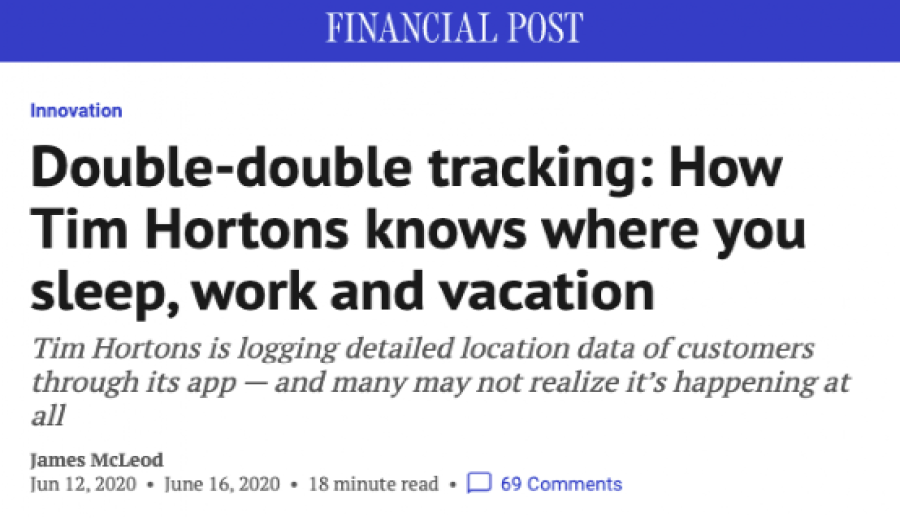
Introduction:The well-known Canadian coffee chain Tim Hortons has been embroiled in a class-action lawsuit over its mobile app’s unauthorized tracking of users’ locations. Recently, the company proposed a settlement involving free coffee and desserts as compensation, but the court has not yet approved the plan. What personal data did the company collect? Are the settlement terms reasonable? How will the court rule? This article details the full story and legal issues surrounding the case.
The Canadian coffee chain Tim Hortons (Tims) is facing multiple class-action lawsuits over allegations that its mobile app continuously collected precise location data without user consent. The brand recently reached a preliminary settlement with the plaintiffs, agreeing to offer affected users free coffee and doughnuts, as well as permanently delete specific user information collected between April 2019 and September 2020. However, this proposal is still pending court review, with a hearing scheduled for September 6 at the Quebec court.
As early as 2020, media reports revealed that Tims, through third-party technology provider Radar, was continuously tracking users’ detailed location information—such as their homes, workplaces, and daily travel routes—even when the app was not in use. It was even able to analyze users' daily routines and consumption habits. At the time, the Office of the Privacy Commissioner of Canada also began looking into the matter.
It wasn’t until June of this year that the Office of the Privacy Commissioner of Canada officially released a report confirming that Tims’ app did indeed collect user location data for advertising purposes, but it never actually used that data for its intended goal. More seriously, the company was found to be conducting high-frequency location tracking through Radar without explicit user consent—even when the app was not active—which is believed to have violated Canada’s personal data protection laws.
In response to the multiple class-action lawsuits, Tims announced on July 29 that it had reached settlement agreements in four of the cases. However, the company emphasized that settling did not mean admitting to any wrongdoing, as the allegations in the lawsuits had not yet been proven in court. Under the settlement, affected users would receive free coffee and doughnuts as compensation. This move has drawn criticism from the public, with many arguing that offering small tokens in exchange for users’ sensitive location data is unfair to consumers.
Some local legal experts pointed out that while it is unclear how many users actually accessed the app during the 18-month data collection period, given the overall number of users, the settlement could be considered reasonably practical. However, others argue that the cost of a single coffee and a doughnut is far too low compared to the potential risks of long-term personal data surveillance.
Notably, while media reports claimed that Tims collected a single user’s location data over 2,700 times within just five months, these allegations have not yet been confirmed by the court. As a result, some lawyers believe that if it ultimately turns out the location data was not misused, users may not have suffered any actual harm.
Currently, Tims’ proposed settlement is still awaiting the court’s final decision. A hearing is scheduled at the Quebec court on September 6 to discuss whether the settlement is fair, reasonable, and in the public interest.
This incident highlights the importance of personal data protection behind the convenience of mobile applications. When installing or using various apps, consumers should carefully review permission requests to avoid unnecessary risks of personal information leakage.
The above content is compiled by CoffeeHunters, a coffee news website.


