








Introduction:The Coffee Taster’s Flavor Wheel is a core tool for professional cupping and sensory training, yet many people are unsure where to start when they get their hands on one. Based on the widely used SCAA 2016 edition of the flavor wheel, this article will guide you through four key aspects to master the correct interpretation techniques: clarifying the proper role of the flavor wheel, analyzing the logical connections of its three-tier classification structure, using color psychology to aid memory, and observing category distributions to gauge flavor affinities. Paired with practical tasting steps and considerations, it helps you gradually build a systematic framework for understanding coffee flavors.
The Coffee Taster’s Flavor Wheel is an indispensable tool for anyone deeply exploring the world of coffee, but only if you grasp the correct logic for using it. Currently, the industry generally refers to the upgraded 2016 version released by the SCAA, which is listed as the standard textbook for sensory evaluation courses by most professional coffee training institutions worldwide. This article will take this internationally recognized version as the main focus, breaking down its core value from four practical perspectives: clarifying the right mindset for using the flavor wheel, understanding the relationships between flavors through its three-tier classification, using visual colors to reinforce memory links, and analyzing category distribution density to judge flavor similarity.

To use this tool effectively, the first key is to move beyond the misconception that “the flavor wheel provides absolute answers.” The development process of the 2016 edition was highly academically rigorous — the SCAA collaborated with the World Coffee Research (WCR), Kansas State University in the United States, the University of Applied Sciences for Agriculture in Germany, and invited multiple industry experts. They conducted a systematic flavor analysis of 105 representative samples from 13 major coffee-producing regions, ultimately compiling them into the authoritative reference known as the "World Coffee Research Sensory Lexicon."
Later, a research team at the University of California, Davis, used an improved sensory evaluation statistical model and invited 72 certified sensory judges to scientifically rank the flavor attributes in the lexicon. Through a complex data conversion process, they transformed abstract flavor descriptions into an intuitive wheel-shaped diagram. However, it’s important to note that some of the included flavor descriptions, such as spices like nutmeg, are relatively rare in everyday experience. Without actual exposure, it may be difficult to accurately identify them in coffee. Therefore, beginners are advised to view the flavor wheel as a guided tool for systematic learning, rather than a direct reference for comparison.
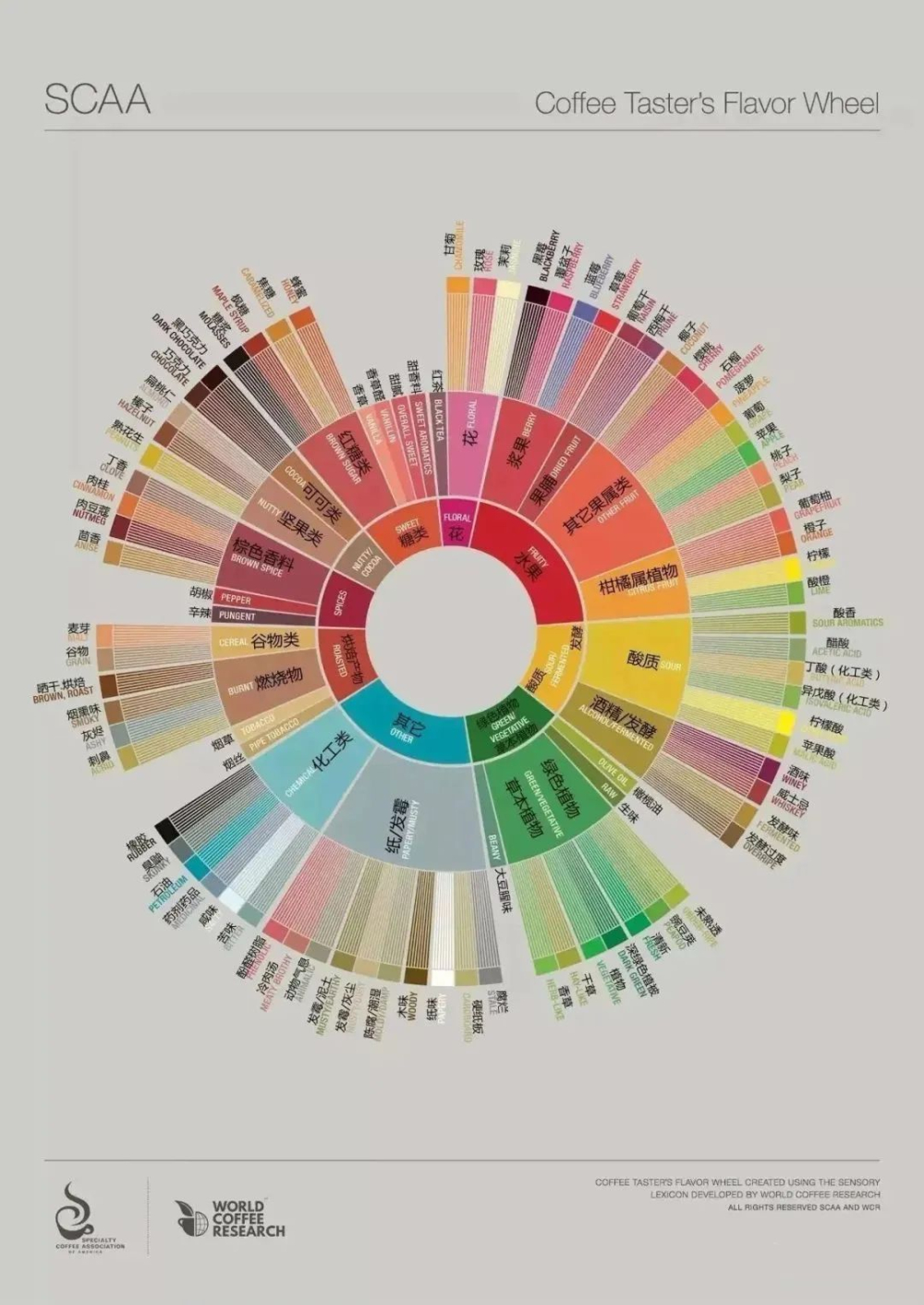
A deeper analysis of the logic behind this three-tier design can help build a clearer network of flavor associations. The innermost ring defines eight basic flavor categories: including herbal tones, acidity and fermentation types, fruit aroma lineages, floral fragrance groups, sugar sweetness ranges, nut and cocoa categories, spice families, roasting flavor characteristics, and other special flavor types. The middle ring further subdivides into 32 secondary subcategories — for example, the fruit category is divided into specific classifications such as citrus, tropical fruits, berries, and dried fruits. Notably, within the flower group, in addition to common flowers, black tea is also specially included as a unique case. This means that when you perceive a rich, tea-like depth in coffee, it actually falls under an extension of floral aromas.
The outermost ring precisely locates over 100 specific flavor descriptions — for instance, within the citrus category, it clearly distinguishes unique acidic characteristics such as lime, lemon, sweet orange, and grapefruit. In practical application, it’s recommended to start with daily dietary training — when tasting food, actively try to classify it according to the logic of the flavor wheel. For example, when tasting coffee, first determine the acidity attribute: if it belongs to a bright, refreshing fruity acid type, you can further narrow it down to citrus (highly acidic and bright) or berries (acidic-sweet balance); if you prefer a warm, sweet aroma, it may fall under dried fruits (caramelized sweetness). Through this step-by-step analytical process, you can gradually build your personal flavor memory bank.
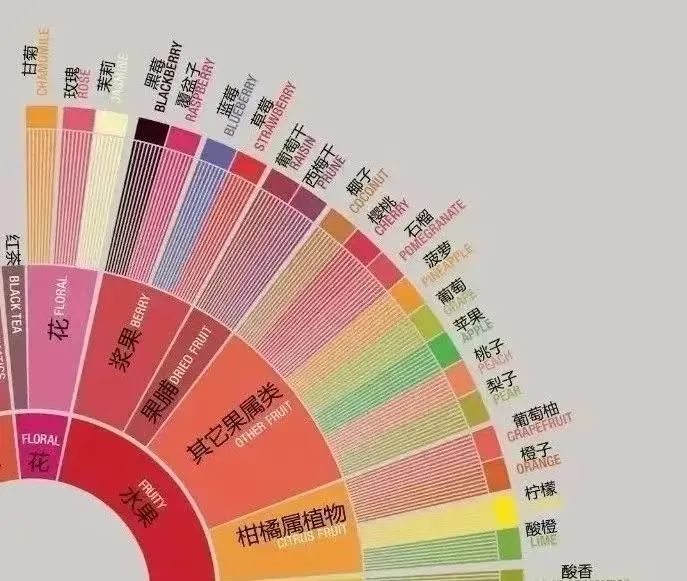
Color design plays a key supporting role in this version — the color scheme meticulously planned by the London-based professional design agency One Darnley Road allows each flavor block to establish a visual connection intuitively. For example, white tones represent light floral scents like jasmine, pink hues correspond to the rich fragrance of roses, and orange spectrums naturally evoke the bright acidity of citrus. At the same time, be aware of certain warning colors such as blue-gray, dark green, or earthy yellow. These color blocks, which deviate from common food color palettes, usually correspond to undesirable flavor profiles — for example, cardboard (blue-gray), over-fermentation (dark green), or earthy (earthy yellow) — all of which are abnormal characteristics to watch out for.
Observing the spatial distances between various flavor categories can reveal the deep insights of professional evaluators into flavor relationships. Practical examples show: blueberries and strawberries, both belonging to the berry category, are positioned closely together on the wheel, reflecting their high flavor similarity. In contrast, while blueberries and raspberries are both berries, their positions on the wheel show more distinct differences. Similarly, in the floral group, the adjacent placement of roses and jasmine highlights the affinity in their aromatic lineage, while the relatively distant positioning of roses and citrus suggests a distinctly different sensory experience. This visual spatial language can help evaluators quickly locate the relative position and strength of association of flavor characteristics during actual cupping.
Synthesizing these analytical dimensions, the value of the flavor wheel does not lie in providing definitive answers, but in establishing a systematic thinking framework. It is recommended to pair it with practical tasting exercises: after each brew, record the flavor elements you perceive, trace their corresponding positions on the flavor wheel, and observe the differences in flavor distribution across different regions, processing methods, or roast levels. Through continuous observation, comparison, and memory reinforcement, you can gradually develop precise flavor identification skills, ultimately achieving a complete transformation from theoretical understanding to sensory practice.
The above content is compiled by CoffeeHunters, a coffee news website.


