







Introduction:A Swiss Nestlé factory discovered high-purity cocaine in a shipment of imported Brazilian coffee beans, which, although not entering the production line, has raised consumer concerns about coffee safety. On May 9, the Asian Coffee Association and the Yunnan Coffee Industry Association jointly issued a statement, emphasizing the need to strengthen full supply chain controls. This article details the incident, the specific recommendations from the associations, and explores response measures in the Chinese market to help you understand how to avoid potential risks.
Recently, a local Swiss Nestlé factory found an unidentified white powder in a container of Brazilian-imported coffee beans. Police testing confirmed the powder to be cocaine with a purity of 80%. Although the incident was immediately contained within the factory and the involved coffee beans did not come into contact with any production equipment, it still raised doubts among many consumers about the safety of coffee products.
Following the incident, Nestlé quickly issued a statement through official channels, stressing that the implicated coffee beans had not entered the production process and assuring that its products were completely safe for consumers to enjoy. However, the event still struck a nerve with the public, especially in an era where food safety is increasingly prioritized.
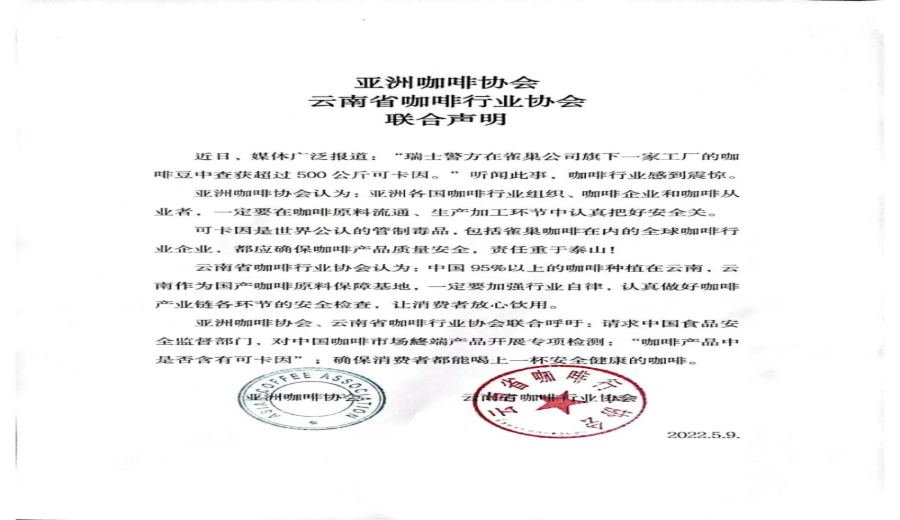
In response to this incident, on May 9, the Asian Coffee Association and the Yunnan Coffee Industry Association jointly released an important statement, calling on the industry to enhance full-chain safety management from raw materials to end products. The Asian Coffee Association explicitly pointed out that coffee industry organizations, enterprises, and professionals worldwide must strictly control every step of coffee raw material procurement, transportation, and production processing to ensure no prohibited substances infiltrate.
The association particularly emphasized that cocaine, as an internationally recognized controlled narcotic, must absolutely not be present in any coffee product. Not just Nestlé, but all global coffee companies have the responsibility to ensure the purity and safety of their products — this is a fundamental commitment to consumers.
The Yunnan Coffee Industry Association noted that over 95% of China’s coffee cultivation area is concentrated in Yunnan, making it a key supply base for domestic coffee raw materials. Therefore, Yunnan should strengthen industry self-discipline and implement rigorous safety inspections at every step of the coffee supply chain, including planting, harvesting, primary processing, transportation, and storage, to ensure that every cup of coffee consumers drink is worry-free.
The two associations jointly called on China’s food safety regulatory authorities to promptly carry out special testing actions on coffee end products available on the market, focusing on screening for prohibited substances such as "whether coffee products contain cocaine," in order to maintain market order and consumer health.
Although this incident is an isolated case, it serves as a wake-up call for the entire coffee industry. When purchasing coffee products, consumers should not only pay attention to flavor and origin, but also look into the brand’s traceability system and safety certifications. The industry, in turn, needs to further improve detection mechanisms to prevent similar incidents at the source and ensure the healthy development of the coffee market.
The above content is compiled by CoffeeHunters, a coffee news website.


