







Introduction:Luckin Coffee’s co-branded packaging with Yeshu Brand Coconut Juice unexpectedly went viral thanks to its strongly rustic aesthetic, while HEYTEA teamed up with Japanese streetwear icon Hiroshi Fujiwara to create a minimalist black-themed series. Through these two vastly different co-branding strategies, both brands are vying for the favor of young consumers. This article will take an in-depth look at the differences in packaging design, color selection, and marketing approaches between the two collaborations, as well as explore their underlying market positioning and target demographics—helping readers understand how contemporary coffee beverages attract younger markets through cross-industry partnerships.
When Luckin Coffee launched its new co-branded product “Coconut Cloud Latte” with Yeshu Brand Coconut Juice, many consumers who were originally fans of the Original Coconut Latte were instantly drawn to its unassuming yet uniquely designed packaging. Netizens joked that the packaging was “so rustic it becomes trendy,” with some even admitting they bought it purely to collect the distinctive cup sleeves and packaging bags.
Notably, Yeshu Group, a company that hadn’t collaborated with any other brand in 34 years, chose to work with Luckin this time, instantly sparking market buzz. Consumers were filled with curiosity about this crossover, rushing to buy the co-branded merchandise just to experience this wave of “rustic trend.”
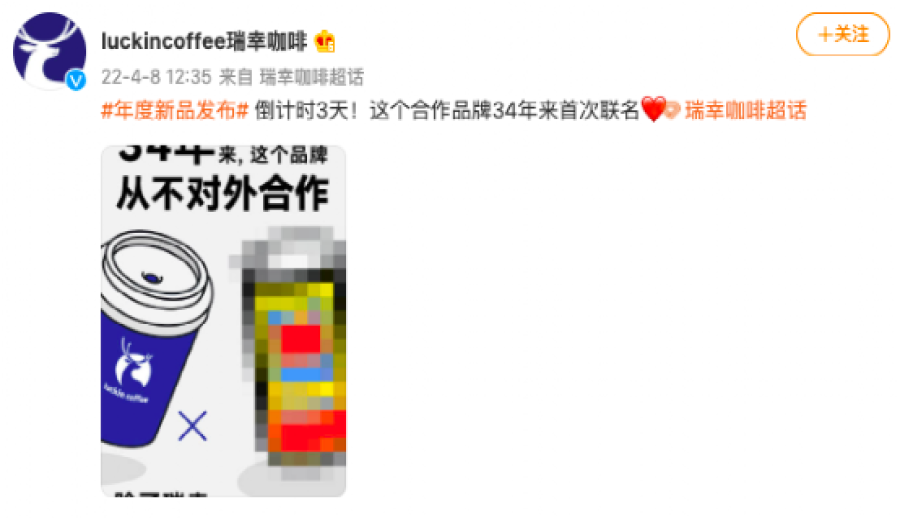
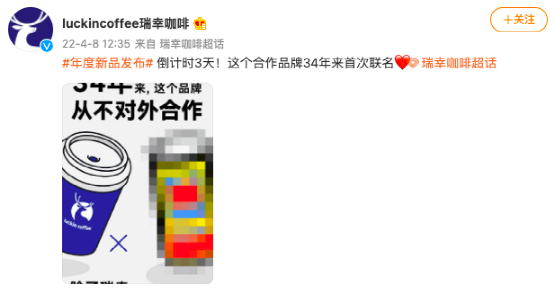
On April 8th, Luckin posted a countdown teaser on its official Weibo account—a poster showing the left side as the outline of a classic coffee cup and the right side covered in mosaic, successfully sparking online speculation. Consumers in southern regions almost immediately recognized the familiar black, yellow, red, and blue color scheme as the iconic look of Yeshu Brand Coconut Juice.
Yeshu Group’s packaging style has always been personally overseen by Chairman Wang Guangxing, who adheres to a design philosophy of “big text and bright colors.” This approach makes the words “Yeshu” stand out in bright yellow, creating a strong visual contrast against the black bottle. Even though it previously faced controversy for ads bordering on vulgarity, the brand impression was deeply rooted in the public's mind. In this collaboration with Luckin, while the copywriting was more restrained—such as changing “drank it since childhood” to “drank it since childhood all the way to the atmosphere”—it still retained pixel-style small graphics, sparking connections with modern trends like NFTs and the metaverse. This successfully transformed traditional rustic charm into a modern cyberpunk style.
In contrast to Luckin’s rural-inspired route, HEYTEA opted to collaborate with Japanese street culture legend Hiroshi Fujiwara to launch a minimalist black-themed series. On April 6th, HEYTEA officially announced the collaboration on its Weibo account. From the cup itself, cup sleeves, packaging bags to limited-edition merchandise, the entire line adopted a matte black design, reflecting an aesthetic highly consistent with Fujiwara’s signature Fragment Design double-flash store style.
HEYTEA’s “blackening” strategy successfully attracted a large number of young people passionate about street culture. The black base paired with high-contrast color blocks in white, yellow, red, and blue conveys a premium, simple, and luxurious vibe—perfectly aligning with the street culture aesthetic that pursues ultimate minimalism. This further reinforces HEYTEA’s positioning in the trend-driven beverage market.
Observing these two collaborations, it’s easy to see that although both use black as a base, they convey vastly different brand tones through distinct color schemes and design languages. The partnership between HEYTEA and Hiroshi Fujiwara uses black-and-white contrast to create a high-end street feel, while the combination of Luckin and Yeshu employs a warm red-yellow palette to deliver a strong visual impact. Coupled with concise and powerful ad copy and plenty of negative space in the layout, it successfully resonates with netizens’ shared memories of internet rustic memes.
For coffee enthusiasts, whether the product takes a rustic or trendy route, flavor and quality are ultimately what matter most. In this battle for the hearts and minds of young consumers, Luckin’s competition seems to no longer be just Starbucks, but also tea beverage brands that are actively innovating and frequently engaging in collaborations—especially HEYTEA. This cross-industry brand rivalry not only reflects market trends but also reminds us: besides chasing fashion and buzz, how to balance the essence of coffee and the consumer experience is the true foundation for long-term brand success.
The above content is compiled by CoffeeHunters, a coffee news website.


