







Introduction:This article delves into the market price trends of Yunnan’s small-grain Arabica coffee beans from 2021 to 2022, analyzing the underlying changes in the industrial chain, supply and demand factors, and challenges. It also observes how regions such as Pu’er are driving upgrading through premiumization strategies. Readers will gain insights into the reasons behind price fluctuations, the current state of production areas, and future development potential, offering valuable references for coffee enthusiasts and industry professionals who follow Arabica bean market trends.
Yunnan’s coffee industry has recently garnered significant market attention and seen rising prices, especially after 2021. With the emergence of domestic coffee and new-style tea beverage brands, Yunnan-grown Arabica small-grain coffee beans have gradually become a mainstream choice. The rise of the guochao (national trend) movement and growing domestic interest in local coffee have led to a substantial increase in the number of industry players and consumers visiting Yunnan, further boosting demand and price performance.
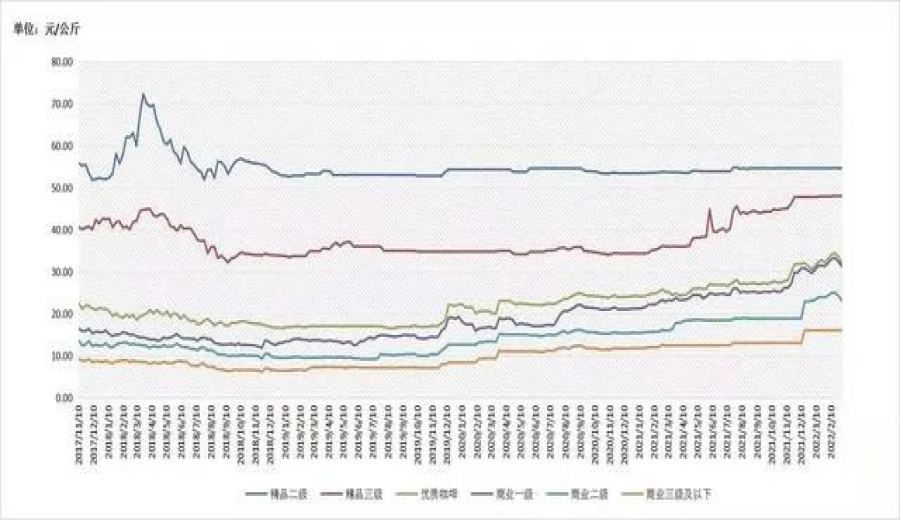
A local industry practitioner noted that since 2021, the purchase price of Yunnan’s Grade 1 commercial coffee beans has rapidly climbed from 24 to 26 yuan per kilogram to 34 yuan by early 2022, with an overall spot price increase of about 65%. This upward trend reflects the market’s positive response to Yunnan coffee and highlights the synchronized improvement in both quality and demand.
However, alongside the price increases, the industrial chain faces multiple challenges. Many specialty coffee farms report that although order volumes have significantly increased, production costs have also risen sharply, even doubling, squeezing profit margins. Particularly for specialty coffee beans, there is limited room for price adjustments, and continued price hikes may exceed the acceptance level of the consumer market.
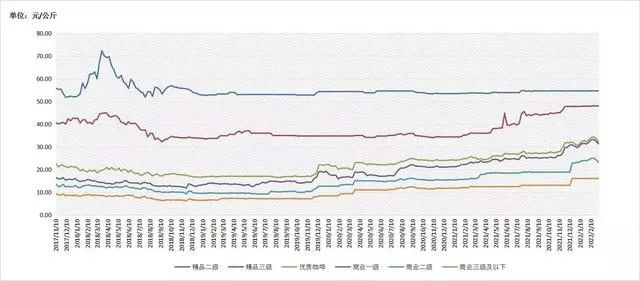
This price fluctuation is closely related to the supply chain issues brought about by the global pandemic. During the pandemic, logistics between major coffee-producing countries and consumer regions were disrupted, with average delivery times extending from one to two months to three to four months, leading to a tight market supply. At the same time, domestic coffee consumption demand in China has expanded rapidly, creating a supply-demand imbalance that has further driven up the market prices of Yunnan coffee.
Industry insiders also pointed out that Yunnan coffee beans were previously often seen as “contract beans” for international brands. Although they hold potential, there are still disparities in planting techniques and quality consistency. Due to the need for some traders to procure large quantities of raw materials, they often have to purchase from different coffee farmers, leading to the phenomenon of “hundred-household beans.” This not only results in inconsistent batch quality but also affects overall evaluation and bargaining power.
Although the Yunnan region boasts a natural environment suitable for coffee cultivation, compared to other international producing areas, it still faces challenges such as talent shortages, insufficient industrial chain support, and its geographic distance from ports, making it difficult to completely shed its role as a raw material supply base. Although the state has established coffee trading centers in Yunnan and Chongqing in an attempt to influence pricing power, the actual effectiveness remains limited due to the lack of international competitive advantages in the producing areas themselves.
In terms of production area development strategies, Pu’er City, as an important distribution hub for Yunnan coffee, is promoting an upgrade towards premiumization and standardization. According to plans, Pu’er hopes to become a globally significant production base for specialty coffee and high-quality commercial coffee, as well as a regional coffee trading and roasting processing center in Asia during the 14th Five-Year Plan period.
Ning’er County, as one of the key producing areas under Pu’er’s jurisdiction, achieved a total coffee output value of 278 million yuan in 2021 and is expected to surpass 300 million yuan in 2022. With policy support and technological investment, in addition to continuously cultivating the traditional ‘Catimor’ variety, the region has gradually introduced other Arabica varieties, enhancing overall quality through varietal optimization, thereby increasing market selling prices and competitiveness.
According to relevant data, on March 7, 2022, the closing price of the Yunnan Coffee Price Index was 27.56 yuan per kilogram, indicating that the market remains at a relatively high operating level. Going forward, with the advancement of refined management and branded operations in the producing areas, Yunnan’s small-grain coffee beans are expected to occupy a more solid position in the global Arabica market.
The above content is compiled by CoffeeHunters, a coffee news website.


