







Introduction:The new-style tea brand Lelecha has undergone multiple adjustments in recent years, completely withdrawing from the South China market and focusing on development in East China. There were also reports in 2022 that it planned to go public in Hong Kong. Is this a strategic restructuring of the brand or a move to pave the way for capital operations? This article details Lelecha’s exit trajectory in South China, market feedback, and future capital paths, helping you understand the business logic behind the brand’s transformation.
The competition in the new-style tea market is becoming increasingly fierce, with strong brands dominating at all price levels. Headquartered in Shanghai, Lelecha entered Guangzhou in 2017 but officially withdrew from the South China market in February 2022 by closing its last store there. Prior to this, Heytea founder Nie Yunchen had clearly stated that he did not consider acquiring Lelecha, and the brand’s store closures in multiple regions once plunged it into negative public opinion. However, Lelecha officially responded that this was only a “temporary farewell” and that it planned to go public in Hong Kong within 2022, drawing widespread attention from the industry.
In today’s new-style tea market, there is intense competition across both the premium and affordable segments. Premium brands are represented by Heytea and Nayuki; the mid-range market is firmly occupied by Chunshuiyuan; and in the price-friendly mass market, Mixue Ice Cream & Tea dominates almost entirely. In the South China region, Heytea and Nayuki have been deeply rooted for many years, with a solid consumer base. As a brand headquartered in Shanghai, Lelecha entered the Guangzhou market in 2017 and maintained operations for only about five years, finally closing its last store at Guangzhou Link Plaza on February 23, 2022.
Going back to July 2021, Heytea founder Nie Yunchen publicly stated that he would “completely, thoroughly, and resolutely” reject the proposal to acquire Lelecha, sparking widespread discussion. Subsequently, Lelecha successively closed multiple stores in Chongqing, Xi’an, and Guangzhou in the second half of the year, with its market presence continuously declining. Among them, Lelecha’s Huachenghui and Lifeng stores in Guangzhou closed in April and August 2021, respectively, and when the Guangzhou Link Plaza store shut down, Lelecha officially exited the South China market.
On February 23, Lelecha confirmed in an official Weibo super topic that the Guangzhou Link Plaza store was its final day of operation, emphasizing that this was only a “temporary farewell to South China,” and that the brand expected to return to the region by the end of that year or early the following year.
In fact, as early as January 6, 2022, Lelecha had conducted an online poll, inviting netizens to choose their most desired city for the brand to enter from a list of 12 cities, covering Central China, South China, and East China, with six of them being in South China. This move showed that Lelecha still had a certain loyal customer base in South China, and the withdrawal might only be a temporary adjustment.
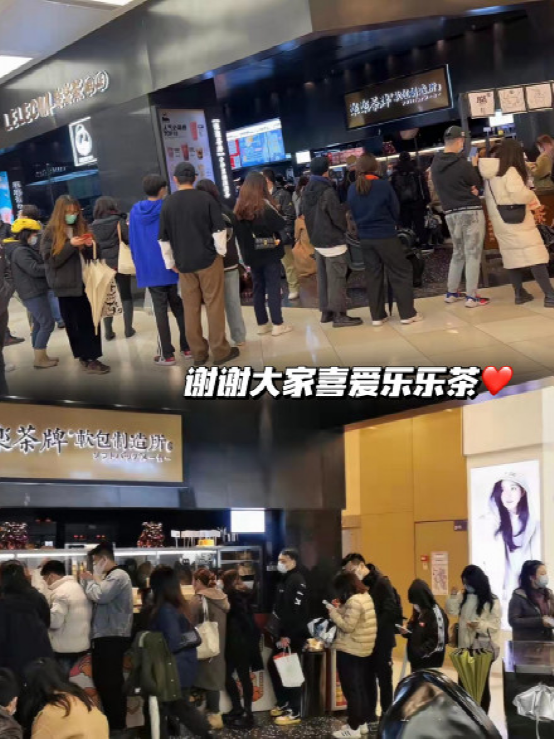
Many local Guangzhou consumers expressed regret over Lelecha’s store closures, with some fans even queuing up on the day of closure to buy the last batch of products. Scalpers even took the opportunity to hike prices on-site. A Lelecha enthusiast left a comment expressing hope for the brand’s early return to the Pearl River Delta and missing its signature bread products.
Lelecha was founded in East China in 2016 and quickly gained high popularity with its then highly eye-catching “dirty” series products, such as dirty buns and dirty tea, which also boosted its brand value. It steadily ranked among the top three in the premium freshly made tea market, only behind Heytea and Nayuki.
In December 2021, Lelecha announced the opening of 22 new stores at once, demonstrating its expansion ambitions. However, as raw material and labor costs continued to rise, the brand faced increasing operational pressures. Currently, Lelecha is no longer blindly pursuing coverage in its expansion strategy but is instead focusing on increasing store density in key cities to more effectively control costs and improve operational efficiency.
In mid-September 2021, there were market rumors that Lelecha might go public in Hong Kong in 2022, planning to raise $300–500 million through an initial public offering (IPO). At the time, a Lelecha spokesperson responded that the company was currently focused on business development and had no specific timeline for going public. Nevertheless, the market generally believes that the brand still has plans for an IPO, and this concentrated effort to develop the East China market may be laying the groundwork for future capital operations.
Lelecha’s complete withdrawal from South China and shift in focus to East China has led outsiders to speculate that this may be a “do-or-die” strategy amid fierce competition. Whether Lelecha can truly return to the South China market a year later is worth continued observation.
The above content is compiled by CoffeeHunters, a coffee news website.


